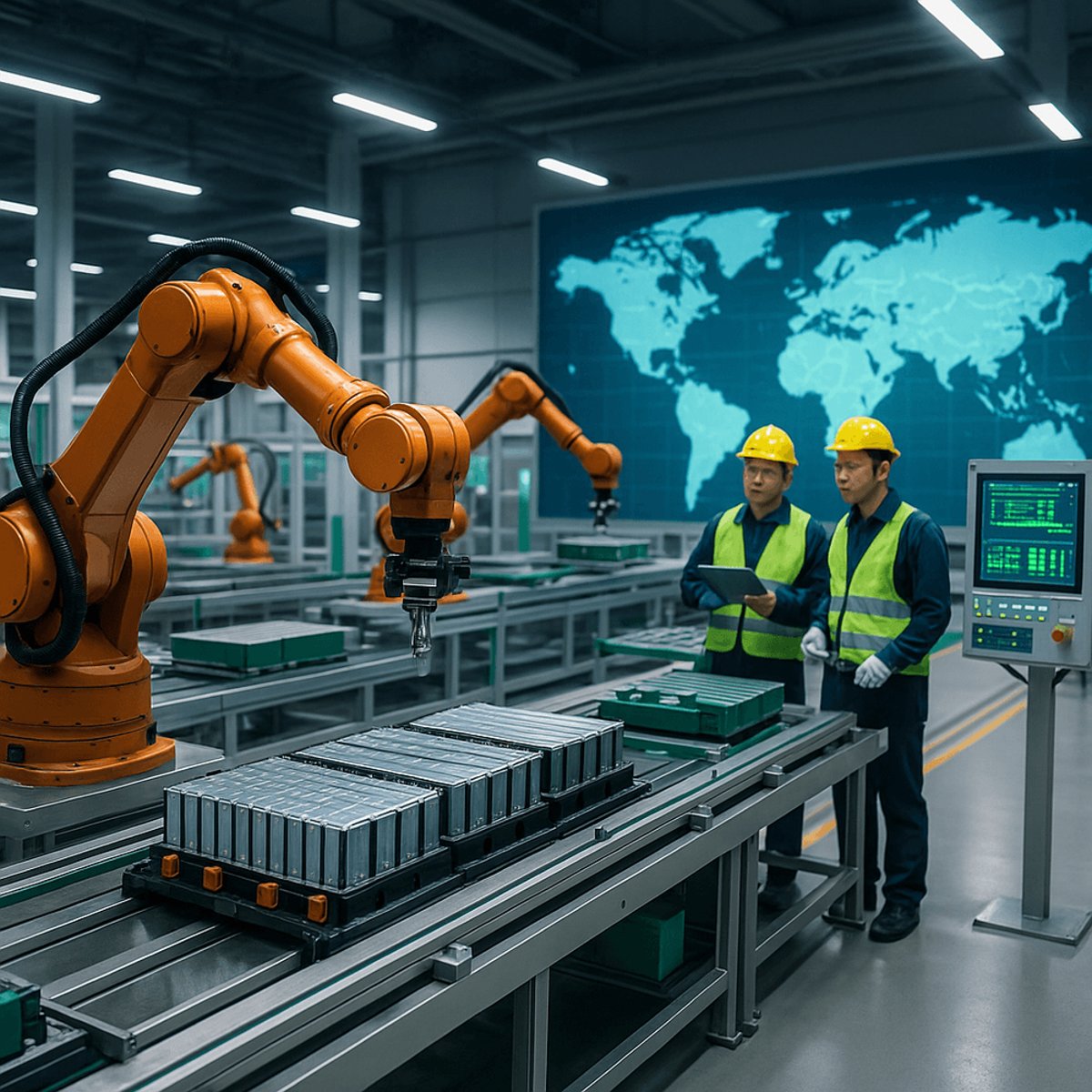
Chinese lithium battery makers are rewriting the rules of global manufacturing. Companies like CATL, BYD, and Gotion have built or announced 68 factories across nearly every continent over the past decade, according to new research from the Rhodium Group. The expansion marks a dramatic reversal - where Western automakers once traded technology for access to China's market, American and European firms now partner with Chinese battery giants to learn state-of-the-art production techniques. But the rapid buildout is sparking local tensions over jobs, environmental impact, and who really benefits from the green energy transition.
The world's battery supply chain is undergoing a seismic shift, and it's happening faster than most governments anticipated. Chinese lithium battery manufacturers have quietly built a global factory network that spans from Hungary to Michigan, challenging everything we thought we knew about manufacturing competitiveness and technology transfer.
According to data compiled by the New York-based think tank Rhodium Group, Chinese battery companies have established 68 production facilities outside their home market over the past decade. The buildout represents more than just factory construction - it signals China's evolution from a low-cost manufacturing hub to a technological powerhouse capable of competing anywhere in the world.
CATL, the world's largest lithium battery maker, leads the charge alongside BYD and Gotion. These companies became so efficient at battery production that they can now relocate operations to high-cost labor markets and still undercut local competitors. The factories are reshaping the transition to clean energy, producing batteries that power everything from electric vehicles to grid storage systems.
But the expansion isn't going as smoothly as Chinese executives might have hoped. Hungary offers a preview of the challenges ahead. The Eastern European nation has become ground zero for Chinese battery investment, with at least four plants under construction including an $8.5 billion facility - possibly the largest overseas factory ever planned by a Chinese battery company.
The Hungarian experience reveals deep tensions. Many locals question whether Chinese firms will actually hire Hungarian workers or import cheaper labor from Central Asia and Southeast Asia. When CATL laid off more than 100 employees at its Hungarian site last summer, the local municipality launched an investigation into whether the company violated promises to prioritize local hiring.
"They arrived in the country at a time when local labor supply was low because many Hungarians moved to other parts of Europe in recent years in search of work," András Bartók, an assistant professor at Ludovika University of Public Service, told Wired. The labor shortage forced Chinese companies to work with the Hungarian government to bring in migrant workers, triggering backlash from residents.
Environmental concerns are equally pressing. CATL faces protests over water use and pollution in drought-prone regions. A Hungarian court ordered a Samsung battery plant to suspend production in October over pollution concerns, and Chinese factories inherited these tensions. "Way before these Chinese investments were announced, there were national-level protests with how groundwater is polluted during battery manufacturing," Bartók explained.
The disconnect runs deeper. Most batteries produced in Hungary are destined for wealthy Western European car buyers, not Hungarians themselves. "The average Hungarian has the money to buy a 10-year-old used car from Germany, usually powered by diesel or gas. They don't have the money to buy electric vehicles," Bartók noted.
The global expansion is hitting speed bumps elsewhere too. Of the 68 factory investments identified by Rhodium Group, at least five have been paused or canceled - some after construction already began. The culprit? Slower-than-expected EV adoption in markets outside China.
Chinese battery makers planned their aggressive buildouts when Western governments offered generous subsidies and tax credits. That enthusiasm is fading fast. The Inflation Reduction Act under President Biden incentivized factory construction, but President Trump canceled EV subsidies outlined in the legislation. Even Europe, which set a 2035 deadline to end gas car production, is reconsidering.
"Battery manufacturers, of course, would be less incentivized to make a big investment if they're not sure what the policy direction is," Alexander Brown, a senior analyst at the Mercator Institute for China Studies, told Wired.
Some Chinese battery companies are deploying a backup strategy - pivot to energy storage. Ford, which is building a massive battery plant in Michigan using CATL's manufacturing technology, announced in December it would shift from EV batteries to energy storage production. Envision AESC, another major Chinese battery maker, recently announced its Tennessee plant will make the same switch.
The pivot makes strategic sense. Energy storage technology hasn't been politicized the way EVs have. Both Democratic-leaning California and Republican-dominated Texas have embraced grid-level battery storage, suggesting Chinese factory ambitions won't go completely to waste.
But the most striking element of this story is the technology transfer reversal. For three decades, Western automakers traded their technological know-how for access to China's massive car market. Today, that relationship has flipped entirely.
Ford CEO Jim Farley laid it out bluntly in an interview with New York Times columnist Thomas Friedman: "The way we compete with them is to get access to their IP, just the way they needed ours 20 years ago, and then use our innovative ecosystem and American ingenuity and our great scale and our intimacy with the customer to beat them globally."
French President Emmanuel Macron echoed the sentiment at this week's World Economic Forum, saying China is welcome to invest in Europe if it can "contribute to our growth, to transfer some technologies, and not just to export towards Europe."
Brian Engle, chairman of NAATBatt International, a US trade association for the battery industry, sees this as the right path forward. A former gas car engineer who transitioned to battery safety research, Engle predicts the US will learn to "bring that revenue home, we're gonna enable these new technologies, we're gonna grow our economy." The alternative - continuing to bet on petroleum - "shows zero vision," he says. "This is a technology evolution that's not reversing."
The global battery landscape is being redrawn by Chinese manufacturing prowess, and Western governments are still figuring out how to respond. The 68 factories represent more than industrial expansion - they're a fundamental shift in who controls critical clean energy technology. Whether these plants deliver on promises of local jobs and technology transfer, or simply serve as export platforms for Chinese dominance, will shape the energy transition for decades. What's clear is that the West's strategy has evolved from blocking Chinese investment to embracing it - on the condition that knowledge flows both ways. The irony isn't lost on anyone who watched Western companies make the same calculation in reverse 30 years ago.