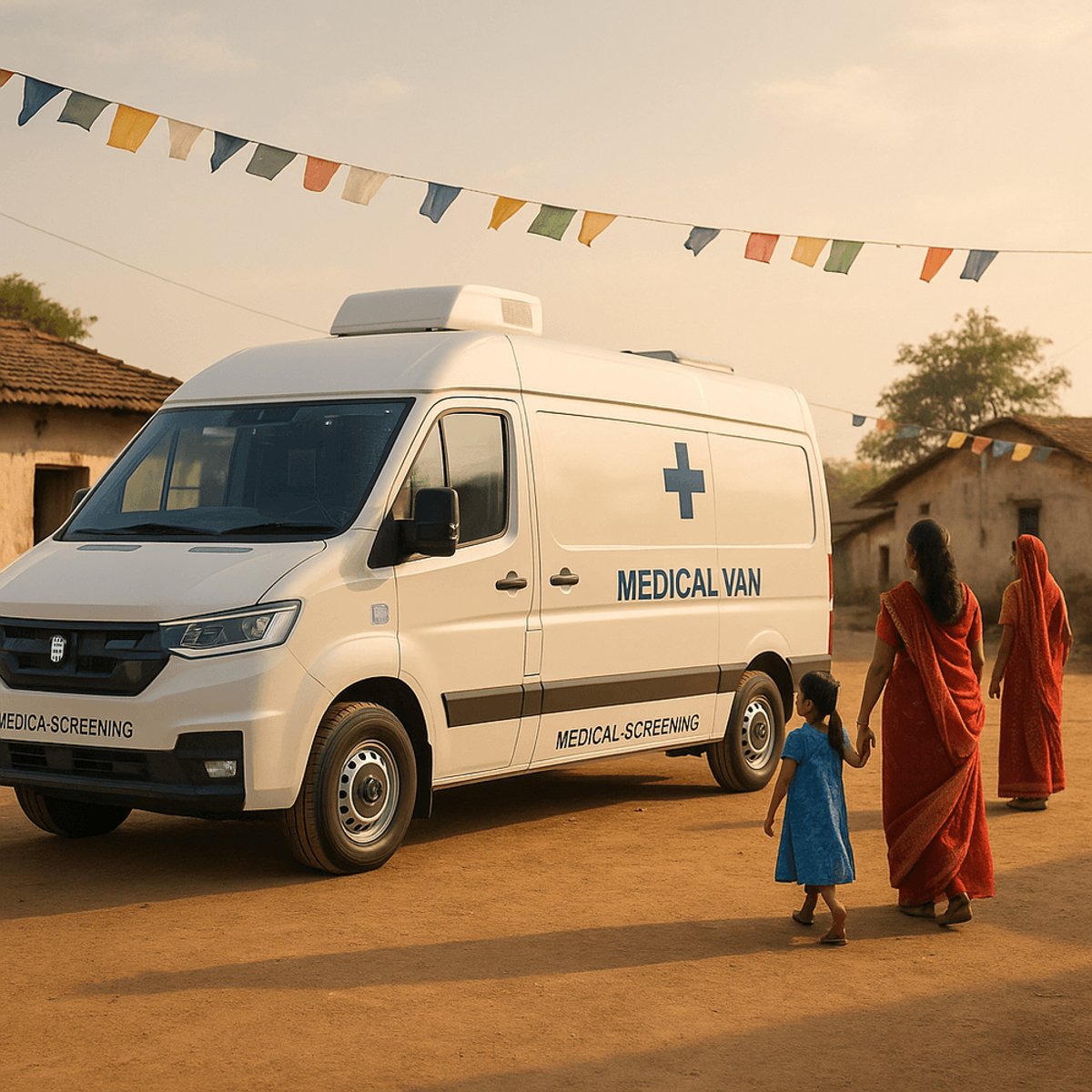
Mobile cancer screening vans powered by AI are transforming healthcare access in rural India, where two-thirds of the population lives. The initiative has screened over 3,500 women - 90% getting their first-ever mammogram - and identified 24 confirmed breast cancer cases that might otherwise have gone undetected until advanced stages.
An unassuming van rolling through India's countryside is quietly revolutionizing cancer care for millions of women who've never had access to screening. The Women Cancer Screening Van, run by the nonprofit Health Within Reach Foundation, carries something remarkable: AI-powered mammography that's bringing world-class diagnostics to villages where preventive healthcare barely exists.
The numbers tell a striking story. In just one year, these mobile clinics have screened over 3,500 women across rural areas around Pune - and 90% had never had a mammogram before. More critically, the AI system flagged about 300 abnormal findings, leading to 24 confirmed breast cancer diagnoses that were caught early enough for treatment.
"Using our software built with NVIDIA technology, they identified 24 cancer-positive patients and connected them to treatment before the disease could progress further," Ron Nag, CEO of MedCognetics, told NVIDIA's blog. "This is the way I want to see AI implemented around the world, to help people."
The Dallas-based MedCognetics, part of the NVIDIA Inception startup program, has developed FDA-cleared AI systems that can spot the tiniest tumors radiologists might miss. The software runs on NVIDIA IGX Orin edge AI platforms or cloud-based NVIDIA Tensor Core GPUs, processing mammography data in real-time to flag high-risk cases.
"One of the biggest challenges is finding small tumors," Nag explained. "When we started, all the radiologists we spoke to said they didn't want AI to help them see tumors the size of raisins or golf balls - they wanted AI to help them see the tumors that are so small they might easily be missed."
The mobile approach tackles a brutal healthcare reality in India. Dr. Mudassar Shaikh, chief medical officer of the Health Within Reach Foundation, points out that "developing countries generally have a lot of load on their existing healthcare institutions." For the nearly two-thirds of Indians living in rural areas, traveling to urban centers for screening isn't just inconvenient - it's often impossible.
"Breast cancer tumors are generally painless, so there is a propensity for women in communities where healthcare is expensive or hard to access to postpone screenings," Shaikh noted in the NVIDIA blog post. "The majority of new cases are diagnosed in advanced stages, a factor that directly affects patient survival rates."
The AI doesn't just detect cancer - it's reshaping the entire workflow. Currently, mammogram images are uploaded to cloud systems when vans return to urban hubs, where radiologists review AI-flagged cases first. But the team is working toward true edge deployment that could enable on-site triage even in areas without reliable internet connectivity.
MedCognetics' software suite goes beyond basic detection, offering cancer triage, breast density assessment, and even risk models that forecast a patient's likelihood of developing breast cancer within a year. The company is preparing additional features for regulatory submission, including image denoising capabilities that can clean up motion artifacts common in mobile screening environments.
The technology stack represents a convergence of several AI trends. The NVIDIA Holoscan platform handles real-time sensor processing, while the edge AI approach promises to bring sophisticated diagnostics to the world's most underserved communities. It's exactly the kind of AI deployment that transforms abstract technological capabilities into tangible human impact.
For NVIDIA, this represents a key validation of its healthcare AI strategy. The company has been pushing hard into medical applications, positioning its hardware and software stack as the foundation for next-generation diagnostic tools. Having MedCognetics successfully deploy FDA-cleared AI on NVIDIA infrastructure in challenging real-world conditions provides a compelling case study for other healthcare AI startups.
The broader implications extend far beyond India. Mobile AI-powered screening could reshape healthcare delivery in rural communities worldwide, from sub-Saharan Africa to remote parts of the Americas. As edge AI hardware becomes more powerful and affordable, the model pioneered by Health Within Reach and MedCognetics could scale globally.
The success of AI-powered mobile screening in rural India offers a glimpse into healthcare's future, where sophisticated diagnostics reach the world's most underserved populations. As MedCognetics and similar companies refine edge AI deployment, we're likely to see this model replicated globally, potentially transforming early cancer detection from a privilege of urban centers into a universal healthcare capability. The 24 lives already impacted represent just the beginning of what could become a fundamental shift in how we deliver preventive care worldwide.