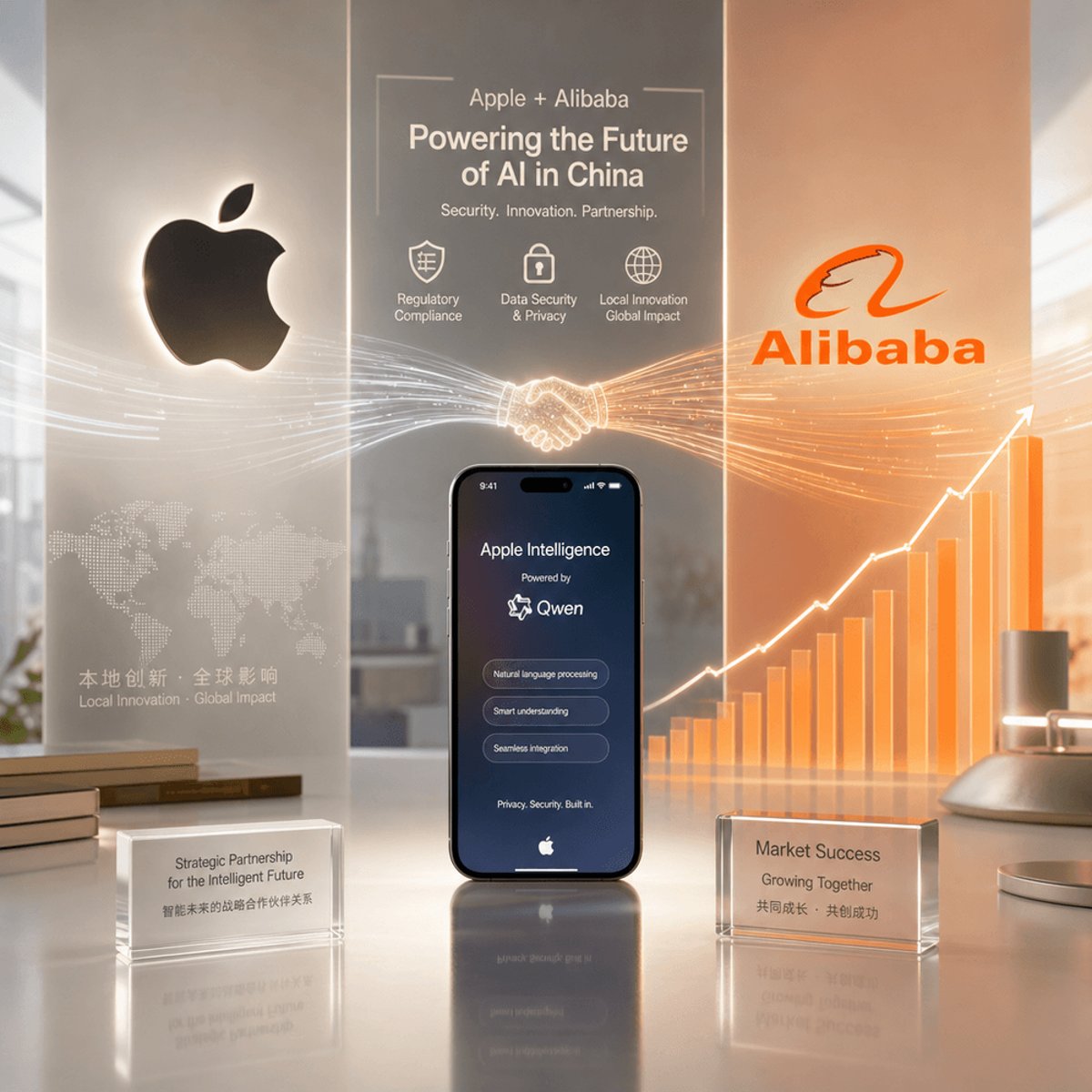
Alibaba's U.S.-listed shares surged 4% Wednesday after China's top internet regulator greenlit a landmark AI partnership with Apple. The Cyberspace Administration of China added Apple Intelligence to its approved AI services list, clearing the way for Alibaba's Qwen language model to power Apple's AI features in the world's largest smartphone market. The move marks a strategic win for both companies as they navigate China's strict tech regulations and intensifying AI competition.
Apple just solved its biggest China problem. The Cupertino giant's AI ambitions got a major boost Wednesday when Beijing's internet watchdog blessed its partnership with Alibaba, sending the Chinese tech giant's American depositary shares climbing 4% in early trading.
The approval from China's Cyberspace Administration isn't just bureaucratic rubber-stamping. It's the key that unlocks Apple Intelligence for hundreds of millions of iPhone users across mainland China, where foreign AI services face intense scrutiny and domestic alternatives dominate. By tapping Alibaba's Qwen language model, Apple gets a regulatory-compliant path to deploy features like AI-powered writing tools, image generation, and enhanced Siri capabilities without running afoul of Beijing's tech sovereignty demands.
For Alibaba, the deal represents validation at a moment when Chinese tech firms are racing to prove their AI models can compete globally. Qwen has been quietly improving since its 2023 launch, but landing Apple as an integration partner catapults it into a different league entirely. The model will now power AI features on devices used by some of China's most affluent consumers, giving Alibaba invaluable real-world testing data and enterprise credibility.
The timing couldn't be better for Apple, which has struggled to maintain momentum in China as local rivals like Huawei chip away at its premium market share. Apple Intelligence launched in the U.S. and select markets earlier this year, but the China rollout stalled pending regulatory approval. Wednesday's green light means the company can finally compete on AI features in a market that generated $72.6 billion in revenue last fiscal year.
China's AI regulatory framework requires foreign companies to partner with approved domestic providers, a policy that's reshaped how global tech giants approach the market. Microsoft previously partnered with local cloud providers to offer Azure services, while Google has remained largely shut out. Apple's Alibaba alliance follows this playbook but with higher stakes given the iPhone's deep integration of AI features.
The Cyberspace Administration's approved providers list also includes ByteDance, Baidu, and Tencent, all of which have developed competing language models. Apple could theoretically integrate multiple Chinese AI providers, giving users options similar to how it offers different search engines. But the Alibaba partnership appears to be the primary thrust, at least initially.
Market reaction suggests investors see this as more than a regulatory formality. Alibaba's 4% pop reflects optimism that the Apple deal could drive enterprise adoption of Qwen beyond consumer devices. If the model performs well powering iPhone features, other Western companies navigating China's AI landscape might follow Apple's lead.
The partnership also highlights the fragmentation emerging in global AI infrastructure. While OpenAI's GPT models and Anthropic's Claude dominate in Western markets, China is building a parallel AI ecosystem with its own leaders and standards. Companies operating in both spheres will need multiple AI partnerships, increasing complexity but also creating opportunities for firms like Alibaba that can bridge the divide.
For Apple, the regulatory win comes as the company faces pressure to prove Apple Intelligence can drive iPhone upgrade cycles. Early adoption in the U.S. has been modest, with many users still discovering what the AI features can do. A China launch backed by local infrastructure could provide the scale needed to refine the technology and demonstrate compelling use cases.
The approval doesn't mean smooth sailing ahead. Apple must still navigate China's content restrictions, data localization requirements, and the political sensitivities of operating in a market where tech policy shifts rapidly. But Wednesday's announcement removes a major roadblock and signals that Chinese regulators see value in allowing controlled foreign AI deployment rather than complete isolation.
This isn't just a regulatory checkbox for Apple and Alibaba. It's a blueprint for how global tech giants will navigate the AI era's geopolitical fault lines. Apple gets the China AI solution it desperately needed, Alibaba gains a marquee customer that legitimizes its language model on the world stage, and both companies demonstrate that strategic partnerships can unlock markets where going solo means staying shut out. As AI features become table stakes for premium smartphones, expect more of these cross-border alliances where technology meets regulatory pragmatism. The real test comes next: whether Qwen can deliver an AI experience Chinese iPhone users find compelling enough to justify staying in Apple's ecosystem.