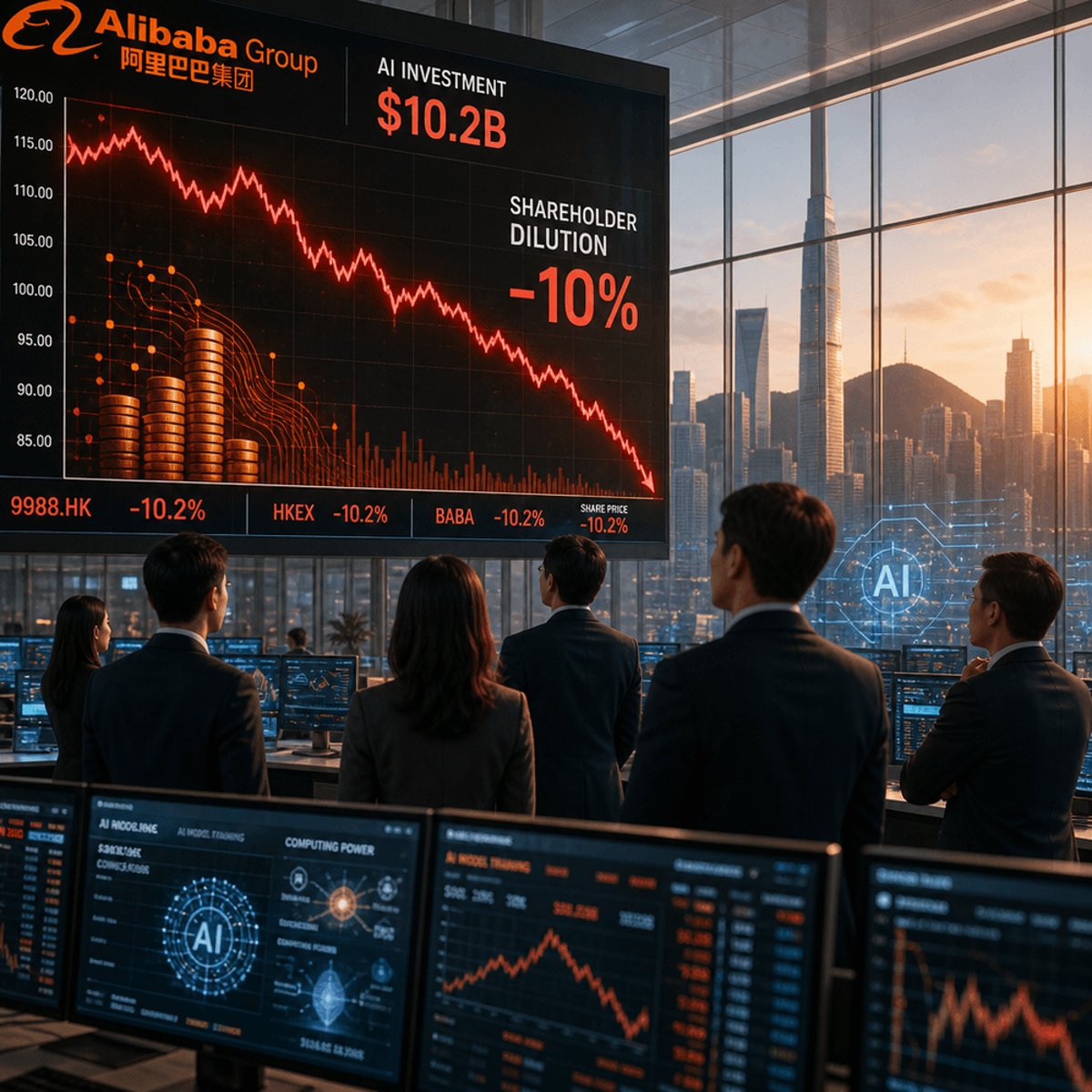
Alibaba's ambitious AI bet just cost investors billions. The Chinese e-commerce giant's shares plunged 10% in Hong Kong trading after the company priced a massive $10.2 billion share placement to fuel its artificial intelligence expansion. The dilution hit comes as tech behemoths worldwide burn through cash to compete in the escalating AI arms race, with Alibaba now joining the ranks of companies betting their balance sheets on generative AI infrastructure.
Alibaba Group just sent shockwaves through Asian markets with one of the largest tech capital raises of 2026. The company's decision to dilute existing shareholders through a $10.2 billion share placement triggered an immediate 10% stock plunge in Hong Kong, wiping out roughly $20 billion in market value within hours of the announcement.
The timing reveals just how desperate the AI race has become. While U.S. giants like Microsoft, Google, and Amazon have spent tens of billions building out AI infrastructure, Chinese tech companies now face an existential choice: match that spending or risk irrelevance. Alibaba's choosing to match it, and investors are paying the immediate price.
According to the CNBC report, the placement was priced Monday morning Hong Kong time, catching many investors off guard with its size and timing. The $10.2 billion figure represents one of the largest secondary offerings by a Chinese tech company since the regulatory crackdown of 2021-2022, signaling management's confidence that they've moved past that turbulent period.
But here's what's really happening beneath the surface. Alibaba's been quietly building out its Tongyi Qianwen large language model to compete with Baidu's Ernie Bot and a flood of domestic AI startups. The company needs massive computing power - think tens of thousands of Nvidia GPUs and custom chips - to train models capable of handling everything from e-commerce recommendations to cloud services for enterprise clients. That hardware doesn't come cheap, especially with U.S. export restrictions limiting access to cutting-edge chips.
The share placement structure lets Alibaba raise cash without taking on debt, preserving financial flexibility in an uncertain macro environment. It's a move straight from the playbook Meta used during its metaverse pivot and Amazon deployed for AWS expansion. The difference? Those companies had already established market dominance in their core businesses. Alibaba's still fighting regulatory headwinds and intense domestic competition.
Investors clearly weren't expecting dilution of this magnitude. The 10% drop suggests the market's pricing in not just the immediate shareholder dilution, but concerns about capital efficiency and return timelines. AI investments notoriously take years to generate meaningful returns - just ask Google, which spent over a decade building its AI capabilities before they translated to significant revenue.
The competitive pressure Alibaba faces is intense. ByteDance has been pouring resources into AI for content recommendation and creative tools. Tencent's leveraging AI across gaming and social platforms. Baidu's positioned itself as China's AI-first company. Meanwhile, Alibaba's cloud division - the logical home for AI infrastructure - has been growing but remains unprofitable as it battles for market share.
What makes this capital raise particularly significant is the geopolitical backdrop. Chinese tech companies can't simply rely on U.S. cloud providers or chip manufacturers for AI infrastructure. They need domestic alternatives, which means higher costs and longer development timelines. That $10.2 billion will likely stretch less far than equivalent spending by U.S. counterparts with unfettered access to the latest hardware.
The Hong Kong listing gives Alibaba access to international capital markets despite ongoing U.S.-China tensions, but it also exposes the company to global investor sentiment. And right now, that sentiment's clearly skeptical about massive AI spending with uncertain payoffs. The selloff mirrors reactions to other big tech AI investments throughout 2025 and 2026, as markets question whether every company really needs to build frontier models.
For Alibaba specifically, the AI push represents an attempt to revitalize growth after years of regulatory pressure and slowing e-commerce expansion. Management's betting that AI-powered services can unlock new revenue streams in cloud computing, business intelligence, and consumer applications. But they're making that bet with shareholder money, and those shareholders just voted with a 10% haircut.
Alibaba's $10.2 billion gamble crystallizes the brutal economics of the AI arms race. The company's joining global tech giants in spending massive sums on infrastructure that may take years to pay off, but investors are clearly questioning whether the juice is worth the squeeze. The 10% share price collapse isn't just about dilution - it's a referendum on how much more cash the market's willing to let tech companies burn in pursuit of AI dominance. For Alibaba, that referendum came back negative, at least for now. The real test comes in whether those billions translate to meaningful AI products and revenue, or just keep the company from falling further behind rivals already deep into their own AI transformations.