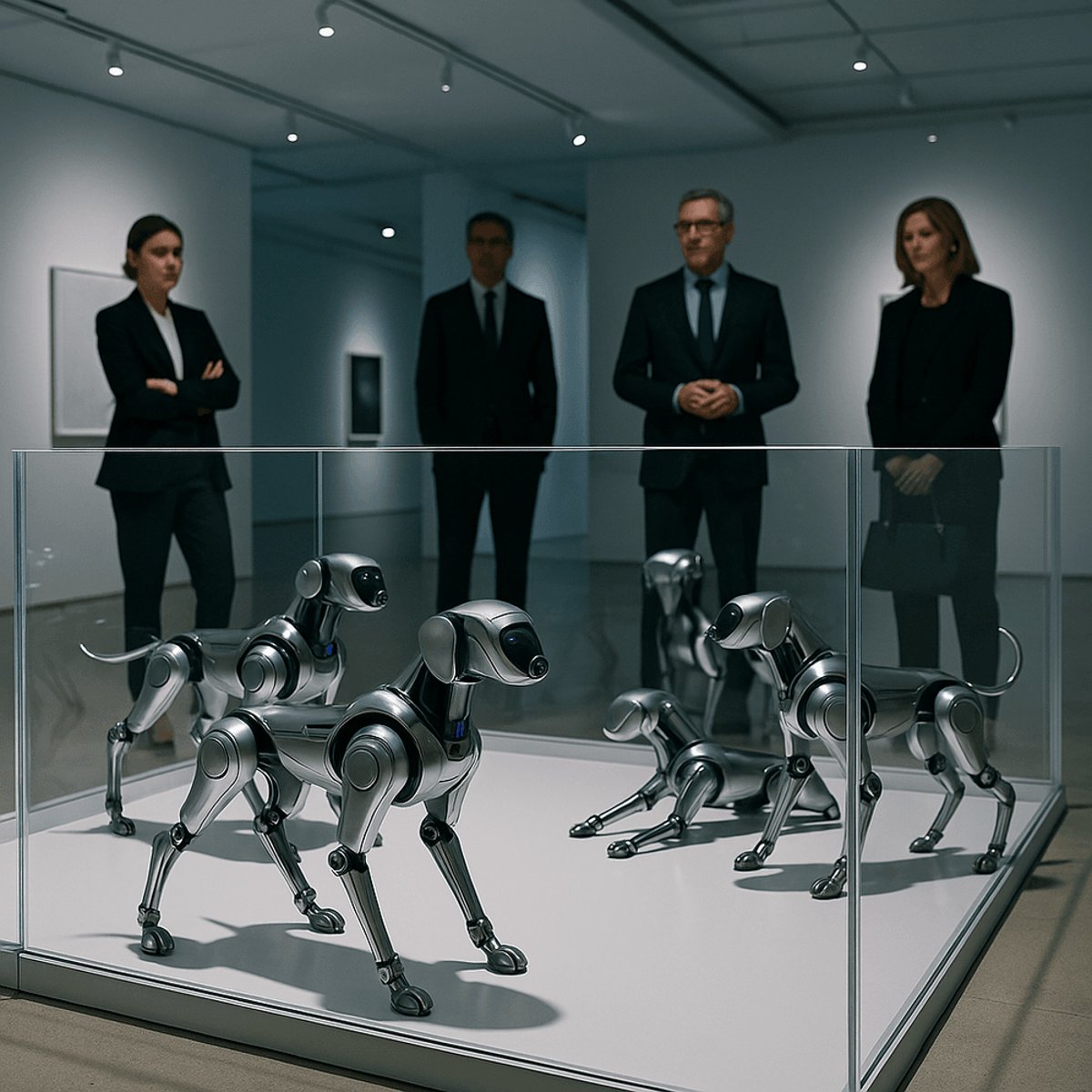
Digital artist Beeple just turned Art Basel Miami Beach into his personal tech CEO showcase. His 'Regular Animals' installation features $100,000 robotic dogs sporting hyper-realistic heads of Elon Musk, Mark Zuckerberg, and Jeff Bezos – and surprisingly, his own self-portrait dog sold first. The AI-powered art pieces roam a plexiglass pen, capturing images and dispensing NFT-coded prints in bags labeled 'Excrement Sample.'
Mike Winkelmann just proved he's still the master of viral art stunts. The digital artist known as Beeple has unleashed his latest provocation at Art Basel Miami Beach, and it's as audacious as you'd expect from the man who sold a digital collage for $69 million.
His 'Regular Animals' installation transforms tech's biggest names into $100,000 robotic dogs. Elon Musk, Mark Zuckerberg, and Jeff Bezos get the full treatment alongside art legends Pablo Picasso and Andy Warhol. But here's where it gets interesting – Beeple included himself in this exclusive pack, a move the Charleston-based artist called 'ballsy,' according to The Wall Street Journal.
The twist? His self-portrait dog sold first, catching even Beeple off guard. The installation runs through Sunday, giving Miami's art crowd one last chance to witness this bizarre spectacle.
These aren't just static sculptures. The robotic dogs roam a plexiglass pen, equipped with chest-mounted cameras that capture images processed by AI algorithms. The system then 'poops out' prints – yes, you read that right – with 256 of them containing QR codes for free NFTs, all dispensed in bags labeled 'Excrement Sample.'
It's peak Beeple: equal parts technological innovation and cheeky commentary on our digital obsessions. The artist has built his reputation on daily digital art creation, amassing millions of followers who tune in for his satirical takes on politics, technology, and culture.
This marks Winkelmann's second major moment as the art world's main character. Four years ago, his digital collage 'Everydays: The First 5000 Days' sold at Christie's for a record-breaking $69 million, catalyzing the NFT boom that would dominate 2021 before largely imploding by 2022.
The timing feels deliberate. As AI reshapes creative industries and tech CEOs dominate headlines, Beeple's robotic menagerie offers both celebration and critique. The choice to include himself alongside these titans suggests an artist confident in his cultural influence.
The $100,000 price tag per robotic dog reflects the continued appetite for high-concept tech art, even as the broader NFT market has cooled significantly. Miami's Art Basel crowd represents exactly the type of collectors who drove the previous digital art surge.
What's particularly clever is how Beeple uses the robot dogs as both artistic medium and commentary vehicle. The AI-generated prints create an endless stream of unique works, while the excrement metaphor offers pointed commentary on content creation in the digital age.
The installation also highlights how physical and digital art continue to merge. These robot dogs exist in real space but generate digital assets, blurring traditional boundaries in ways that have become Beeple's signature.
For the tech industry figures depicted, this represents another layer of their cultural transformation from business leaders to pop culture icons. Having your likeness featured in a major art installation signals a different kind of influence.
The project continues through Sunday at Art Basel Miami Beach, where it's generated significant buzz among collectors and industry watchers. Whether it sparks another digital art surge or remains a standalone spectacle, Beeple has once again positioned himself at the intersection of technology, celebrity, and artistic provocation.
Beeple's latest installation proves that the convergence of AI, robotics, and celebrity culture still has the power to captivate collectors and generate headlines. While the broader NFT market has cooled, his ability to create viral moments through provocative art remains intact. The success of his self-portrait dog suggests audiences are as fascinated by the artist as his subjects, cementing his position as both commentator and participant in our tech-obsessed culture.