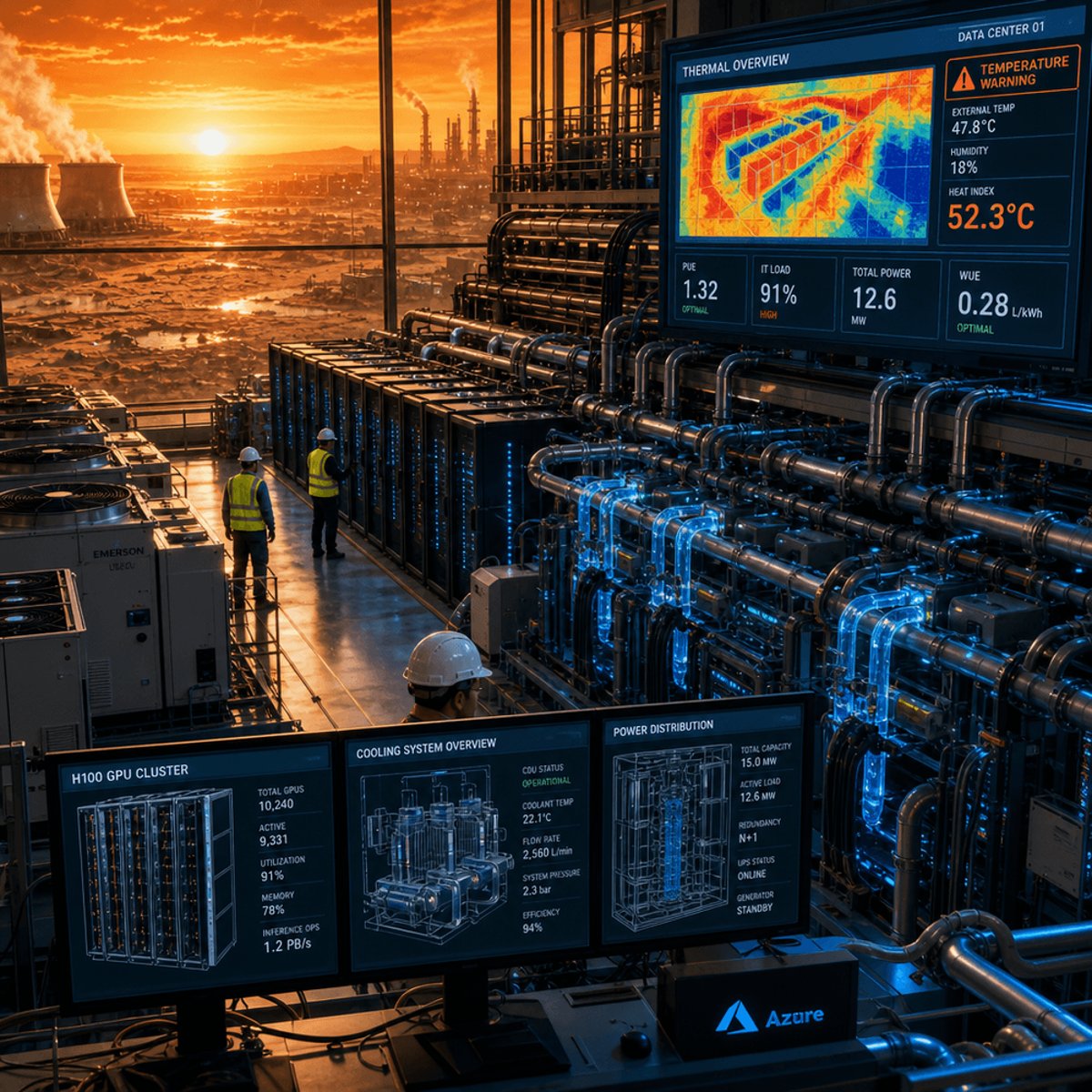
The AI revolution is running into an unexpected wall: the planet itself. As heatwaves intensify across key data center regions, tech giants are facing a perfect storm of grid strain, skyrocketing cooling costs, and rising insurance premiums that threaten to slow the breakneck pace of AI deployment. The infrastructure powering ChatGPT, Claude, and Gemini wasn't built for a climate in crisis, and the cracks are starting to show.
The timing couldn't be worse for Big Tech's AI ambitions. Just as Microsoft, Google, Amazon, and Meta race to build out massive data center capacity to train and run increasingly powerful AI models, Mother Nature is making those facilities exponentially harder to operate.
Record-breaking heatwaves across the southwestern United States and parts of Europe are pushing data centers beyond their thermal limits. Facilities designed to operate efficiently at ambient temperatures of 95°F are now routinely facing exterior conditions exceeding 110°F, forcing cooling systems into overdrive and, in some cases, triggering emergency protocols that shut down non-critical operations entirely.
The problem goes deeper than just hot days. Modern AI training runs - the kind that power systems like GPT-4, Gemini, and Claude - generate extraordinary amounts of heat. A single rack of Nvidia H100 GPUs can draw 10-15 kilowatts of power, with most of that energy converting directly to heat. Multiply that across thousands of racks, and you've got facilities that need industrial-scale cooling just to keep the lights on. When outside temperatures spike, the delta between what needs cooling and what's physically possible starts to narrow dangerously.
Grid operators are sounding alarms too. AI data centers already consume between 1-2% of global electricity, and that figure is projected to hit 4% by 2030. But it's not just the total consumption that's problematic - it's the timing. Peak AI training loads increasingly coincide with peak cooling demands during heatwaves, exactly when grids are most stressed. Utilities in Arizona, Texas, and California have started implementing emergency load-shedding protocols that can force data centers to throttle operations during critical heat events.
The financial implications are piling up fast. Operators are reporting cooling cost increases of 30-40% compared to previous years, driven by both higher temperatures and the need to run redundant systems at full capacity. Some facilities are burning through water supplies at unsustainable rates - evaporative cooling, while effective, can consume millions of gallons daily. In drought-stricken regions, that's becoming politically and practically untenable.
Insurance markets are responding with brutal efficiency. Carriers are reassessing risk models for data centers in heat-prone and storm-vulnerable areas, leading to premium increases of 50-100% for some operators. More concerning, several major insurers are reportedly adding exclusions for climate-related outages or refusing to renew policies altogether for facilities in high-risk zones. For companies that have already invested billions in physical infrastructure, retroactively relocating isn't an option.
Amazon Web Services and Microsoft Azure have both acknowledged the challenge in recent infrastructure planning documents, though neither company has publicly disclosed how weather-related disruptions have impacted service availability. Industry insiders suggest that the hyperscalers are quietly shifting new construction toward more climate-stable regions - thinking Pacific Northwest over Phoenix, Ireland over Spain - but that's a slow-moving solution to an accelerating problem.
The collision of AI's power appetite with climate volatility is forcing some uncomfortable reckonings. Liquid cooling systems, which can handle higher heat loads more efficiently than traditional air cooling, are gaining traction but require massive capital expenditures to retrofit existing facilities. Some companies are experimenting with offshore data centers or facilities in Nordic countries, but that creates latency challenges for real-time AI applications.
There's also a darker irony at play: AI systems are increasingly used for climate modeling and weather prediction, yet the infrastructure running those models is itself vulnerable to the very phenomena it's trying to forecast. It's a feedback loop that's getting harder to ignore.
What comes next likely depends on how severe the next few summers get. If 2026 proves to be an outlier, the industry might absorb the costs and keep building. But if extreme weather becomes the new baseline - as climate scientists suggest it will - tech companies may face a fundamental constraint on AI scaling that no amount of venture capital can solve. You can't train models when the power's out and the servers are overheating.
The AI boom promised to reshape everything from search to software development, but no one factored in whether the planet could handle the infrastructure bill. As heatwaves intensify and grids strain under the load, tech companies are learning an expensive lesson: you can't optimize your way out of physics. The next chapter of AI development won't just be about better algorithms or more powerful chips - it'll be about whether we can keep the data centers running at all. For an industry built on the assumption that scaling is always possible, that's an unfamiliar and deeply uncomfortable constraint.