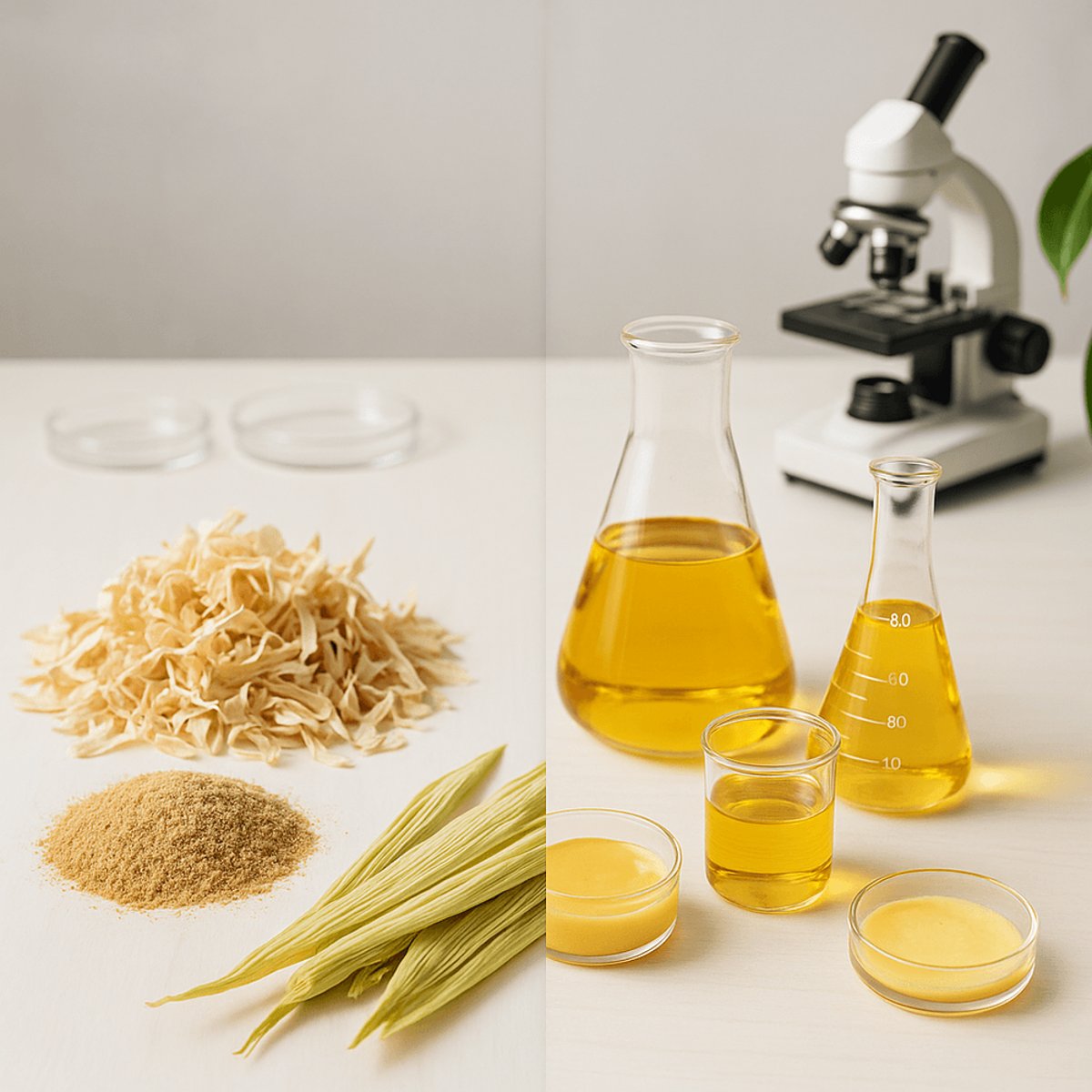
A tiny Estonian startup is tackling one of the food industry's biggest environmental problems with an unlikely solution: turning sawdust into edible fat. ÄIO has developed a proprietary yeast strain that consumes agricultural waste sugars and outputs fat molecules, potentially offering a sustainable alternative to ecologically destructive palm oil production that has decimated rainforests worldwide.
The palm oil industry has a massive environmental problem, and two Estonian scientists think they've cracked the code with engineered microbes and agricultural waste. ÄIO just emerged from TechCrunch Disrupt's Startup Battlefield with a technology that could fundamentally reshape how the world produces edible fats.
Co-founders Nemailla Bonturi and Petri-Jaan Lahtvee didn't set out to revolutionize food production. Bonturi was deep in doctoral research when she engineered something remarkable: a strain of yeast that breaks every rule in the fermentation playbook. Instead of the typical sugar-to-alcohol or sugar-to-CO2 conversion we see in bread and beer, her microbe consumes sugar and outputs fat molecules.
"We started working on it, developing metabolic engineering tools," Lahtvee told TechCrunch during the company's Battlefield presentation. The breakthrough came when they realized Estonia's abundant agricultural waste - corn stalks, lumber byproducts, sugarcane refuse - could feed their engineered yeast at industrial scale.
The timing couldn't be better for palm oil alternatives. The industry has become a $65 billion environmental nightmare, with plantations destroying 27 million acres of rainforest since 1990. Major food companies are scrambling for sustainable alternatives, but most substitutes sacrifice functionality or cost-effectiveness. ÄIO's approach solves both problems simultaneously.
"Our fat profile is very similar to existing fats," Lahtvee explains, noting their solid-fat form "most closely resembles chicken fat." But here's where it gets interesting - they can modify the fermentation process to produce liquid oils that compete directly with canola and rapeseed oil. The versatility opens doors across food manufacturing, cosmetics, and industrial applications.
The company's purity claims are bold but substantiated. "We have a very extensive analysis after we make our product and, so far, what we have seen is that our final product is to the same level as vegetable oils, except for the pesticides - even more pure," Bonturi told TechCrunch.
Since launching in 2022, ÄIO has raised approximately $7 million and won the 2024 Baltic Sustainability Award. More importantly, they've signed partnerships with over 100 companies worldwide - a validation that suggests serious commercial interest beyond the usual startup hype.
The regulatory pathway looks promising but challenging. ÄIO plans to start with Singapore, which has historically been more open to alternative food production technologies than the U.S. or EU. "It's a novel type of way of producing food, and we have to go through all the permits and analysis," Bonturi acknowledged.
The commercial timeline is aggressive but achievable. ÄIO plans to build a facility producing fats at commercial quantities by 2027, while simultaneously licensing their technology to cosmetic and food manufacturers. This dual revenue model - direct production plus licensing - mirrors successful biotech companies like Novozymes and Ginkgo Bioworks.
What makes ÄIO particularly compelling isn't just the technology, but the founders' backgrounds. Lahtvee was a professor of Food Tech and Bioengineering at Tallinn University of Technology, running his own biotech lab since 2016. When he hired Bonturi as his first researcher, she brought her doctoral microbe research with her. They spent years making the organism hardy enough for industrial manufacturing - the kind of patient, methodical work that separates real innovations from lab curiosities.
The competitive landscape for palm oil alternatives is heating up quickly. Companies like Perfect Day and Motif Ingredients are tackling different aspects of sustainable food production, while traditional agriculture giants like Cargill are investing heavily in alternative protein and fat sources. But ÄIO's approach - using abundant waste streams to feed engineered microbes - offers unique advantages in cost structure and scalability.
ÄIO represents the kind of deep-tech innovation that could actually move the needle on sustainability. While other startups chase consumer trends, Bonturi and Lahtvee are solving fundamental infrastructure problems with serious science. Their vision of "two scientists in this small country could actually do something better for the world" might sound modest, but transforming agricultural waste into sustainable fats could reshape entire industries. The real test comes in 2027 when commercial production begins - but with $7 million raised, 100+ partnerships signed, and regulatory approval underway, ÄIO looks positioned to deliver on its ambitious promises.