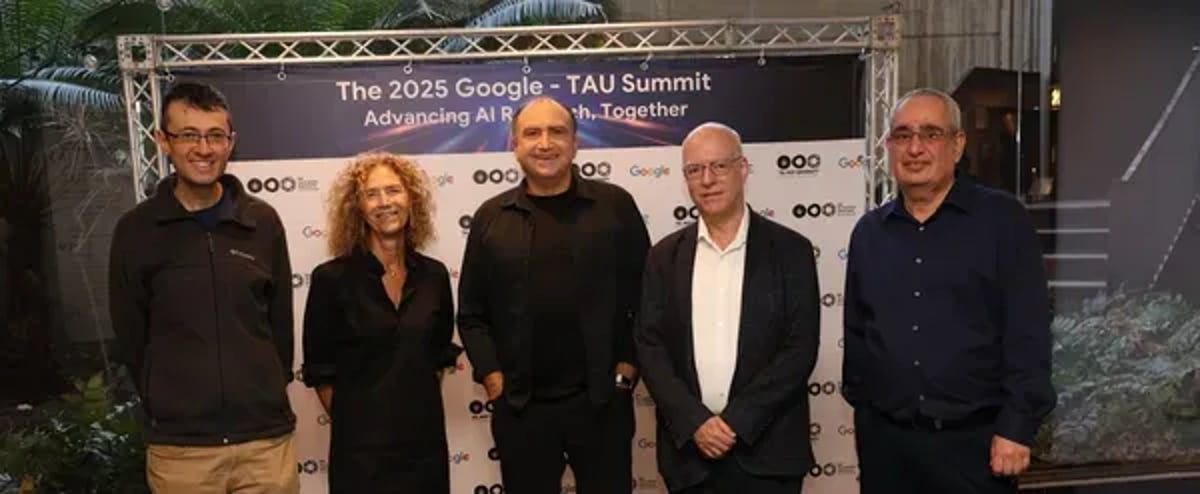
Google just committed $1 million to expand its AI research partnership with Tel Aviv University through 2028, marking a significant investment in foundational AI research and academic collaboration. The three-year funding from Google.org builds on a successful partnership that has already produced over 20 research projects since 2020, spanning AI for social good, sustainability, and education.
Google is doubling down on academic AI research with a major expansion of its Tel Aviv University partnership. The tech giant announced today it's committing $1 million through Google.org to fund a three-year research collaboration running from 2026 to 2028, significantly expanding what has already been one of the company's most productive academic partnerships.
The announcement comes as tech companies increasingly look to universities for breakthrough AI research that might not emerge from corporate labs. Google's partnership with TAU's Center for AI and Data Science has already produced impressive results since its 2020 launch, generating over 20 research projects ranging from educational values in large language models to using AI for wastewater treatment optimization.
Leslie Yeh, Director of Scientific Progress at Google.org, emphasized the partnership's focus on "driving scientific discovery and empowering the next generation of AI researchers." The funding targets four critical research areas that could reshape how AI systems operate: making AI more efficient and sustainable, building multilingual and multicultural AI systems, exploring quantum computing applications, and advancing privacy-preserving AI techniques.
But this isn't just theoretical research. Google Research teams are launching immediate collaborative projects with TAU researchers on pressing topics like GenAI evaluation methods and AI applications for climate and weather research. One particularly ambitious project aims to create the first-ever global map of flower colors for conservation efforts using machine learning - the kind of interdisciplinary work that's difficult to pursue within traditional corporate research constraints.
The partnership reflects Google's broader strategy of investing in external research capabilities while maintaining access to cutting-edge academic talent. Prof. Yossi Matias, Vice President of Google and Head of Google Research, noted that "the biggest challenges can only be solved when we work together," highlighting how academic partnerships complement internal research efforts.
TAU brings significant AI expertise to the table through its Center for AI and Data Science, led by Prof. Yishay Mansour. The university has been integrating AI and data science courses across traditionally non-computational fields - from law and humanities to life sciences - creating a pipeline of researchers who can apply AI tools to previously unexplored domains.
The funding structure reveals Google's commitment to nurturing long-term research talent. Direct support for PhD students includes scholarships and travel awards for presenting research globally, while two TAU students have already received Google PhD Fellowship awards this year. The company is also providing Israeli university students with free one-year access to Google AI Pro plans.
Technical infrastructure support through Google Cloud Platform credits ensures researchers can tackle resource-intensive projects and experiment with Google's latest open models like Gemma directly within their research workflows. This removes traditional barriers that often limit academic AI research scope and ambition.
The expanded partnership positions Google strategically within Israel's growing AI ecosystem while addressing criticism that tech giants aren't investing enough in fundamental research. Unlike product-focused corporate labs, university partnerships can pursue longer-term, higher-risk research that might not show commercial applications for years.
Industry observers note that such academic partnerships are becoming increasingly important as AI development costs soar and the need for diverse research approaches becomes clear. Google's commitment through 2028 provides the kind of stability that allows researchers to pursue ambitious, multi-year projects rather than quick wins.
Google's expanded Tel Aviv University partnership signals a broader industry shift toward sustained academic collaboration in AI research. As fundamental AI challenges require longer-term, more diverse research approaches, tech giants are finding that university partnerships offer access to talent and research directions that complement internal labs. The $1 million commitment through 2028 provides the stability needed for ambitious research projects while positioning Google within Israel's growing AI ecosystem. Watch for similar academic partnerships to emerge as companies compete for breakthrough research that might not surface from traditional corporate R&D cycles.