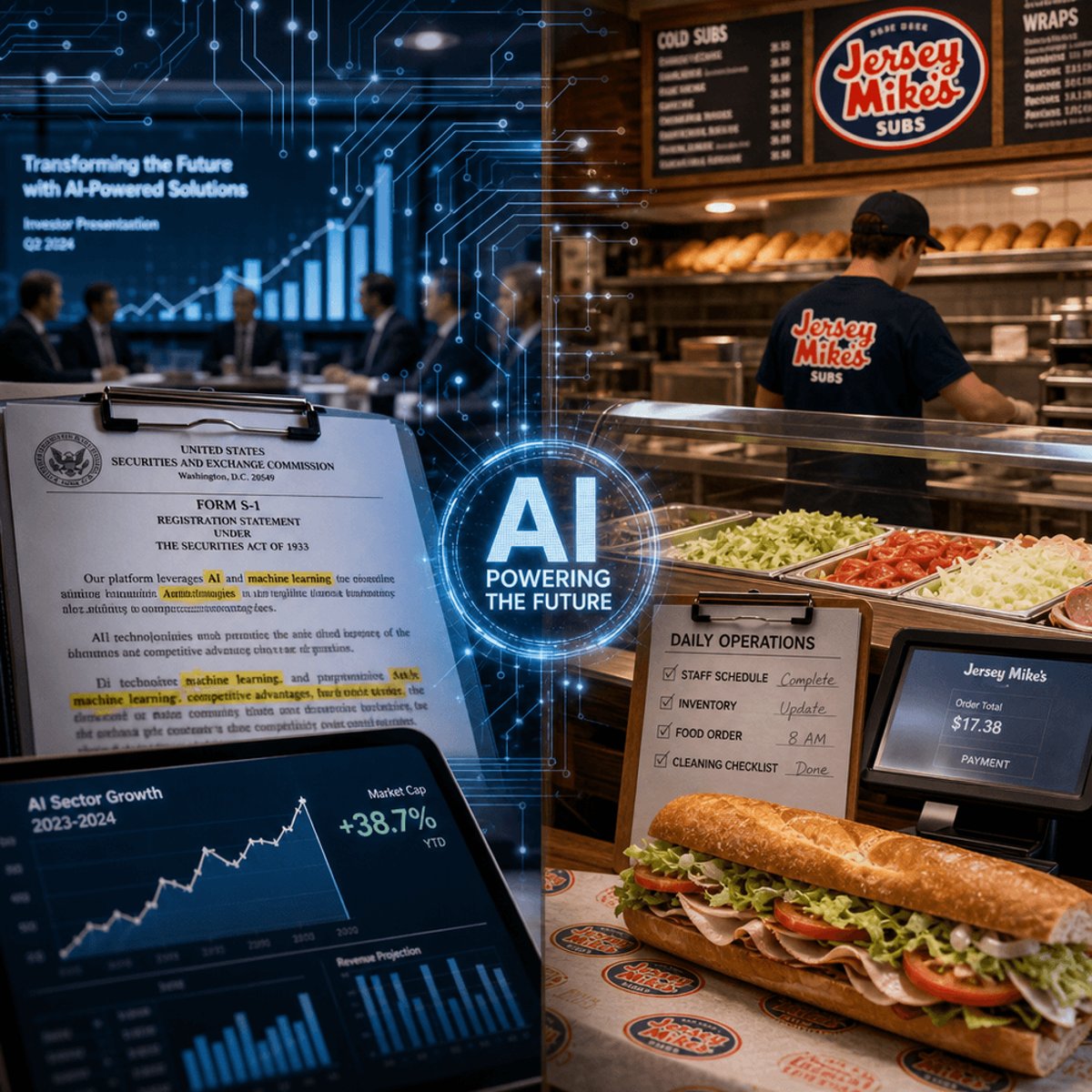
When a submarine sandwich chain starts talking about artificial intelligence in its IPO documents, you know we've reached peak AI hype. Jersey Mike's, the fast-casual restaurant chain known for slicing cold cuts, just filed to go public - and buried in the paperwork are references to AI that highlight how desperate companies have become to catch the algorithm wave. It's the latest sign that AI mentions have become less about actual innovation and more about checking a box for investors who can't stop throwing money at anything with 'machine learning' in the deck.
Jersey Mike's just proved that AI hype has officially infiltrated every corner of the business world - even the ones that smell like fresh-baked bread and vinegar. The submarine sandwich chain's IPO filing, spotted by TechCrunch, includes references to artificial intelligence, joining a growing parade of unlikely companies trying to ride the AI wave straight to Wall Street.
It's a moment that captures something essential about where we are in the AI boom. When a business built on the simple premise of making really good sandwiches feels compelled to talk about algorithms in its pitch to investors, we've crossed a line from innovation into theater.
The phenomenon isn't unique to Jersey Mike's. Analysis of SEC filings shows that AI mentions in IPO documents have exploded 340% since 2022, according to data from financial research firm Acuity Knowledge Partners. Traditional retail chains, restaurants, and even landscaping companies are suddenly discovering they've been using AI all along - or at least that's what their lawyers are helping them claim.
Goldman Sachs analysts noted in a recent report that companies mentioning AI in their IPO filings saw their first-day pop average 23% higher than those that didn't, creating a powerful incentive to find any tenuous connection to the technology. It's become the 2026 version of slapping 'dot-com' on your company name in 1999.
The pressure is coming from both sides. Venture capitalists are asking portfolio companies to articulate their AI strategy before funding rounds. Institutional investors are using AI mentions as a screening tool, according to interviews with investment managers. And retail investors, flush with stories of Nvidia's meteoric rise and OpenAI's cultural dominance, are primed to buy anything that promises exposure to the trend.
But there's AI, and then there's AI. Meta is spending $65 billion this year building data centers and training massive language models. Google is rebuilding search around generative AI. Those are fundamental business transformations. Jersey Mike's potentially using scheduling software or inventory management tools that happen to include some machine learning features? That's just modern business operations with a buzzword slapped on top.
The distinction matters because it reveals how hollow much of the current AI discourse has become. Real AI implementation requires massive capital investment, technical talent, and often a complete rethinking of business processes. Mentioning AI in an S-1 filing requires only a willing lawyer and a creative interpretation of existing systems.
Industry observers are starting to push back. "We're seeing companies describe basic automation or even just Excel macros as AI," one investment analyst who declined to be named told industry publication The Information. "It's making it harder to identify which companies are actually doing interesting things with the technology."
The trend has caught the attention of regulators too. The SEC has reportedly started asking companies to substantiate their AI claims in follow-up questions during the IPO review process, according to securities lawyers familiar with recent filings. But enforcement remains light, and the incentives to exaggerate remain strong.
For Jersey Mike's specifically, any AI implementation is likely mundane - perhaps predictive ordering systems, labor scheduling algorithms, or customer preference tracking. These are useful tools, but they're not the kind of transformative technology that justifies the premium investors are placing on AI-branded companies.
What makes this moment particularly absurd is the timing. We're simultaneously in the middle of a genuine AI revolution - large language models really are changing how we work and create - and a speculative bubble where companies are incentivized to pretend they're more involved in that revolution than they actually are. Jersey Mike's sliding AI mentions into their IPO paperwork is a symptom of the latter threatening to overshadow the former.
The question is what happens when investors start demanding proof that all this AI talk is actually driving results. Tesla can point to Full Self-Driving, however controversial. Microsoft can show GitHub Copilot revenue. What does a sandwich chain point to? Marginally better shift scheduling?
This isn't to say traditional businesses can't benefit from AI - they absolutely can and should adopt useful tools. But there's a difference between using technology to improve operations and positioning yourself as an AI company to goose your valuation. Jersey Mike's is a restaurant business that might use some AI tools, not an AI business that happens to sell sandwiches. The market would be healthier if we could all acknowledge the difference.
Jersey Mike's AI-sprinkled IPO filing is more than just an amusing quirk - it's a canary in the coal mine for the current investment environment. When sandwich shops feel compelled to talk about artificial intelligence to compete for investor dollars, we've entered territory where hype is overwhelming substance. The real AI revolution is happening, but it's getting harder to spot through all the noise from companies that are just trying to catch a ride on the trend. Investors who can tell the difference between genuine AI implementation and opportunistic buzzword deployment will be the ones who actually profit when this sorting process inevitably begins. For everyone else, there's always a good submarine sandwich.