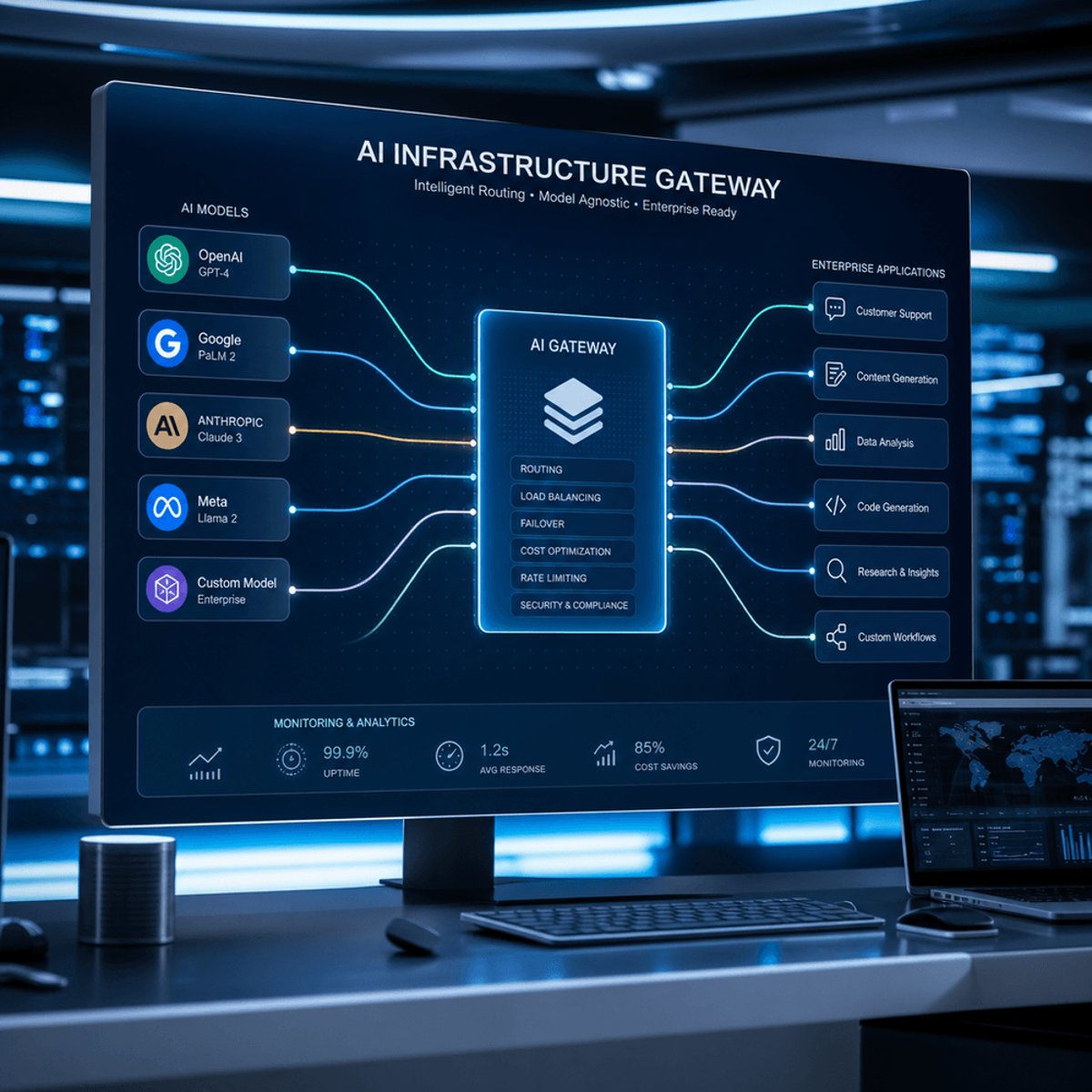
Microsoft CEO Satya Nadella just issued a stark warning to enterprises: betting everything on a single AI model could be a fatal mistake. Speaking at an industry event, Nadella introduced the concept of 'AI gateways' - a critical infrastructure layer that sits between company prompts and AI models - as essential survival technology. Companies that skip this step or fail to develop their own models may not make it, according to the Microsoft chief who's overseen the company's $13 billion bet on OpenAI.
Microsoft CEO Satya Nadella is rewriting the enterprise AI playbook with a provocative message: your AI strategy might kill your company. In remarks that challenge the prevalent 'pick a vendor and go all-in' approach, Nadella painted a picture of a multi-model future where flexibility trumps loyalty.
The core of Nadella's argument centers on what he calls 'AI gateways' - an infrastructure layer that most enterprises haven't even considered yet. Think of it as a translation system that sits between your company's prompts and whatever AI model you're using. Without this buffer, companies become dangerously dependent on a single AI provider's capabilities, pricing, and roadmap decisions.
'Companies without their own models - or without a layer of AI infrastructure known as AI gateways to separate their prompts from the model itself - will be in trouble,' Nadella said, according to TechCrunch.
It's a fascinating pivot from the executive who championed Microsoft's massive investment in OpenAI. Rather than pushing enterprises toward exclusive GPT-4 adoption, Nadella's embracing architectural flexibility. The message: build infrastructure that lets you swap models like you swap cloud providers.
This isn't just theoretical architecture talk. The AI gateway concept addresses real pain points enterprises are already hitting. What happens when your primary AI model goes down? When pricing suddenly doubles? When a competitor's model suddenly outperforms yours on specific tasks? Without an abstraction layer, companies face costly rewrites of every application they've built.
The timing reveals Microsoft's strategic repositioning. As Google, Anthropic, and open-source alternatives chip away at OpenAI's dominance, Microsoft needs Azure to be the Switzerland of AI infrastructure - not just the OpenAI delivery mechanism. AI gateways let Microsoft sell infrastructure regardless of which model wins.
Several startups are already racing into this space. Companies like Portkey and LangChain have built early gateway solutions that let developers route prompts to different models based on cost, speed, or capability requirements. Now Microsoft appears ready to legitimize and potentially dominate the category.
For enterprises, Nadella's warning crystallizes a decision point. Do you build custom models trained on proprietary data? Invest in gateway infrastructure? Or risk the single-vendor path? The safe money says we'll see a surge in 'multi-model strategies' replacing the current 'pick your AI religion' approach.
The shift also exposes tensions in Microsoft's own positioning. The company has spent two years marketing Copilot as the enterprise AI answer - a Microsoft-controlled experience powered primarily by OpenAI. Now its CEO is essentially saying that's not enough. You need the infrastructure to go beyond whatever Microsoft or anyone else offers.
What Nadella didn't say is equally telling. He didn't specify whether Microsoft plans to productize AI gateway technology through Azure, though it seems inevitable. He also didn't address how this philosophy squares with Copilot's integrated approach, where the gateway is essentially invisible and Microsoft-controlled.
The broader implication: the AI stack is fragmenting faster than anyone expected. Just as enterprises learned not to build exclusively on one cloud provider, they're now learning not to bet everything on one AI model. The companies that survive won't be those with the best AI - they'll be those with the best AI infrastructure.
Nadella's AI gateway warning marks a turning point in enterprise AI strategy. We're moving from the 'pick a winner' phase to the 'build flexible infrastructure' phase - and that shift will reshape how companies architect their AI investments. The enterprises scrambling to deploy ChatGPT integrations everywhere might want to pause and ask whether they're building on sand. Microsoft's CEO just told them the answer, even if it complicates his own company's Copilot pitch. Smart CIOs will start evaluating gateway solutions now, before they're locked into architectures that can't adapt when the next breakthrough model arrives.