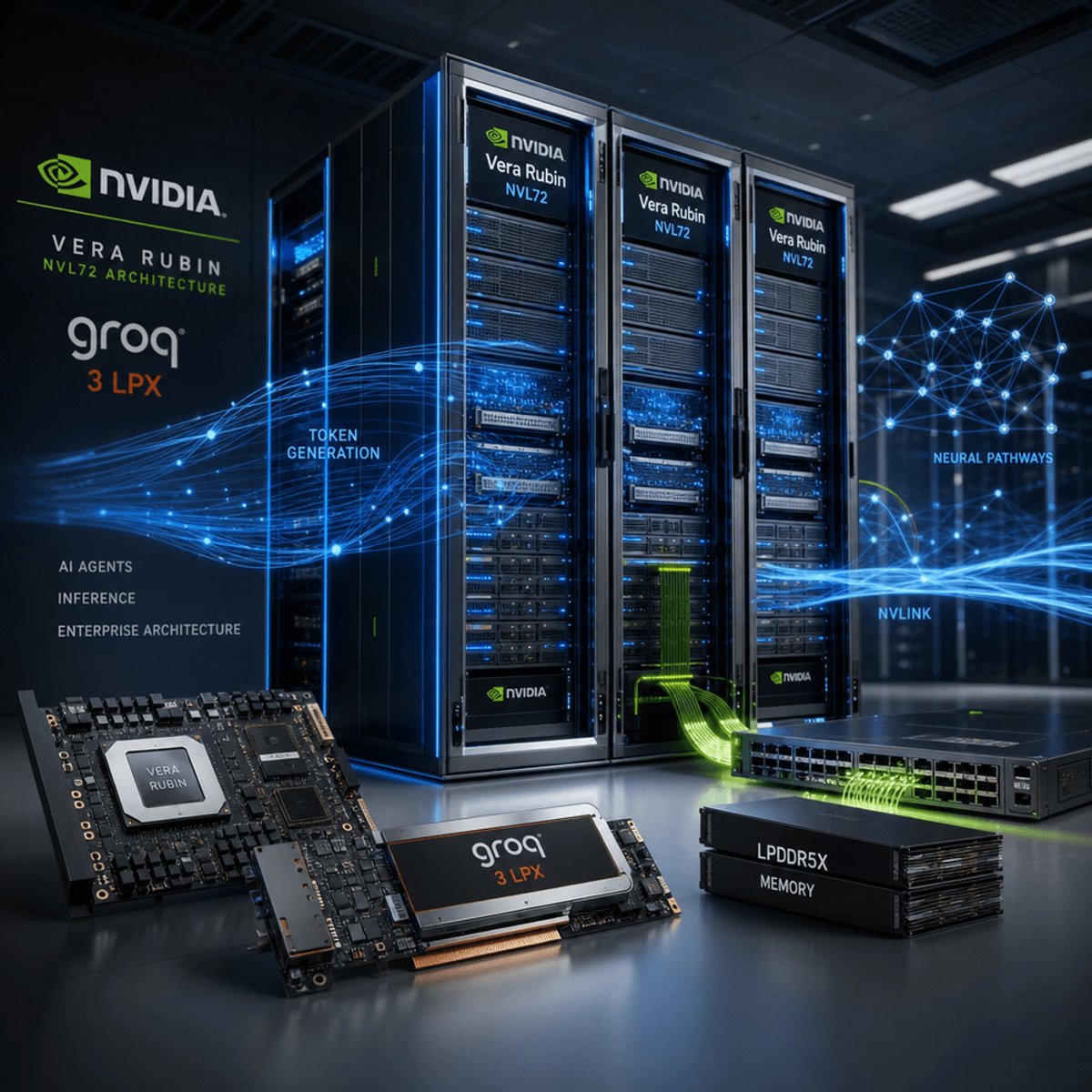
The AI inference wars just entered a new phase. NVIDIA is extending its Vera Rubin NVL72 rack-scale system with enhanced capabilities for agentic AI workloads, announcing today that the platform now integrates fast token generation optimized for the next wave of autonomous AI systems. The move signals a strategic shift from raw compute power to integrated infrastructure designed specifically for AI agents that reason, plan, and execute multi-step tasks without human intervention.
NVIDIA isn't just updating a chip - it's reimagining how AI inference happens at scale. The company's latest announcement extends its Vera Rubin NVL72 rack-scale system with capabilities specifically engineered for agentic AI, those autonomous systems that don't just answer questions but actively reason through problems, plan multi-step solutions, and execute tasks independently.
The timing matters. While the industry has spent the past two years obsessing over training ever-larger models, the real bottleneck has shifted to inference - specifically, the kind of inference that powers AI agents. These systems generate thousands of tokens as they think through problems, dramatically different from the quick-response chatbot interactions that defined AI's first wave.
"The next era of AI inference won't be defined by a single breakthrough chip, network or system," according to NVIDIA's official announcement. "It'll be defined by how every layer of the AI factory works together." That philosophy represents a fundamental departure from the speeds-and-feeds battles that have dominated semiconductor marketing for decades.
The Vera Rubin NVL72 extension incorporates technology from Groq 3 LPX, which NVIDIA confirms is now in full production. The integration focuses on fast token generation, the metric that matters most when AI agents are reasoning through complex tasks rather than simply retrieving information. An agent planning a multi-city business trip might generate tens of thousands of tokens as it considers flight options, checks hotel availability, coordinates meeting schedules, and optimizes for cost and time - all before presenting a final itinerary.
NVIDIA's rack-scale approach bundles compute, memory, and networking into a unified system optimized for these workloads. The NVL72 architecture connects 72 GPUs through NVLink, creating what the company calls an "AI factory" where data moves between processors with minimal latency. For agentic workloads that constantly shuffle information between reasoning steps, those milliseconds add up.
The enterprise implications are significant. Companies deploying AI agents for customer service, code generation, or business process automation face different infrastructure requirements than those running traditional inference workloads. A customer service agent might need to query databases, check inventory systems, process refund policies, and generate personalized responses - all in real-time. That requires infrastructure that can handle both the token generation and the orchestration of multiple API calls and data sources.
NVIDIA's move comes as competitors scramble to address the same market shift. Specialized inference chip startups have raised billions arguing that general-purpose GPUs are overkill for AI deployment, but the rise of agentic AI complicates that narrative. These systems need the flexibility to handle reasoning, tool use, and dynamic problem-solving - precisely the workloads where NVIDIA's GPU architecture has historically excelled.
The Groq integration is particularly noteworthy. While details remain limited in the announcement, Groq's architecture has focused on deterministic performance and low-latency inference - exactly what agentic systems demand. Bringing Groq 3 LPX to full production inside the Vera Rubin platform suggests NVIDIA is betting on heterogeneous compute, mixing specialized processors for different parts of the agentic workflow rather than relying on GPU monoculture.
For enterprises evaluating AI infrastructure, the announcement raises the stakes on long-term platform decisions. Companies that standardized on NVIDIA for training now face questions about whether they need the same vendor's inference infrastructure, or whether specialized alternatives make more sense. NVIDIA's argument is that tight integration across the stack - from silicon to networking to orchestration software - delivers better total performance than mixing best-of-breed components.
The broader implication is that AI inference is fragmenting. The infrastructure that serves a million users asking ChatGPT quick questions looks nothing like the infrastructure needed for AI agents autonomously managing supply chains or writing complex software. NVIDIA is positioning Vera Rubin as the platform for the latter category, where latency, throughput, and orchestration matter more than raw compute density.
NVIDIA's Vera Rubin extension signals that the AI infrastructure market is splitting into distinct segments, with agentic workloads demanding fundamentally different architecture than first-generation chatbots. The company's bet on integrated, rack-scale systems positions it for the autonomous AI era, but also locks customers deeper into proprietary ecosystems at precisely the moment when inference alternatives are proliferating. For enterprises, the question isn't whether to invest in agentic AI infrastructure - it's whether NVIDIA's integrated approach delivers enough performance advantage to justify the platform commitment. The answer will shape data center buying decisions for the next decade.