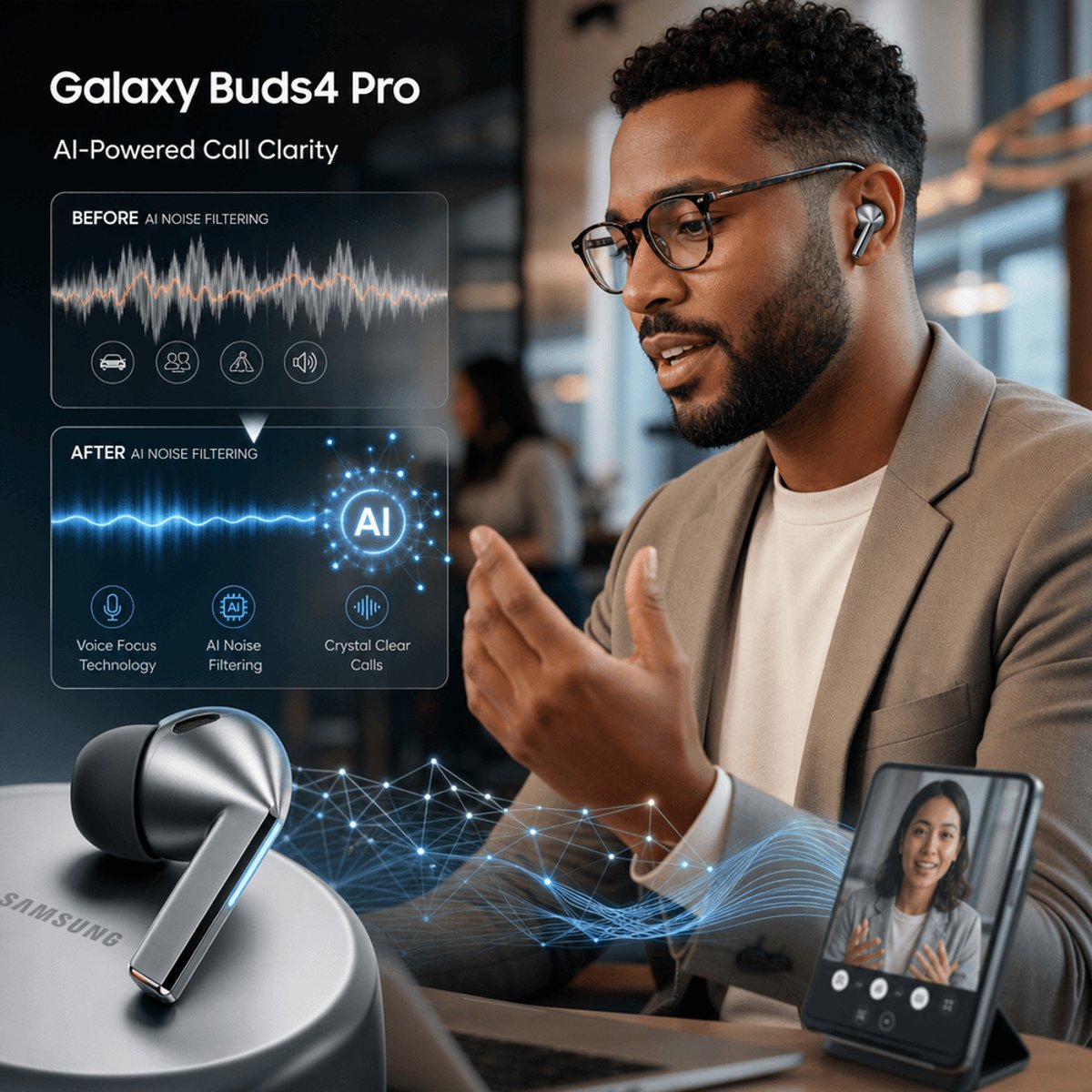
Samsung just dropped the Galaxy Buds4 Pro, and the company's betting big on AI-powered call quality to set these earbuds apart. The new buds combine bone conduction sensors with a Deep Neural Network that's been optimized to run entirely on-device, promising crystal-clear voice calls even when you're standing next to a busy street or in a packed cafe. It's Samsung's answer to one of wireless earbuds' most persistent problems - actually being heard when you're on a call.
Samsung is taking another swing at solving wireless earbuds' biggest weakness - making sure people can actually hear you on calls. The Galaxy Buds4 Pro launches with what the company calls Sensor Fusion technology, a system that pulls data from multiple sensors to cut through background noise and keep your voice front and center.
The tech works by combining inputs from three microphones scattered around each earbud - two external mics capture your voice directly, while a third internal mic picks up speech transmitted through your body. But here's where it gets interesting: Samsung also built in a Voice Pickup Unit sensor based on bone conduction that detects physical vibrations in your head when you speak. That's four separate data streams working together to figure out what's your voice and what's just noise.
Traditional earbuds have always struggled with this because the microphone sits farther from your mouth than a phone's mic does. When you're walking past traffic or sitting in a crowded restaurant, ambient noise often drowns out your voice completely. Samsung says its multi-sensor approach solves that by giving the earbuds multiple ways to detect and isolate your speech, even when the environment is louder than you are.
The real heavy lifting happens in the algorithm. Samsung built a Deep Neural Network - essentially an AI system modeled after how the human brain processes information - to handle noise reduction. Normally, software this sophisticated requires massive computing power that won't fit in something as small as an earbud. But Samsung's engineers optimized the algorithm to run entirely on-device, cutting the processing load to about 10% of what it would typically require and shrinking the model size to just 30% of the original.
That optimization matters because it means the Galaxy Buds4 Pro can do all this AI processing without draining the battery or introducing lag. The DNN analyzes past, present, and predictive sound data in real time, constantly adapting as your environment changes. According to Samsung, the upgraded algorithm captures 16 times more vocal detail than previous Galaxy Buds models, preserving everything from high-pitched tones to sharp consonants and subtle word endings.
The earbuds also account for fit issues. When earbuds shift around - which happens constantly as you move - they create what Samsung calls "fit leakages" that let background noise seep in. Galaxy Buds4 Pro continuously monitors signals from its inner and outer microphones to estimate leakage in real time, then dynamically adjusts the audio to compensate. It's the kind of detail work that only shows up when you're actually using the product in messy real-world conditions.
When paired with a Galaxy smartphone, the system gets an extra boost through Super Wideband connectivity that reaches up to 16 kHz. That's a wider frequency range than standard phone calls support, which Samsung says delivers richer and more natural voice quality during conversations.
To validate all this technology, Samsung brought the real world into the lab. The company used massive wind simulators to recreate acoustic scenarios based on actual location recordings, then conducted extensive field tests in genuinely noisy environments - bustling cafes, loud department stores, echoing train stations. They even tested call quality while walking outdoors at night and riding in cars with windows down.
It's a feature launch, not a product launch - Samsung hasn't announced pricing or availability yet - but the technology signals where the earbuds category is heading. As audio companies run out of obvious ways to differentiate their products on sound quality alone, call clarity is emerging as the new battleground. Apple has been pushing adaptive audio features in AirPods Pro, while Sony and other competitors have their own AI-powered noise cancellation systems.
What makes Samsung's approach notable is the combination of hardware sensors - particularly that bone conduction VPU - with heavily optimized AI that runs locally instead of relying on cloud processing. That should mean faster response times and better privacy, since your voice data isn't being sent to servers for analysis.
The consumer audio market has been heating up as companies look for ways to justify premium pricing on earbuds. With smartphone sales flattening, accessory categories like wireless earbuds represent a growth opportunity for manufacturers. Samsung shipped roughly 9 million Galaxy Buds units in 2025, according to industry estimates, putting it in the top five globally but still well behind Apple's dominant AirPods line.
The Galaxy Buds4 Pro's AI-driven call quality could give Samsung a talking point that resonates with the growing number of people who rely on earbuds for work calls, not just music. As remote and hybrid work becomes permanent for many workers, earbuds have evolved from a nice-to-have accessory into essential communication tools. If Samsung's technology delivers on its promise, it could shift buying decisions in a crowded market where most premium earbuds sound pretty similar.
For now, Samsung is positioning this as a technical deep-dive to showcase the engineering behind the product. The real test will come when reviews and user feedback start rolling in to see if the AI-powered noise reduction actually works as advertised in those chaotic real-world scenarios.
Samsung's Galaxy Buds4 Pro represents a clear bet that AI-powered call quality will matter more to buyers than incremental improvements in music playback. By combining bone conduction sensors with heavily optimized on-device AI, Samsung is addressing a genuine pain point that anyone who takes calls on wireless earbuds has experienced. Whether this translates into a competitive advantage depends on real-world performance, but the technical approach suggests the earbuds category is shifting from a pure audio play to a broader communication tool. As remote work makes clear voice calls more critical, Samsung's timing could be spot-on.