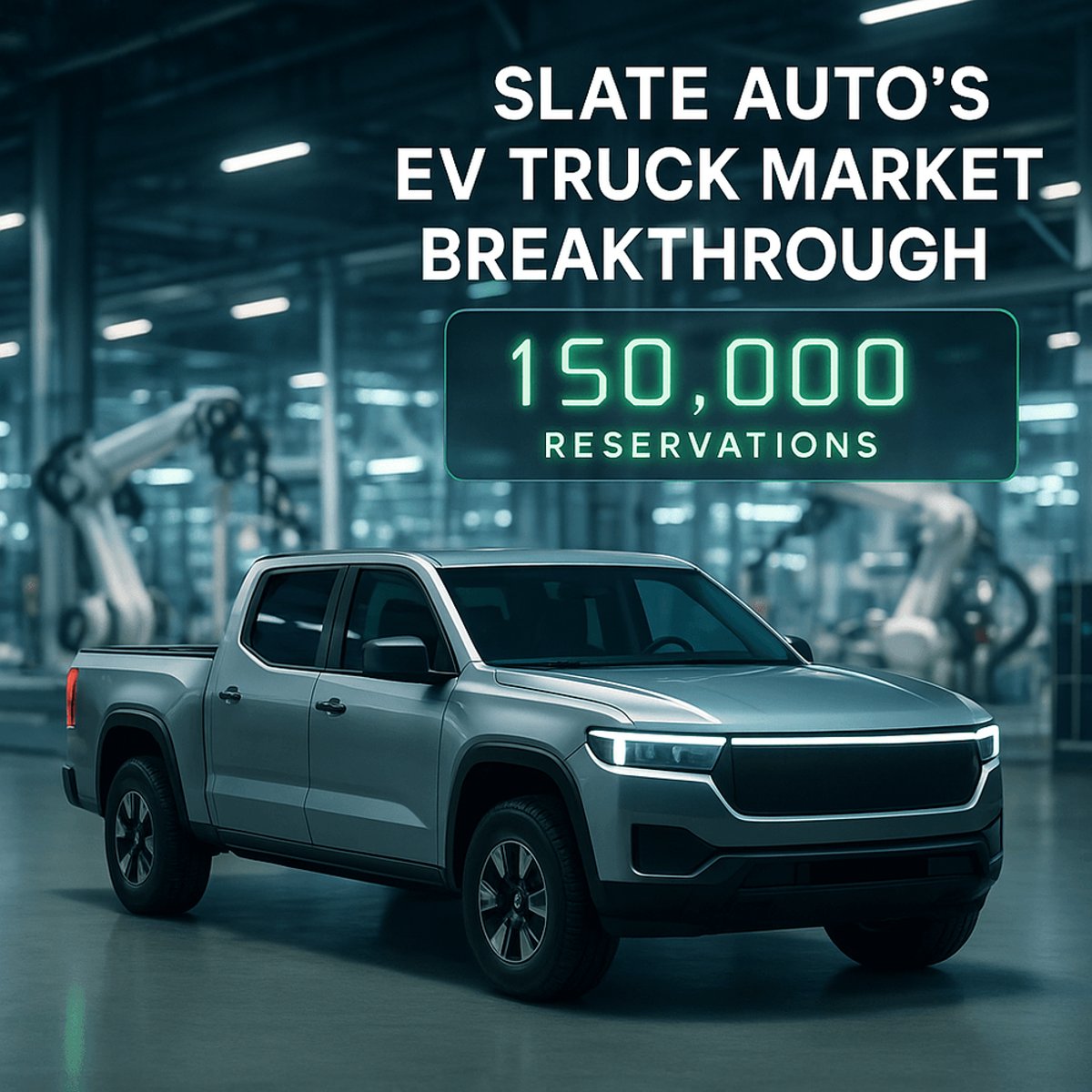
Slate Auto just crossed 150,000 reservations for its affordable electric truck, even as the broader EV truck market shows serious cracks. The Jeff Bezos-backed startup announced the milestone in a Q&A video with CEO Chris Barman, proving that new customer interest is still outpacing any order cancellations. The timing is significant: Ford just killed the F-150 Lightning, and competitors like Tesla's Cybertruck are struggling to move volume.
The electric truck market just got a little less crowded and a lot more interesting. Slate Auto, the Jeff Bezos-backed startup, announced it's crossed 150,000 refundable reservations for its low-cost EV, a milestone that arrives at a particularly telling moment in the industry. Just yesterday, Ford announced it's killing the F-150 Lightning, the first major battery-powered pickup truck to hit the U.S. market, because it simply wasn't making enough money.
The contrast is striking. While established automakers are backing away from electric trucks, Slate keeps stacking orders. CEO Chris Barman shared the reservation figure in a new Q&A video aimed at reservation holders, answering practical questions about features like rear-seat car seat anchors and the company's approach to self-driving (spoiler: there isn't one). The fact that people are still signing up matters more than the absolute number itself.
But here's where the story gets nuanced. Slate hit 100,000 reservations back in May, right after coming out of stealth. That means it took seven months to grow from 100K to 150K - a 50% bump that's measurable but not exactly explosive. The real signal is that reservations continue climbing faster than cancellations, which means the company is actually converting interest despite a brutal market for new EVs.
That growth rate needs context. The EV truck landscape has basically imploded over the past 18 months. Ford's F-150 Lightning never broke a few thousand sales per quarter despite having a recognized brand and dealer network behind it. Tesla's Cybertruck is still ramping production but consistently fails to meet delivery targets. General Motors' Silverado EV exists mostly in the shadows of the EV world. So Slate's continued momentum suggests the company has found something these bigger names missed.
Part of it's timing and design philosophy. The Lightning was essentially a Frankenstein effort, with Ford forcing EV technology into a platform originally built for gas engines. Slate's truck was engineered from the ground up as an EV, which matters for efficiency, cooling, space management, and economics. The company is also laser-focused on one thing: a sub-$25,000 price point that makes EVs actually accessible to regular truck buyers. That's the sweet spot everyone's been chasing but nobody's cracked yet.
The Warsaw, Indiana factory Slate is refurbishing tells you something about scale ambitions. The company plans to produce 150,000 vehicles annually once it hits stride. That means it needs significantly more than 150,000 reservations to actually succeed. Converting reservations into confirmed orders, then getting customers to actually buy the truck at launch - that's where reality gets hard.
History's not kind to startups with reservation numbers. Fisker touted massive preorder figures before basically collapsing. Lordstown Motors turned reservation counts into a narrative that eventually crumbled under production and accounting pressure. Reservations are basically interest indicators, not binding orders. People cancel. Life happens. Market conditions shift.
That said, Slate's the only electric truck startup that's actually found a factory to refurbish and seems serious about production timelines. The company is targeting an end-of-2026 launch, which is probably optimistic but at least in the ballpark of possible.
What really matters for Slate is what happens in 2027 when Ford brings its actual ground-up EV truck to market - not some retrofitted Lightning or gas-hybrid compromise. Ford will have dealer networks, financing relationships, brand recognition, and scale advantages Slate can only dream about. The startup's got a window to build market presence and prove production capability. 150,000 reservations is a good start. Actually building 150,000 trucks a year while maintaining profitability? That's where this story either validates or collapses.
Slate Auto's 150,000 reservations represent more than just a vanity metric - it's proof that demand exists for what the startup is selling: an affordable, purpose-built electric truck when legacy automakers are retreating from the category. The challenge now shifts from proving market interest to actually executing production at scale while maintaining the cost structure that makes the vehicle competitive. With Ford's real low-cost EV truck coming in 2027 and the company's own ambitious 150,000-unit-per-year target, Slate has roughly 12 months to move from reservation collector to production reality. That's the test that matters.