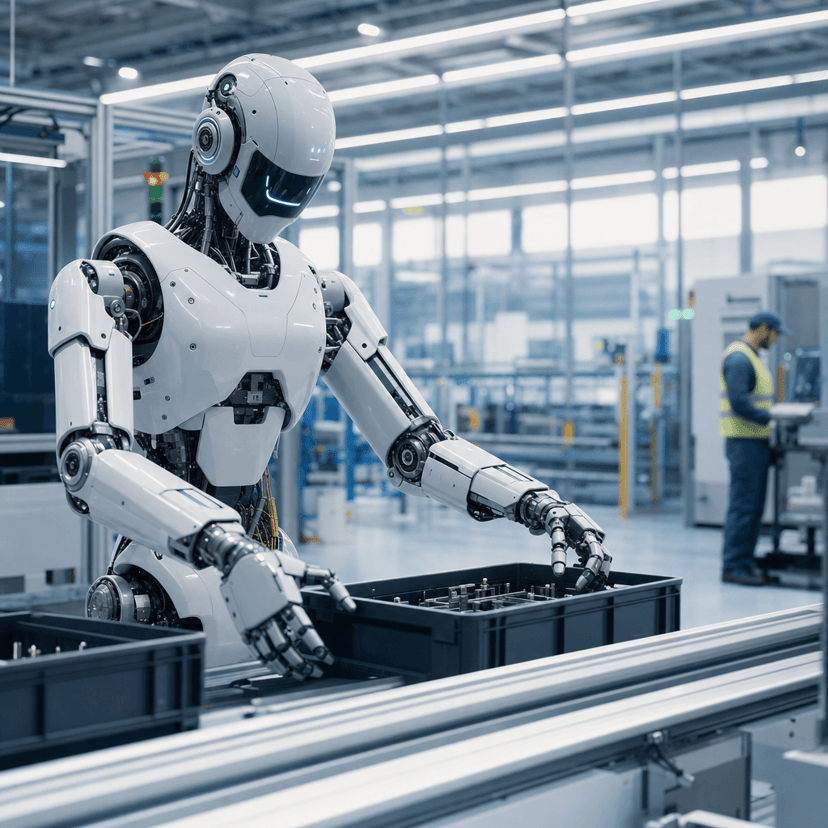
Standard Chartered is preparing to cut thousands of roles as artificial intelligence reshapes traditional banking operations, marking one of the first major workforce reductions by a UK-headquartered bank driven explicitly by AI adoption. The London-based lender plans to redeploy affected workers to other positions within the organization rather than outright layoffs, signaling how financial institutions are navigating the tension between automation efficiency and workforce preservation. This move comes as AI automation expands beyond tech giants into traditional finance, fundamentally changing how banks operate.
Standard Chartered just became the first major UK bank to announce thousands of job cuts explicitly tied to AI adoption, a watershed moment that signals automation's march from Silicon Valley into the heart of traditional finance. The London-headquartered banking giant is planning a significant workforce reduction as artificial intelligence takes over tasks that have defined banking careers for decades.
But here's where Standard Chartered is charting a different course from the tech sector's recent playbook. Instead of straight layoffs like those that hit Meta and other tech companies earlier this year, the bank says it aims to move affected workers to other roles within the business. It's a corporate tightrope walk that acknowledges AI's efficiency gains while trying to soften the human impact.
The announcement comes as banks worldwide race to deploy AI across operations from customer service to risk assessment. JPMorgan Chase recently revealed its AI assistant is handling tasks equivalent to hundreds of thousands of hours of human work, while Goldman Sachs has been quietly automating significant portions of its trading operations. Standard Chartered's move suggests this trend is accelerating rather than slowing.
What makes this particularly significant is the scale and the candor. While banks have been automating for years, few have publicly connected workforce reductions directly to AI implementation at this magnitude. The thousands of roles targeted represent a meaningful chunk of Standard Chartered's global workforce, which spans 53 markets across Asia, Africa, and the Middle East.
The banking sector has been watching AI's impact on tech companies with a mix of interest and apprehension. When companies like Microsoft and Google announced AI-driven restructuring, it was seen as a tech-sector phenomenon. Standard Chartered's announcement makes clear that no industry is immune to this transformation.
Industry analysts point to several factors driving this shift. AI tools can now handle everything from processing loan applications to detecting fraud patterns to managing customer inquiries, tasks that once required armies of human workers. The cost savings are substantial, but so are the productivity gains. Banks can process more transactions, serve more customers, and manage more complex risk assessments with fewer people.
The internal redeployment strategy Standard Chartered is promising faces real challenges. Banking jobs eliminated by AI tend to be administrative and operational roles, while the positions banks are creating skew heavily toward data science, AI engineering, and advanced analytics. That's not a simple skills transfer, and it raises questions about how many affected workers can realistically transition to new roles without significant retraining.
This announcement also comes at a sensitive time for UK banking. The sector is already under pressure from regulators about branch closures and reduced service in rural areas. Adding thousands of job cuts, even with redeployment plans, will likely intensify scrutiny from both regulators and politicians concerned about employment in the financial services sector.
What we're seeing is the collision of two powerful forces: AI's undeniable capability to automate knowledge work, and the social and economic reality that millions of people currently do that work. Standard Chartered's approach, offering redeployment rather than layoffs, might become a template for other financial institutions facing the same pressure to automate.
The timing suggests banks see AI automation as an immediate priority, not a future consideration. Standard Chartered isn't talking about a five-year plan but appears to be moving now, which implies the AI systems replacing human workers are already tested and ready to deploy at scale.
Standard Chartered's announcement marks a pivotal moment in AI's expansion beyond tech companies into traditional industries. The bank's attempt to balance automation efficiency with workforce preservation through internal redeployment will be closely watched by other financial institutions facing similar pressures. Whether this approach can successfully transition thousands of workers from automated roles to new positions remains to be seen, but the message is clear: AI-driven workforce transformation is no longer a tech sector phenomenon but a reality reshaping industries across the economy. Other banks will likely follow with their own announcements in coming months, making Standard Chartered's redeployment strategy a potential blueprint or cautionary tale for the broader financial services industry.