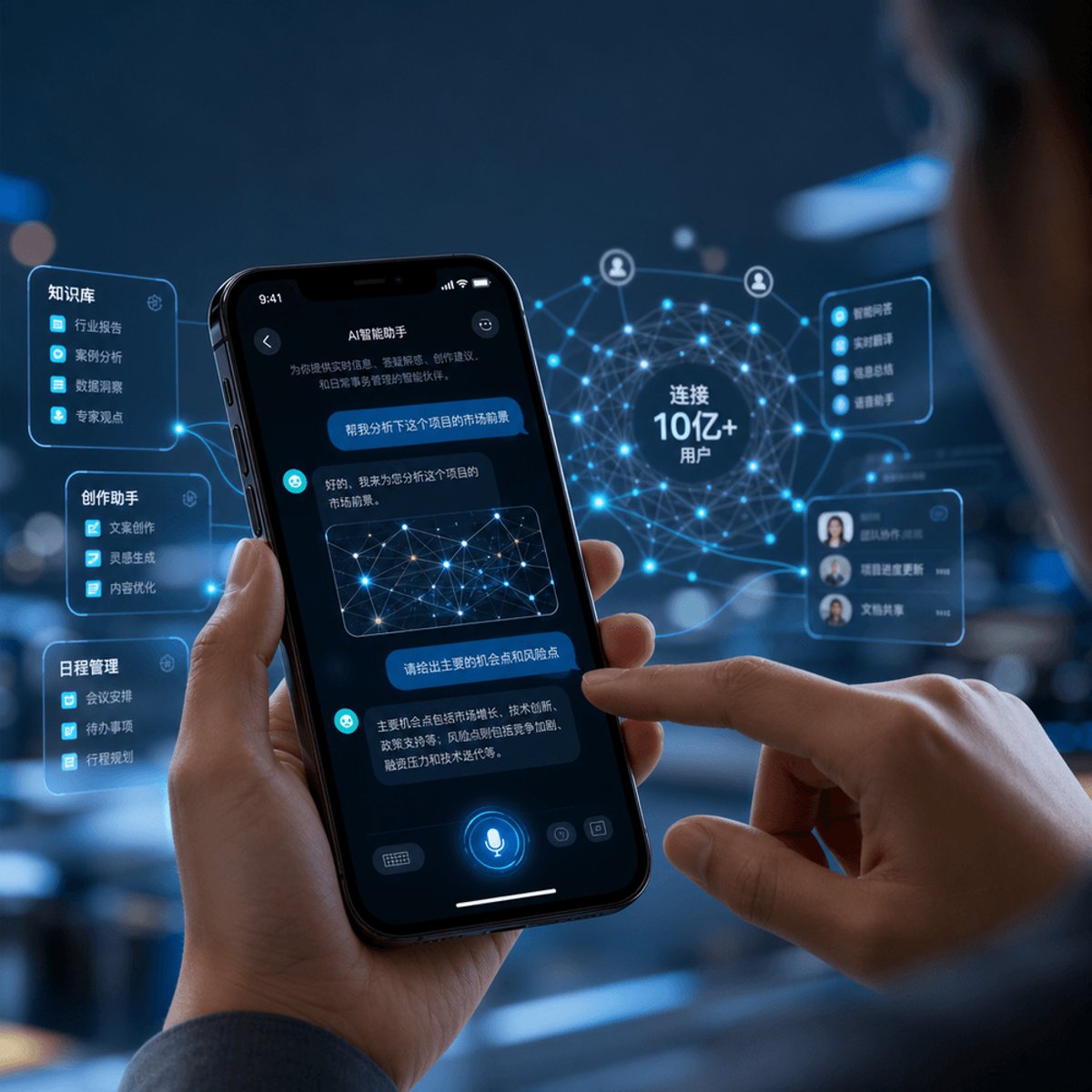
Tencent is rolling out an AI assistant inside WeChat, plugging artificial intelligence directly into the daily routines of over a billion Chinese users. The move marks a critical escalation in China's AI arms race, where the company has lagged behind rivals like Alibaba and ByteDance. By embedding the feature into the country's most essential super-app – used for everything from messaging to payments to government services – Tencent is betting it can turn distribution advantage into AI dominance.
Tencent just made its biggest AI bet yet, and it's happening inside an app that already lives on nearly every smartphone in China. The company is testing an artificial intelligence assistant embedded directly into WeChat, the messaging platform that's become as essential to Chinese life as electricity or running water.
The stakes couldn't be higher. While Tencent fumbled its early AI strategy, competitors sprinted ahead. Alibaba's Tongyi Qianwen has been processing queries for enterprise clients since early 2023. ByteDance's Doubao assistant racked up 47 million monthly users by the end of 2025, according to data from QuestMobile. Baidu's Ernie Bot integrated into search months before Tencent had a consumer-facing product.
But Tencent has something none of them possess: WeChat's 1.34 billion monthly active users, reported in the company's Q1 2026 earnings. That's not just a messaging app. It's China's everything app – the platform where people chat with friends, pay for groceries, book doctor appointments, file taxes, and hail rides. Plugging an AI assistant into that ecosystem is like giving it a direct line to the daily behavior patterns of a fifth of humanity.
The AI assistant is currently in limited testing, appearing as a conversational interface within WeChat's existing mini-program framework. Users can ask questions, get recommendations, and interact with the assistant without leaving the app. The technology reportedly draws on Tencent's Hunyuan large language model, which the company open-sourced in September 2025 in a bid to catch up with competitors who'd already released their foundation models.
"WeChat's distribution advantage is unmatched, but Tencent's been playing catch-up on the AI capability side," one Beijing-based AI researcher told analysts during a recent briefing. The company's delayed entry into the generative AI race stemmed partly from regulatory caution and partly from internal debates about how aggressively to pursue the technology.
Now it's racing to close that gap. The WeChat integration follows Tencent's pattern of leveraging its platform dominance to drive adoption – the same playbook it used to make WeChat Pay a ubiquitous payment method and mini-programs a $240 billion ecosystem. But AI presents different challenges. Unlike payments, where convenience drives adoption, AI assistants need to be genuinely useful to stick.
The competitive landscape in China looks nothing like the West's OpenAI-versus-everyone dynamic. Chinese tech giants are locked in a multi-front war spanning consumer chatbots, enterprise solutions, and specialized vertical AI. Alibaba leads in cloud-based enterprise AI. ByteDance dominates consumer engagement through Doubao's integration with Douyin (the Chinese TikTok). Baidu owns search integration. Tencent's advantage lies in its social graph and transaction data – the behavioral patterns that flow through WeChat's billion-plus user interactions daily.
That data could prove decisive. While competitors train models on web scraping and synthetic data, Tencent has real-time access to how Chinese consumers actually communicate, shop, and make decisions. The company's Hunyuan model, trained on this proprietary dataset, could offer contextual understanding that generic models can't match.
But there's risk too. WeChat users notoriously resist feature bloat – they want the app to remain fast and simple. Tencent killed its video Stories feature in 2019 after users ignored it. The company's Channels short-video feed took years to gain traction. An AI assistant that feels intrusive or unhelpful could face the same fate, no matter how sophisticated the underlying technology.
Regulatory scrutiny adds another layer of complexity. Chinese authorities have tightened controls on AI systems, requiring algorithm registrations and content filtering. Any AI assistant operating at WeChat's scale will face intense oversight, potentially limiting how freely it can respond to user queries. Tencent will need to balance AI capability with regulatory compliance – a tension that's already slowed rollouts across the industry.
The timing suggests urgency. ByteDance's Doubao recently crossed 50 million users and is expanding into enterprise markets. Alibaba just announced deeper Tongyi integration across its e-commerce platforms. Baidu's Ernie is powering autonomous driving systems. Tencent can't afford to sit out the AI race when it's being fought on every front from consumer apps to industrial automation.
Financial pressure is mounting too. Tencent's revenue growth has slowed as gaming regulations tightened and advertising spending softened. The company reported 8% revenue growth in Q1 2026, respectable but far from the double-digit expansion of previous years. AI represents both a defensive necessity – protecting WeChat's relevance as competitors add intelligent features – and an offensive opportunity to unlock new revenue streams through premium AI services.
The WeChat AI assistant test is limited for now, but the infrastructure implications are massive. Serving AI queries to even a fraction of WeChat's user base requires enormous computing resources. Tencent has been quietly building out GPU clusters and investing in AI infrastructure, according to supply chain reports from Taiwanese semiconductor firms. The company's capital expenditure jumped 34% year-over-year in 2025, much of it directed at AI-related hardware.
What happens next depends on user reception and competitive response. If the AI assistant proves genuinely useful – helping users book services, answer questions, or navigate WeChat's sprawling feature set – Tencent could rapidly scale it across the platform. If it flops, the company risks falling further behind in an AI race that's reshaping China's entire tech landscape.
Tencent's WeChat AI assistant test isn't just another product launch – it's a high-stakes attempt to convert the company's distribution dominance into AI leadership. With over a billion users already living inside WeChat's ecosystem, Tencent has the reach competitors can't match. But reach means nothing if the technology disappoints or users reject another feature addition. The next few months will reveal whether Tencent can turn its platform advantage into AI relevance, or whether it's arrived too late to a race that's already been won by faster-moving rivals. For China's AI landscape, the outcome will determine whether super-app distribution still matters in an era when intelligence, not just convenience, drives user loyalty.