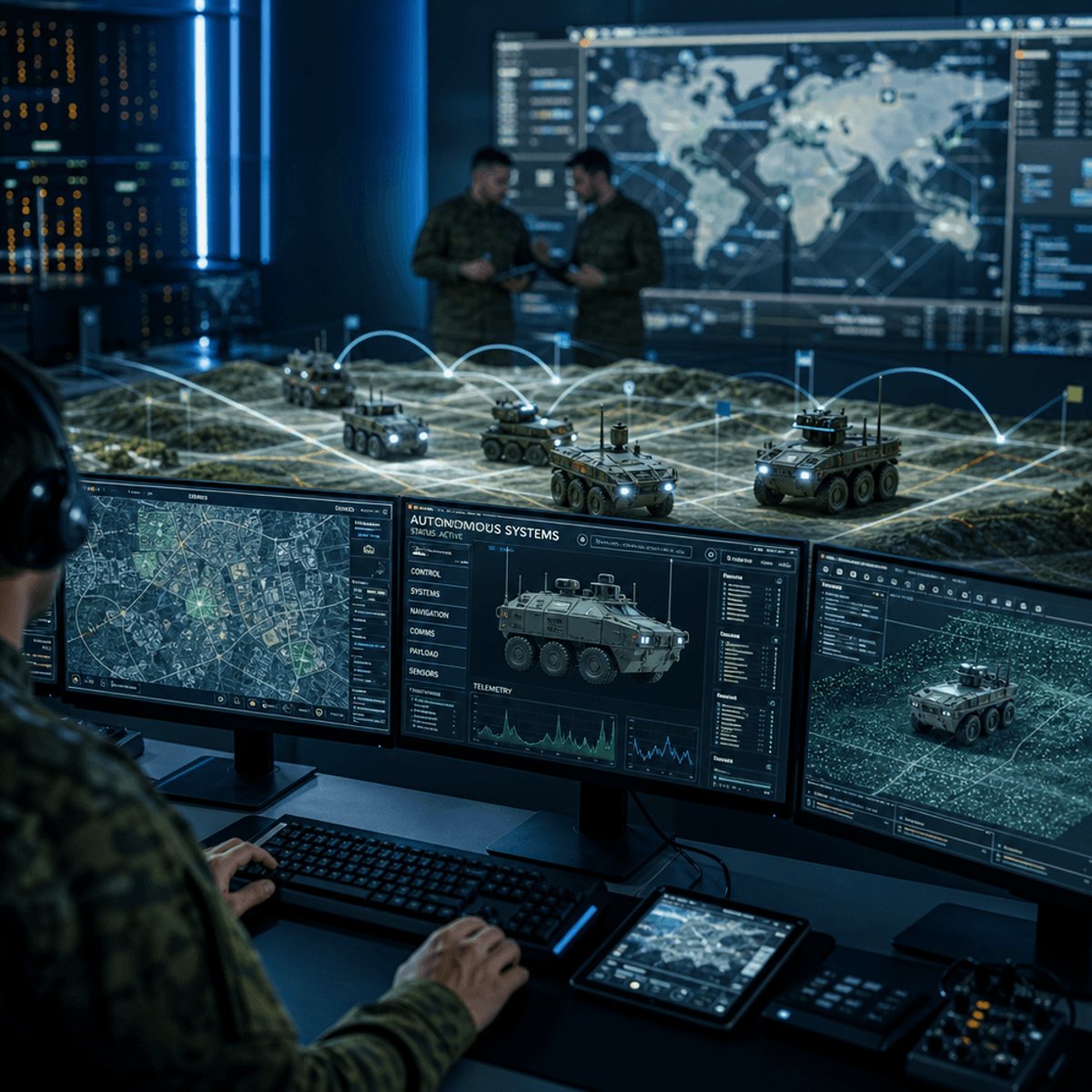
American autonomous vehicles just entered their first real battlefield. Forterra, a Pittsburgh-based robotics startup, has quietly deployed over 100 AI-powered ground vehicles to Ukraine, marking a watershed moment for military autonomy. The move, exclusively reported by TechCrunch, represents the first time US-made autonomous ground systems have seen active combat—a development that could reshape modern warfare and accelerate the Pentagon's push toward robotic force multiplication.
Forterra just crossed a line that's been years in the making. The company's autonomous ground vehicles are now operating in Ukraine's combat zones, handling missions that range from logistics runs through contested territory to reconnaissance sweeps where sending human soldiers would be suicide. It's the kind of deployment that defense analysts have been predicting since drones first changed the calculus of modern warfare—but it's happening faster than most expected.
The timing isn't accidental. Ukraine has become the world's most intense laboratory for military technology, where systems get tested under conditions no simulation can replicate. While Turkish Bayraktar drones grabbed headlines early in the conflict, ground autonomy has been the harder problem to crack. Forterra's breakthrough suggests they've solved challenges around navigation in GPS-denied environments, decision-making under fire, and the kind of reliability that keeps soldiers alive.
Forterra's technology builds on years of work that started in the commercial autonomous vehicle space before pivoting hard toward defense applications. The company's AutoDrive system can retrofit existing military vehicles, turning legacy platforms into remotely operated or fully autonomous units without requiring entirely new vehicle designs. That adaptability matters enormously when you're trying to scale deployment in an active war zone where every asset counts.
The deployment scale—over 100 units—indicates this isn't a small pilot program or publicity stunt. That's enough vehicles to support multiple Ukrainian brigade-level operations simultaneously, suggesting Forterra has overcome the production and support challenges that typically strangle defense tech at the prototype stage. For context, most defense startups struggle to deliver more than a handful of experimental units within their first few years of real-world testing.
What makes this moment particularly significant is how it positions American defense technology against competitors. China's military modernization has emphasized unmanned systems heavily, while Russia has deployed its own ground robots in Ukraine with mixed results. Forterra's successful large-scale deployment gives the US and its allies a tangible edge in what's becoming an autonomous arms race—one where software and AI increasingly matter more than traditional military hardware.
The Pentagon has been pushing toward greater autonomy across all domains, but ground vehicles have lagged behind aerial drones due to the complexity of terrestrial navigation and the political sensitivity around armed robots. Ukraine's willingness to field these systems operationally—and Forterra's apparent success in supporting them—could accelerate timelines for US military adoption dramatically. Defense Department acquisition officials are notoriously risk-averse, but combat-proven technology changes that equation fast.
For Forterra, this deployment represents both validation and enormous pressure. Every mission generates data about how autonomous systems perform when lives are on the line, information that's worth its weight in gold for future development and sales. But it also means any failures will be scrutinized intensely by critics who worry about autonomous weapons and the ethics of delegating lethal decisions to machines.
The competitive implications ripple outward quickly. Defense contractors like Lockheed Martin, Northrop Grumman, and General Dynamics have their own autonomous vehicle programs, but Forterra's first-mover advantage in real combat could prove decisive in upcoming procurement battles. The company's ability to deploy at scale while maintaining operational security until now also signals sophisticated program management that larger, slower-moving defense primes often struggle to match.
Ukraine's embrace of cutting-edge military technology has created unexpected opportunities for startups willing to move fast and take risks that traditional defense acquisition cycles wouldn't allow. Palantir has provided battlefield intelligence software, SpaceX's Starlink has kept communications running, and now Forterra is proving autonomous ground systems work under fire. This pattern suggests the future of defense innovation might look more like Silicon Valley partnerships than Cold War-era programs that took decades to field.
The operational details of how Forterra's vehicles are being used remain closely guarded, likely for good reason. Revealing tactical employment methods or technical capabilities would hand adversaries a roadmap for countermeasures. But the mere fact of deployment at this scale answers a question the defense community has been asking for years: can autonomous ground vehicles actually handle real combat, or are they just expensive science projects? Forterra's answer appears to be an emphatic yes.
Forterra's deployment marks the moment autonomous ground warfare moved from theory to reality. Over 100 vehicles operating in one of the world's most dangerous combat zones represents a technical achievement, but it's also a preview of how future conflicts will be fought. As battlefield data flows back and the technology proves itself under fire, expect the Pentagon to accelerate procurement timelines and competitors to scramble for their own combat validation. The line between experimental robotics and standard military equipment just got a lot blurrier, and there's no going back.