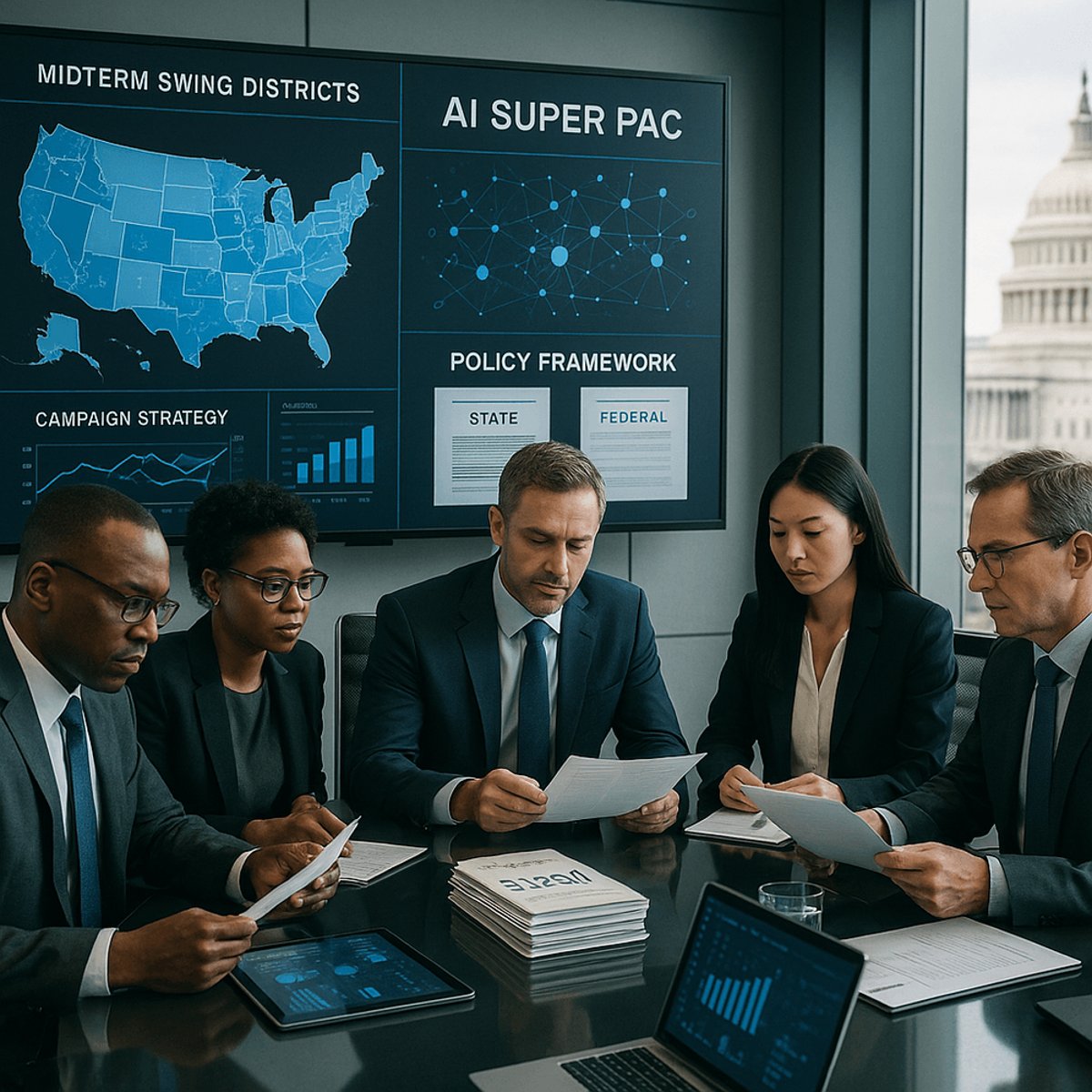
A new political action committee backed by Silicon Valley's AI elite just dropped $125 million into the 2026 midterms, making it one of the most well-funded industry lobbying efforts in recent memory. Leading the Future, which launched last summer with backing from OpenAI, Andreessen Horowitz, and Palantir founders, is deploying its war chest to elect candidates who'll champion a single federal AI framework instead of the state-by-state patchwork currently taking shape. With $70 million still on hand and races already targeted, the group is betting big that Washington can be convinced to preempt state regulators before it's too late.
Silicon Valley just wrote a $125 million check to reshape how America regulates artificial intelligence. Leading the Future, a bipartisan super PAC formed in summer 2025, disclosed the massive fundraising haul ahead of its first official campaign finance filing, according to CNBC. The group still has $70 million in the bank and has already started spending in competitive 2026 midterm races.
The donor list reads like a who's who of AI power players. Andreessen Horowitz, the venture capital firm that's poured billions into AI startups, contributed alongside OpenAI co-founder Greg Brockman, Palantir co-founder Joe Lonsdale, legendary angel investor Ron Conway of SV Angel, and AI search startup Perplexity. It's a rare show of unity from competitors who typically battle over talent and market share but now see an existential threat in fragmented regulation.
The urgency comes from watching states move faster than Congress. New York recently passed comprehensive AI legislation covering everything from algorithmic accountability to deepfake disclosure. California, Massachusetts, and Colorado are advancing their own bills. Industry leaders warn this creates an impossible compliance maze - imagine building AI systems that have to navigate 50 different state rulebooks, each with conflicting requirements for transparency, testing, and liability.
"Leadership in AI innovation will define economic growth, national security, and America's role in the global economy, and lawmakers can't afford to be distracted by demagoguery that would cause us to fall behind," political strategists Zac Moffatt and Josh Vlasto, who lead the PAC, said in a statement to CNBC. "Candidates who grasp the stakes can expect us to help elevate that message."
The group isn't waiting for perfect candidates to emerge - it's actively shaping races now. Leading the Future is spending against Alex Bores, a Democrat running for a Manhattan congressional seat who championed New York's AI law as a state legislator. Meanwhile, the PAC is backing Chris Gober, a Republican candidate in Texas who's signaled openness to federal preemption of state rules. The willingness to play in both parties' primaries shows how seriously the industry takes this fight.
This strategy mirrors tactics from the crypto industry, which spent over $100 million in 2024 elections through Fairshake and related PACs, successfully electing pro-crypto candidates and defeating skeptics. But the AI industry's $125 million opening salvo dwarfs even that effort, and we're still 10 months from Election Day.
Leading the Future operates alongside Build American AI, a connected advocacy group that launched a separate $10 million campaign to lobby lawmakers directly for uniform national policy. The two-pronged approach - electing friendly faces while lobbying current members - maximizes influence both short and long term.
The pitch to voters will likely emphasize American competitiveness against China, which has taken a more centralized approach to AI development and regulation. Tech leaders argue that while Beijing moves fast with unified policy, the U.S. risks hamstringing its AI sector with bureaucratic complexity. It's an argument that resonates across party lines, particularly in swing districts where jobs and innovation play well.
But critics worry this flood of money will drown out voices calling for stronger AI safeguards. Consumer advocates, labor unions, and AI ethics researchers have pushed for robust state-level protections around algorithmic bias, privacy, and job displacement. A federal law could preempt those efforts entirely if it sets a lower baseline than states wanted.
The full campaign finance filing, due soon, will reveal exactly how much each contributor gave and how the PAC has spent so far. Early ads opposing Bores have focused on painting state AI laws as job-killing overregulation. Expect that messaging to intensify as more competitive races take shape and the PAC deploys its remaining $70 million.
What happens in 2026 could set the template for AI governance for the next decade. If Leading the Future succeeds in electing a cohort of federal-preemption supporters, states will lose their ability to experiment with local approaches to AI accountability. If the PAC falls short despite its massive spending, it'll signal that voters care more about AI safety and oversight than Silicon Valley hoped.
The AI industry just placed its biggest political bet yet, and the outcome will determine whether artificial intelligence gets regulated by a single federal standard or a patchwork of state laws. With $70 million still in the bank and the midterms nine months away, Leading the Future has the resources to flood competitive races with messaging that frames national AI policy as a matter of American competitiveness. But whether voters - and ultimately lawmakers - buy that argument over concerns about algorithmic bias, privacy, and accountability remains the $125 million question. Watch for the full campaign finance filing in the coming days to see exactly which AI companies and investors are betting most heavily on a Washington solution.