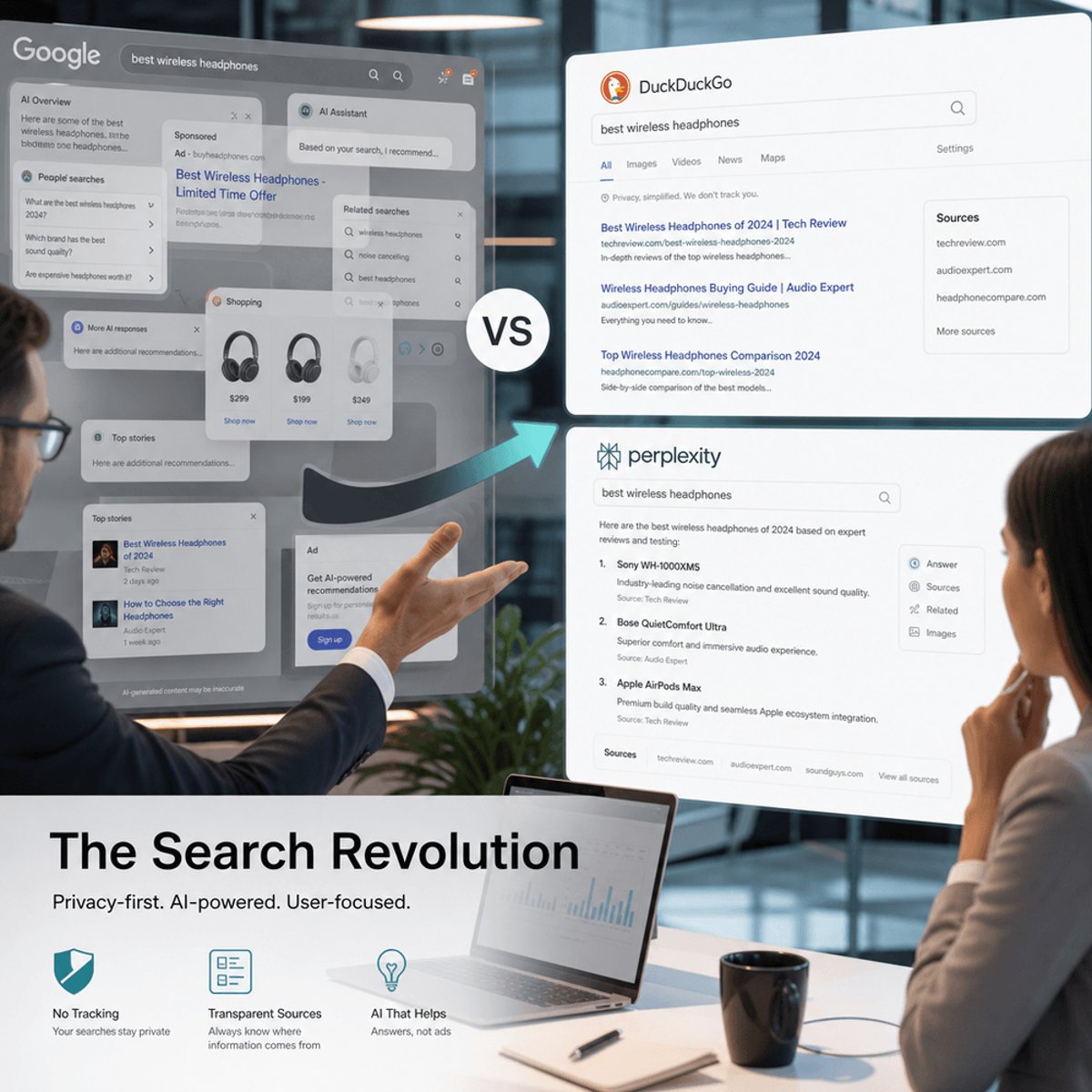
Google is losing its search crown, at least according to one telling experiment. A new hands-on comparison from ZDNet shows that pairing DuckDuckGo with Perplexity delivers noticeably better results than Google's increasingly cluttered, AI-generated answer boxes. The finding comes as Google's Search Generative Experience faces mounting criticism for surfacing low-quality AI content and burying traditional web results. For an industry built on Google's near-monopoly, the shift signals real trouble brewing in Mountain View.
Google just got beat at its own game. A detailed hands-on comparison from ZDNet reveals that switching from Google Search to a combination of DuckDuckGo and Perplexity delivers noticeably better results, cleaner interfaces, and fewer AI-generated distractions. The test couldn't come at a worse time for Google, which is doubling down on its Search Generative Experience even as users complain about declining quality.
The experiment tested real-world queries across categories like technical troubleshooting, product research, and news discovery. DuckDuckGo handled straightforward searches with clean, ad-light results, while Perplexity stepped in for complex questions that benefit from AI synthesis. The combination delivered what users actually wanted without the clutter of Google's increasingly aggressive AI answer boxes, which often bury traditional web links below the fold.
Google's problem isn't just aesthetic. The company's rush to integrate generative AI into search has backfired in quality terms. According to the ZDNet review, Google now surfaces what the tester called "a cesspool of AI-generated answers" that prioritize engagement over accuracy. The Search Generative Experience, which Google began rolling out widely in 2024, was supposed to keep users from clicking away to competitor sites. Instead, it's driving them to alternatives that respect their time and intelligence.
Perplexity has emerged as the standout beneficiary of Google's missteps. The AI-powered search engine, which raised over $500 million in funding through 2025, combines large language models with real-time web crawling to deliver sourced, conversational answers. Unlike Google's opaque AI summaries, Perplexity shows its work with inline citations and lets users drill into source materials. That transparency matters when AI hallucinations remain a persistent problem across the industry.
DuckDuckGo, meanwhile, is capitalizing on its privacy-first positioning just as Google faces renewed antitrust scrutiny. The search alternative doesn't track users, doesn't personalize results based on surveillance, and doesn't clutter pages with algorithmic guesses about what you might want. For the ZDNet tester, that simplicity proved refreshing after years of Google's feature creep and ad expansion.
The timing of this comparison matters. Google is fighting a two-front war against both traditional search competitors and AI-native upstarts like Perplexity and OpenAI's SearchGPT. The company's response has been to aggressively push AI features that users increasingly see as intrusive rather than helpful. Internal metrics may show higher engagement, but qualitative feedback suggests users are getting frustrated with the experience.
The competitive landscape is shifting fast. Microsoft integrated OpenAI's technology into Bing with mixed results, but Perplexity has carved out a niche by focusing purely on answer quality rather than trying to bolt AI onto an existing search infrastructure. DuckDuckGo, which passed 100 million daily queries in 2023, continues growing steadily as privacy concerns mount and Google's ad load increases.
What makes this test particularly damning for Google is that it comes from a mainstream tech publication, not privacy activists or tech enthusiasts. ZDNet's audience includes IT decision-makers and enterprise users who influence technology choices across organizations. If the narrative takes hold that Google Search has become bloated and unreliable, the company risks losing its most valuable users.
The "work smarter" framing in the review stings too. It positions Google as the inefficient legacy option and the DuckDuckGo-Perplexity combo as the savvy power-user alternative. That's exactly the kind of perception shift that can accelerate once it starts. Early adopters switch first, then they tell colleagues, and suddenly the default choice isn't so default anymore.
Google still commands over 90% global search market share, so reports of its demise remain greatly exaggerated. But the company's dominance has historically rested on delivering the best results, not just the most entrenched distribution. If quality continues eroding while alternatives improve, that dominance becomes vulnerable in ways it hasn't been since the early 2000s when Google itself disrupted Yahoo and AltaVista.
This isn't just another "Google killer" story that fizzles out in a few news cycles. The combination of DuckDuckGo's clean simplicity and Perplexity's intelligent synthesis represents a genuine alternative workflow that solves real problems Google created for itself. As AI-generated spam continues degrading search quality and users grow tired of wading through Google's algorithmic guesses, the path of least resistance may finally lead away from Mountain View. Google still has time to course-correct, but the window is closing as competitors prove you don't need to dominate 90% of the market to deliver 100% better results for users who care about quality over convenience.