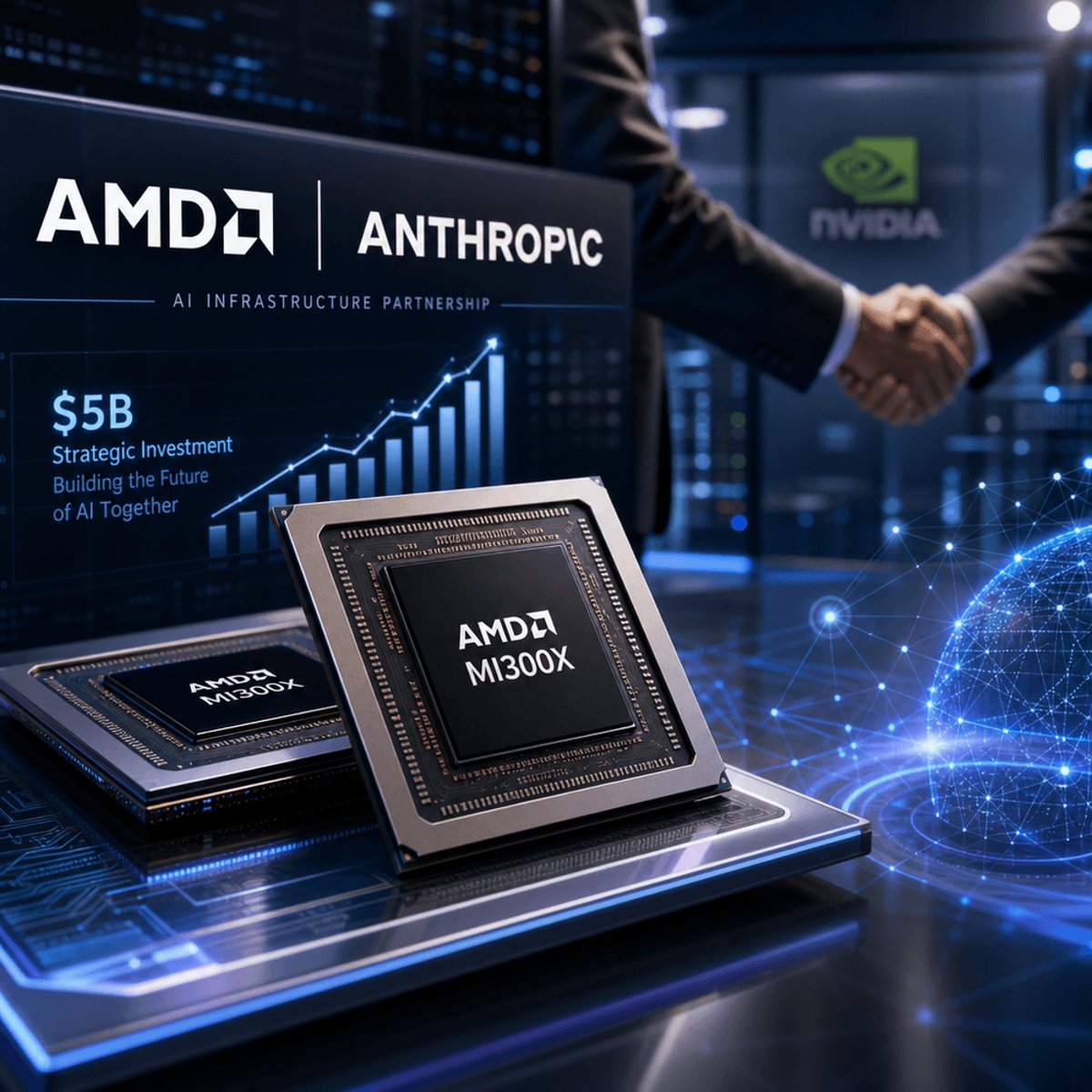
AMD just made its biggest bet on AI yet, committing up to $5 billion to Anthropic as part of a sweeping computing power deal. The partnership announced Wednesday positions AMD as a critical infrastructure player for one of OpenAI's fiercest rivals while taking direct aim at Nvidia's stranglehold on AI chips. For Anthropic, the deal solves an urgent problem - securing enough computing horsepower to train increasingly massive AI models as the company races to keep pace with competitors.
AMD is putting real money behind its AI ambitions. The chip giant's commitment of up to $5 billion to Anthropic represents one of the largest infrastructure investments in the AI sector this year, according to CNBC's report. The deal isn't just financial backing - it's a strategic partnership that ties Anthropic's rapidly growing compute needs directly to AMD's MI300 series accelerators and future chip roadmap.
The timing couldn't be more critical. Anthropic has been on an infrastructure shopping spree in 2026, scrambling to lock down the computing power necessary to train its Claude AI models. Training runs for frontier AI systems now require tens of thousands of chips running for months, with costs easily reaching hundreds of millions per model. The company's agreement with AMD follows similar capacity deals announced earlier this year, though sources familiar with the matter say this represents Anthropic's largest single commitment to a chip partner.
Nvidia has dominated AI training infrastructure since the generative AI boom began, with its H100 and newer H200 chips becoming nearly impossible to acquire without year-long waiting lists. That scarcity created an opening. AMD's MI300X accelerators have been gaining traction as companies desperate for compute capacity look beyond Nvidia's ecosystem. The Anthropic deal validates AMD's years-long effort to position itself as a credible alternative in enterprise AI workloads.
For AMD, this isn't just about selling chips. The investment structure appears designed to lock Anthropic into AMD's hardware stack for the long haul, potentially giving AMD crucial insights into what AI companies actually need from next-generation accelerators. That feedback loop could prove invaluable as AMD designs its MI400 and MI500 series chips. One industry analyst who requested anonymity noted that AMD is essentially paying for product validation at scale - something money usually can't buy.
The financial mechanics of the deal remain partly under wraps, but the "up to $5 billion" language suggests a phased investment tied to specific milestones or capacity commitments. It's likely structured as a combination of direct equity investment, infrastructure credits, and potentially revenue-sharing arrangements. This hybrid approach has become common in large-scale AI infrastructure deals where both parties want skin in the game.
Anthropic's compute appetite keeps growing. The company's Claude 3.5 model family already requires massive training infrastructure, and internal roadmaps reportedly call for even larger models in development. Unlike OpenAI, which has Microsoft's Azure infrastructure backing it, or Google's models trained on proprietary TPUs, Anthropic has needed to piece together capacity from multiple vendors. This AMD partnership provides crucial supply certainty as the company competes for enterprise customers.
The deal also signals shifting power dynamics in AI infrastructure. For years, chip availability determined which AI labs could compete at the frontier. Now we're seeing AI labs with sufficient capital effectively subsidizing chip development through massive purchase commitments and strategic investments. Amazon, already an Anthropic investor, is reportedly involved in facilitating some of the infrastructure deployment through AWS, though details remain scarce.
Competitive implications ripple across multiple markets. Nvidia investors shrugged off the news initially, but multi-billion dollar commitments to AMD represent real share loss in a market Nvidia has owned. For Anthropic, diversifying away from single-chip dependency reduces supply risk and potentially lowers costs through competitive leverage. And for the broader AI industry, it demonstrates that training infrastructure has become valuable enough to justify unprecedented capital deployment.
What makes this partnership particularly notable is the exclusivity it may create. While neither company has confirmed exclusive arrangements, infrastructure investments of this magnitude typically come with commitments that effectively lock out competitors. If Anthropic commits to training its next generation of models primarily on AMD hardware, that's a powerful reference customer for AMD's enterprise sales teams pitching Meta, Apple, and other AI developers.
The deal lands as AI infrastructure spending reaches fever pitch. Industry estimates suggest the top AI labs will collectively spend over $50 billion on computing infrastructure in 2026 alone. That's created a land grab mentality where securing long-term capacity matters more than short-term pricing. AMD appears to be capitalizing on that urgency, using its balance sheet to buy its way into training workloads that were nearly impossible to crack just two years ago.
AMD's $5 billion commitment to Anthropic marks a watershed moment in AI infrastructure competition. It proves that chip challengers can use capital and strategic partnerships to crack Nvidia's dominance, while giving Anthropic the supply certainty it desperately needs to compete with better-funded rivals. But the real winner might be the broader AI industry - more chip diversity means less supply risk, more competitive pricing, and innovation that comes from vendors actually competing for business. As model sizes continue exploding and training costs spiral upward, expect more of these mega-deals that blur the lines between chip vendor, infrastructure partner, and strategic investor. The AI infrastructure wars are just getting started, and they're being fought with billion-dollar checks.