AMD shares tumbled in after-hours trading despite notching a remarkable 132% gain year-to-date, as CEO Lisa Su fielded pointed questions about Elon Musk's public commitment to Nvidia chips. The earnings call revealed a company riding the AI wave while navigating an increasingly crowded battlefield where customer loyalties and CEO tweets can move markets. Su's measured response to the Musk situation underscored the high-stakes nature of the data center chip wars, where every major tech purchase becomes headline news.
AMD CEO Lisa Su found herself in an unusual position during the company's Q2 2026 earnings call - defending her chip empire not against quarterly metrics, but against a billionaire's tweet. The stock dropped in extended trading even as the company posted another quarter of explosive growth fueled by insatiable demand for AI accelerators, highlighting how quickly narratives can shift in the high-stakes semiconductor wars.
The moment came when analysts pressed Su about recent comments from Elon Musk, who publicly reaffirmed his commitment to Nvidia GPUs for Tesla's AI training infrastructure and his xAI ventures. Su brushed off the competitive theatrics with characteristic poise, according to analysts on the call, focusing instead on AMD's expanding customer base and record design wins across cloud providers and enterprise customers.
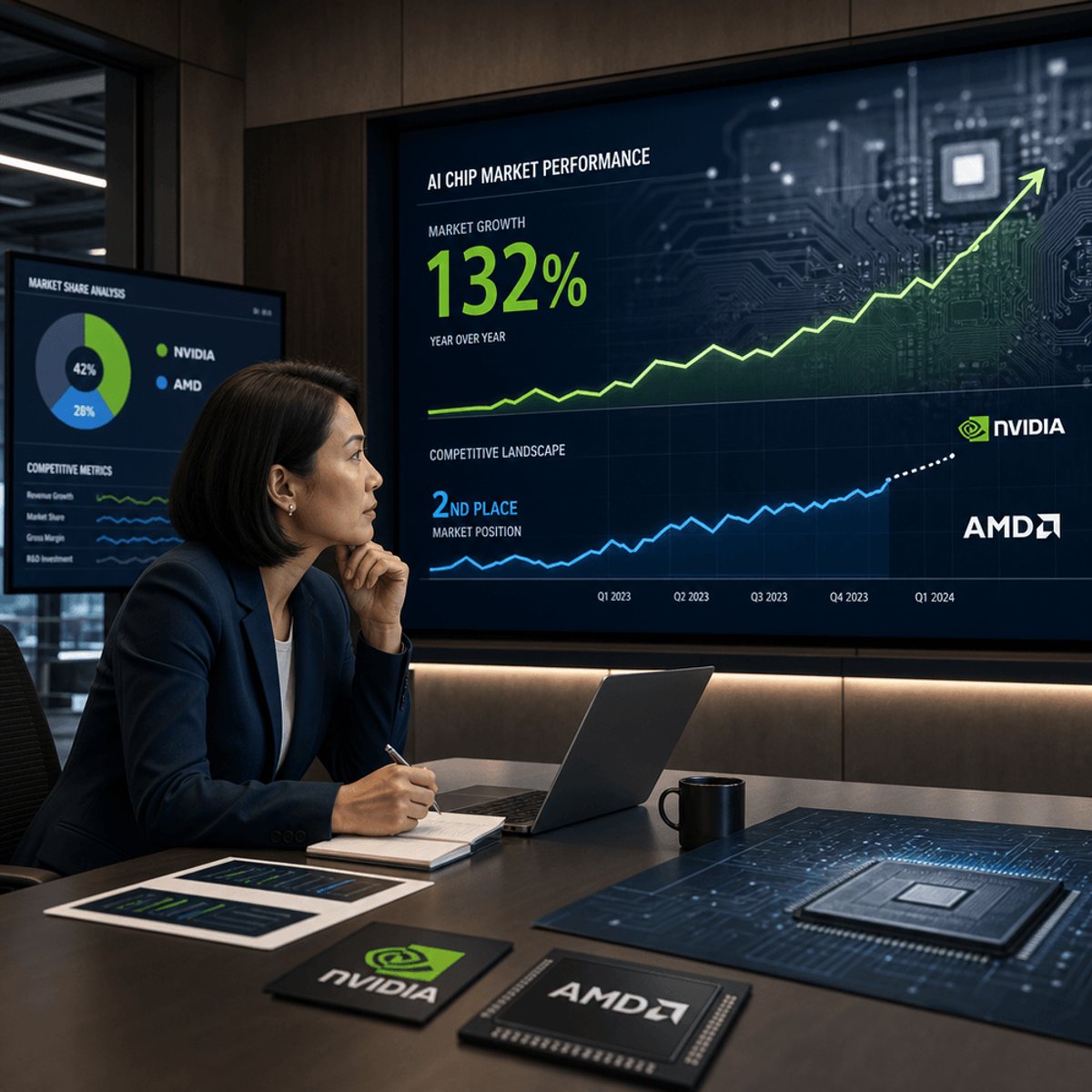
But the market's reaction told a different story. Despite AMD stock trading up 132% in 2026 - a performance that would normally trigger champagne corks - shares slipped as investors digested the implications of remaining a distant second to Nvidia in the most lucrative segment of the chip market. The disconnect between AMD's stellar year-to-date performance and the post-earnings selloff reveals the pressure the company faces to prove it can sustainably chip away at Nvidia's stranglehold on AI training workloads.
AMD has positioned itself as the scrappy alternative to Nvidia's premium-priced GPUs, particularly with its MI300 series accelerators that target cost-conscious hyperscalers looking to diversify their supply chains. The strategy has worked - to a point. Cloud giants including Microsoft, Google, and Amazon Web Services have all publicly committed to deploying AMD's AI chips, driven partly by performance improvements and partly by a desire to avoid single-vendor lock-in with Nvidia.
Yet Musk's comments, however offhand, underscore the loyalty Nvidia commands among the most demanding AI customers. When you're training frontier models or building autonomous vehicle systems, the thinking goes, you don't experiment with alternatives. Nvidia's CUDA software ecosystem and proven track record in AI workloads create switching costs that go beyond raw chip specifications.
Su's response during the earnings call reflected this reality without conceding ground. She emphasized AMD's focus on total cost of ownership, energy efficiency, and the growing importance of inference workloads - where AMD believes it can compete more effectively than in raw training performance. The company has been particularly bullish about AI inference, the process of running trained models in production, which represents a larger and faster-growing market than training itself.
The Q2 results themselves painted a company firing on most cylinders. AMD's data center segment continues to surge as enterprises retrofit their infrastructure for AI workloads, while the company's traditional CPU business benefits from a refresh cycle in servers and PCs. The 132% stock appreciation reflects genuine business momentum, not just market hype around anything AI-related.
But investors are forward-looking, and the after-hours decline suggests concerns about whether AMD can maintain its growth trajectory as the AI infrastructure buildout matures. Nvidia remains the 800-pound gorilla, with market share estimates in AI training chips hovering around 80-90% depending on the analyst. AMD's gains, while significant, largely come from a market expanding so rapidly that even scraps represent billions in revenue.
The Musk situation also highlights how customer concentration risk works both ways in the chip industry. While Nvidia enjoys fierce loyalty from major customers, it also means any single defection makes headlines. AMD doesn't need to win every customer - it needs to win enough to sustain its growth narrative and keep pressure on Nvidia's pricing power.
Su has proven adept at playing the long game. Her turnaround of AMD from near-bankruptcy to chip powerhouse over the past decade ranks among the great CEO success stories in tech. The company's strategy of designing competitive products, pricing aggressively, and capitalizing on competitor missteps has worked in CPUs against Intel and in GPUs against Nvidia in gaming and professional graphics.
Whether that playbook translates to AI accelerators remains the multi-billion dollar question. The market is large enough for multiple winners, but being a distant second in a winner-take-most market doesn't command the same valuation multiples as the category leader. AMD's challenge is converting its AI chip sales from a nice-to-have hedge for cloud providers into a must-have architecture that developers and enterprises actively prefer.
The earnings call revealed a company confident in its product roadmap and customer pipeline, even as it navigates the noise from competitors and their high-profile backers. Su's dismissal of the Musk comments wasn't arrogance - it was a CEO signaling that AMD is focused on execution, not Twitter drama.
AMD's post-earnings stock decline despite a blockbuster year captures the peculiar dynamics of the AI chip wars, where narrative matters as much as numbers. Su's dismissal of Musk's Nvidia loyalty may prove prescient if AMD continues winning cloud deployments and inference workloads, or it may underscore the difficulty of dislodging an entrenched leader with deep ecosystem advantages. Either way, the market has made clear that being a strong second place in AI chips doesn't command the same premium as being first - and AMD has work to do to change that perception, 132% gains notwithstanding. Investors will be watching whether the company's next-gen roadmap and customer wins can shift the conversation from catching up to pulling ahead.