Amazon just dropped its biggest AI bet yet at re:Invent 2025, unveiling autonomous agents that can code independently for days and a new Trainium3 chip promising 4x performance gains. The Las Vegas conference reveals Amazon's strategy to dominate enterprise AI by giving customers unprecedented control over their AI infrastructure, from custom model building to data sovereignty solutions.
Amazon Web Services is betting big that autonomous AI agents will finally unlock the "true value" of artificial intelligence for enterprise customers. At the company's flagship re:Invent conference in Las Vegas, AWS CEO Matt Garman doubled down on this vision, announcing a suite of AI agents that can work independently for days and new chip architectures that promise to shake up the AI training market.
The headliner is Kiro autonomous agent, one of three new "Frontier agents" that AWS claims can learn how development teams work and then operate largely unsupervised for hours or even days. "AI assistants are starting to give way to AI agents that can perform tasks and automate on your behalf," Garman told the packed keynote audience. "This is where we're starting to see material business returns from your AI investments."
The timing couldn't be more strategic. While competitors like Microsoft and Google focus on AI assistants that require constant human oversight, Amazon is positioning itself as the platform for truly autonomous enterprise AI. The other two Frontier agents handle security processes like code reviews and DevOps tasks such as incident prevention during code deployments.
But it's the hardware announcements that reveal Amazon's long-term play against Nvidia. The new Trainium3 chip promises up to 4x performance gains for both AI training and inference while slashing energy consumption by 40%. More intriguingly, Amazon CEO Andy Jassy revealed on X that the current Trainium2 generation is already generating "multi-billion dollar" revenue, suggesting Amazon's chip strategy is gaining real traction with enterprise customers.
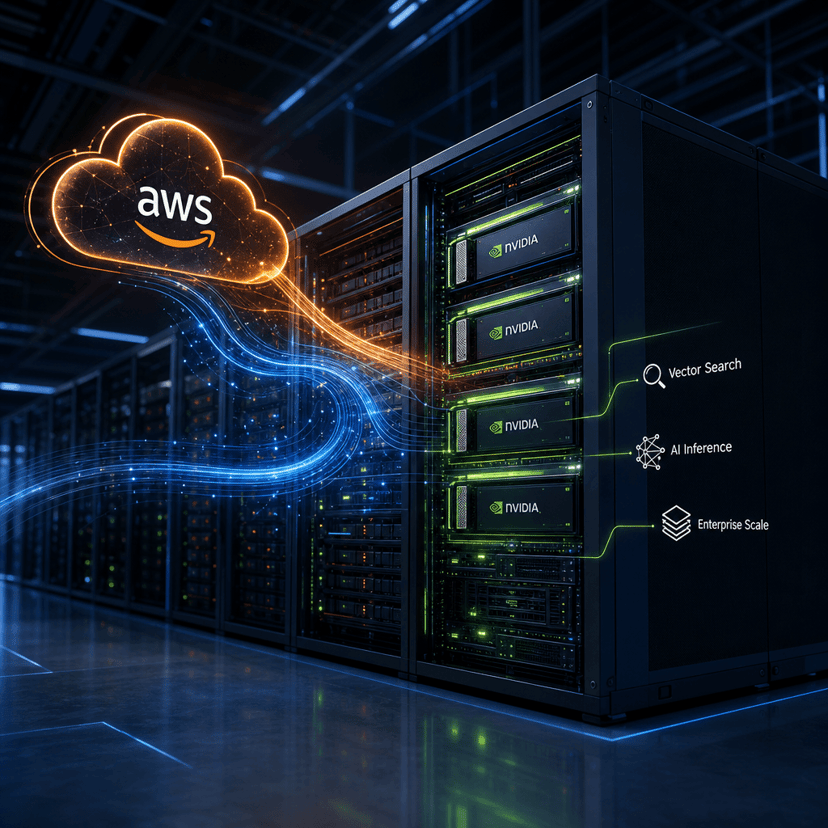
The company also teased Trainium4, which is being designed to support NVIDIA NVLink Fusion high-speed chip interconnect technology and will work seamlessly within common MGX racks alongside GPU servers. This is a clear signal that Amazon wants to give customers flexibility while building its own silicon empire. This dual approach through AI Factories, developed in partnership with Nvidia, allows enterprises and governments to run AWS AI systems in their own data centers using either Nvidia GPUs or Amazon's Trainium3 chips.
"We are living in times of great change," Swami Sivasubramanian, AWS's vice president of Agentic AI, told the conference. "For the first time in history, we can describe what we want to accomplish in natural language, and agents generate the plan. They write the code, call the necessary tools and execute the complete solution."
The enterprise focus extends beyond agents to fundamental infrastructure improvements. AWS finally addressed years of customer pricing complaints by launching Database Savings Plans, offering up to 35% cost reductions for customers who commit to consistent usage over one-year terms. Cloud economist Corey Quinn summed up the industry reaction in a blog post titled "Six years of complaining finally pays off."
For startups, Amazon is taking a more aggressive approach to compete with established AI coding tools. The company announced it will give away free Kiro Pro+ credits for a full year to qualified early-stage startups, though eligibility is limited to certain countries and requires applications before month-end.
The model customization announcements reveal Amazon's broader strategy to democratize AI development. New capabilities in Amazon Bedrock and SageMaker AI include serverless model customization that eliminates infrastructure concerns and Reinforcement Fine Tuning that automates the entire customization process. The Nova AI model family expanded with four new models, including one that generates both text and images, while Nova Forge gives customers access to pre-trained models they can customize with proprietary data.
Real-world validation came from customers like Lyft, which reported that its AI agent built on Anthropic's Claude via Amazon Bedrock reduced average resolution time by 87% and saw 70% increased driver usage this year. These metrics provide concrete evidence that enterprise AI agents are moving beyond proof-of-concept to measurable business impact.
The AgentCore platform received significant upgrades, including Policy features that help developers set AI agent boundaries and memory capabilities that let agents remember user preferences. AWS also introduced 13 prebuilt evaluation systems to help customers assess agent performance - addressing a key concern about AI reliability in enterprise environments.
Amazon's re:Invent 2025 represents a pivotal moment in enterprise AI adoption. By combining autonomous agents that can work independently for days with cost-effective infrastructure improvements and flexible deployment options, AWS is positioning itself as the platform where enterprises can finally see meaningful returns from AI investments. The real test will be whether these autonomous agents can deliver on their promises in production environments, but early customer results like Lyft's 87% improvement in resolution times suggest Amazon may have found the formula that makes AI indispensable for enterprise operations.