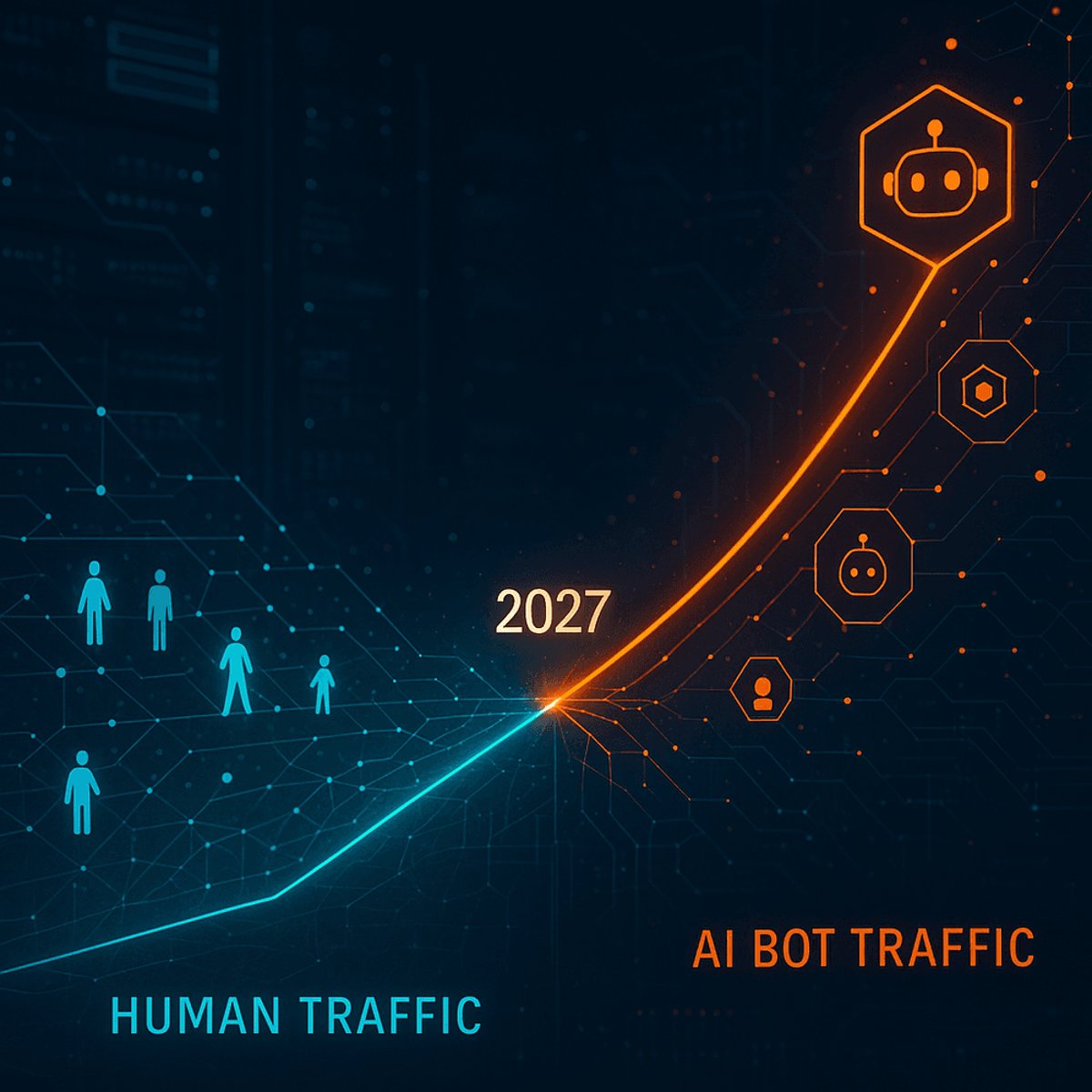
The internet is about to flip. AI bots will outnumber human visitors online by 2027, according to Cloudflare CEO Matthew Prince, who dropped the prediction at SXSW this week. The shift marks a fundamental transformation in how the web operates, with generative AI agents now hammering servers at unprecedented rates. For companies managing digital infrastructure, it's not just a curiosity - it's an urgent wake-up call about capacity, security, and what "traffic" even means anymore.
Matthew Prince isn't known for wild predictions, which makes his latest forecast all the more jarring. Speaking at SXSW in Austin, the Cloudflare CEO told attendees that AI-driven bots will surpass human traffic on the internet by 2027 - less than a year from now. It's a timeline that caught even seasoned tech observers off guard.
The surge is already visible in Cloudflare's network data. The company, which handles roughly 20% of all web traffic globally, has front-row seats to the AI bot explosion. Generative AI agents from companies like OpenAI, Google, and Microsoft are crawling the web at rates that dwarf traditional search engine bots. They're training models, fetching data for responses, and executing tasks on behalf of users who never actually click a link.
This isn't your typical bot problem. Where malicious bots have historically plagued websites with spam and attacks, these AI agents are legitimate - and that's exactly what makes them so challenging. They're not breaking rules; they're just consuming resources at a scale the web wasn't built to handle. Every ChatGPT query that pulls real-time information, every AI assistant booking a flight, every automated research tool scanning documentation - it all adds up to billions of requests that look nothing like human browsing patterns.
The infrastructure implications are staggering. Enterprise IT teams are already scrambling to distinguish between helpful AI agents and harmful ones, while simultaneously preparing server capacity for traffic loads that could double or triple. Traditional rate limiting and bot detection systems weren't designed for this scenario. You can't simply block all automated traffic when half of it is legitimate AI doing work on behalf of actual customers.
Cloudflare has been positioning itself as the solution to this chaos. The company's bot management tools now need to evolve from simple detection to sophisticated classification - figuring out which AI agents serve legitimate purposes and which are just burning bandwidth. It's a technical challenge that's also a business opportunity, as every company with a web presence will need similar capabilities.
The shift also raises thorny questions about how we measure online engagement. Marketing teams obsess over traffic metrics, but what does "unique visitors" mean when half your traffic is AI agents fetching data? Ad networks built on impressions and clicks face an existential reckoning. The entire digital economy has been calibrated around human behavior patterns that are about to become the minority.
Security teams face their own nightmare scenario. Bad actors are already deploying AI agents for reconnaissance and vulnerability scanning at machine speed. The attack surface expands when bots can reason about what they find and adapt their tactics in real-time. Traditional signature-based defenses struggle against AI that can rewrite its own code on the fly.
Prince's prediction also underscores a broader power shift in the tech industry. The companies building the most capable AI agents - OpenAI, Google, Anthropic, Microsoft - are effectively controlling a growing share of internet traffic. Their crawlers and agents set the rules for how websites get accessed, indexed, and ultimately how information flows online. It's a concentration of influence that would make the old search engine wars look quaint.
For Cloudflare, the timing of this prediction isn't coincidental. The company has been aggressively expanding its AI-focused products, from Workers AI for running models at the edge to enhanced bot protection specifically designed for the generative AI era. Prince is both warning about a problem and selling the solution.
But the warning is real, regardless of commercial motivations. Website operators who haven't yet thought about their AI traffic strategy are running out of time. By 2027, according to Prince's timeline, serving AI agents efficiently will be more critical than optimizing for human visitors. That's not a future scenario - it's next year's budget cycle.
The prediction also hints at what comes after. If bots dominate by 2027, what does 2028 look like? Are we heading toward an internet where human browsing is the exception, where most content is created by AI, consumed by AI, and optimized for AI comprehension rather than human reading? The web might not disappear, but it could transform into something fundamentally different from what we've known.
Prince's 2027 prediction isn't just about traffic ratios - it's a signal that the internet's fundamental assumptions are breaking down. Companies that treat this as a distant concern will find themselves flatfooted when AI agents become the dominant force shaping web infrastructure, security protocols, and digital business models. The question isn't whether bots will overtake humans online, but whether organizations can adapt their technology stacks fast enough to handle a web where artificial intelligence is the primary user. For infrastructure providers like Cloudflare, it's a massive opportunity. For everyone else, it's a race to retool before the traffic composition tips past the point of no return.