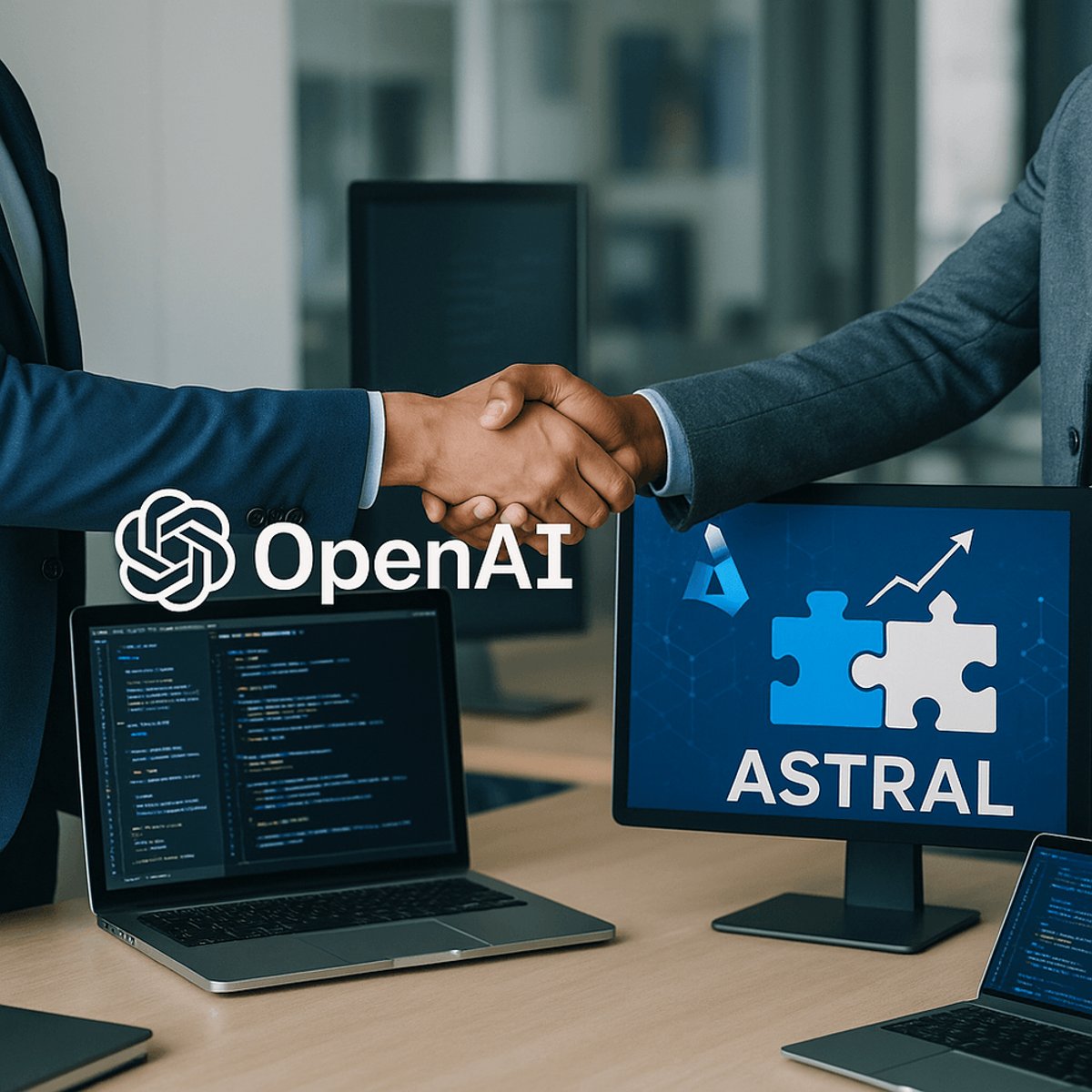
OpenAI is acquiring developer tooling startup Astral in a move that signals the AI giant's aggressive push into the software development market. The deal, which bolsters OpenAI's Codex team responsible for AI-powered coding tools, marks the company's third acquisition in recent months following deals for cybersecurity startup Promptfoo and health-care tech company Torch. The acquisition comes as competition intensifies around AI coding assistants, with Microsoft's GitHub Copilot and Google's Duet AI battling for developer mindshare.
OpenAI just made its boldest move yet into the developer tools market. The company's acquisition of Astral, a rising player in the developer tooling space, directly challenges the dominance of Microsoft's GitHub Copilot and positions OpenAI to capture a bigger slice of the $30 billion developer tools market.
The timing couldn't be more strategic. OpenAI's Codex platform, which powers AI-assisted coding capabilities, has been gaining traction among enterprise developers but still trails behind GitHub Copilot in market penetration. Astral's technology and team could provide the missing pieces OpenAI needs to accelerate its developer platform ambitions.
This marks OpenAI's third acquisition in a remarkably short span, following deals for cybersecurity startup Promptfoo and healthcare technology company Torch. The acquisition spree reveals a company rapidly expanding beyond its core large language model business into adjacent markets where AI can provide immediate value. It's a strategy that mirrors how Google and Meta built their empires - by acquiring promising startups before they become competitive threats.
While financial terms remain undisclosed, the deal comes at a time when OpenAI is flush with capital after raising billions in funding at a reported $157 billion valuation. That war chest is now being deployed strategically to build defensive moats around key market segments. Developer tools represent a particularly lucrative target - companies like Microsoft generate billions annually from tools like Visual Studio and GitHub subscriptions.
The developer tooling market has become increasingly crowded. Amazon's CodeWhisperer, Google's Duet AI, and numerous startups are all racing to embed AI capabilities into the software development workflow. But OpenAI has a unique advantage - its GPT models are already the go-to choice for developers building AI applications. Adding robust developer infrastructure creates a compelling ecosystem play.
Astral's specific capabilities remain somewhat mysterious - the company has maintained a relatively low profile compared to other developer tool startups. However, sources familiar with the matter suggest Astral has been working on novel approaches to code analysis and automated refactoring, areas where current AI coding assistants still struggle.
The acquisition also solves a talent problem. OpenAI has been aggressively hiring engineers to expand Codex, but finding developers who understand both AI systems and traditional software development tooling is challenging. Acquiring an entire team already working on these problems accelerates OpenAI's roadmap by months or even years.
For Microsoft, OpenAI's main investor and partner, this acquisition creates an interesting dynamic. While Microsoft benefits from OpenAI's core AI capabilities through their Azure partnership, the companies are increasingly competing in specific verticals. GitHub Copilot, powered by OpenAI's models, now faces more direct competition from its technology provider.
The Promptfoo and Torch acquisitions signal OpenAI's broader strategy - securing footprints in high-value verticals where AI can deliver immediate ROI. Cybersecurity and healthcare both represent multi-billion dollar opportunities where enterprises are desperate for AI solutions. Developer tools fit perfectly into this playbook, offering recurring revenue and sticky enterprise relationships.
Industry analysts suggest this won't be OpenAI's last acquisition. With billions in the bank and pressure to justify its massive valuation, the company needs to prove it can build sustainable business lines beyond API access to its models. Acquiring proven teams and technologies in strategic markets is faster than building from scratch.
OpenAI's acquisition of Astral represents more than just another M&A deal - it's a signal that the AI wars are expanding into new territories. By strengthening its developer tools offering, OpenAI is building the infrastructure for a future where its technology isn't just consumed through APIs but embedded deeply into how software gets built. The company's rapid acquisition pace suggests we're watching the early stages of a much larger consolidation wave in AI tooling. For developers and enterprises betting on AI-powered workflows, the question isn't whether these tools will become essential, but which platform will emerge as the standard. With this move, OpenAI is making clear it intends to be in that fight.