TL;DR:
• Ocado's robotic arms now pack 40% of all grocery orders, up from prototype status in 2018
• System packed 30+ million orders in 2024, targeting 80% automation within 3 years
• Technology powers deliveries for Kroger across 14 US states plus major retailers globally
• AI breakthrough allows robots to handle complex items like bags of oranges previously impossible to automate
Ocado's revolutionary robotic picking arms have quietly transformed grocery fulfillment, now handling 40% of orders across Kroger, Morrisons, and Sobeys deliveries. The British tech company's OGRP system packed over 30 million orders in 2024 with fewer than 100 arms installed, signaling the arrival of truly autonomous retail logistics that could reshape how millions receive their groceries.
Ocado just crossed a milestone that most shoppers won't notice but every retailer should fear. The British grocery automation company's robotic arms are now packing 40% of all orders flowing through its warehouses, a quantum leap from the prototype curiosities they were just years ago. Deputy CEO James Matthews tells me the company expects to hit 80% automation "in the next two or three years," fundamentally changing how groceries reach consumers across multiple continents.
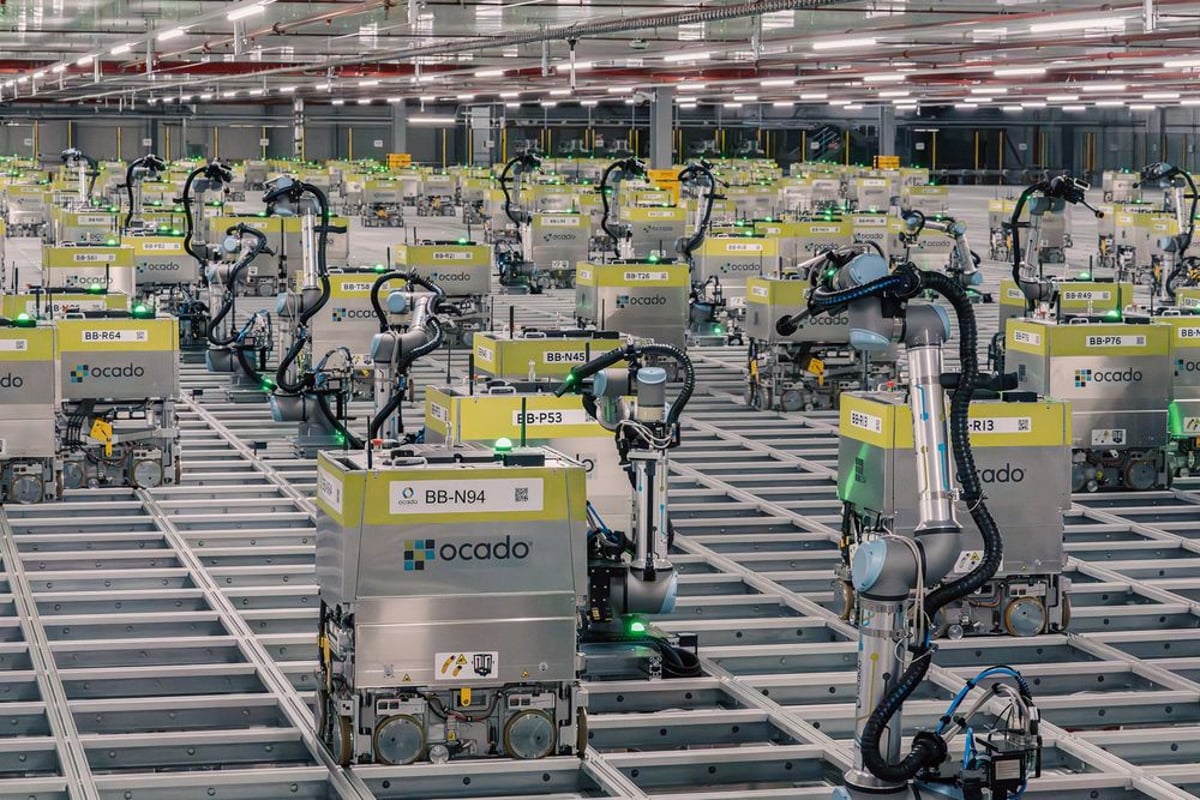
The numbers behind this transformation are staggering. Ocado's On-Grid Robotic Pick (OGRP) system packed over 30 million orders in 2024 using fewer than 100 robotic arms. By year's end, the company projects nearly 500 arms will be operational across its network. Each arm works alongside 500 traditional Grid robots in an orchestrated dance of efficiency that would make any logistics executive weep with envy.
What makes this breakthrough particularly significant is the technology's reach. While shoppers might not recognize the Ocado name, they've likely received groceries packed by these robots. The company's automation powers Kroger deliveries across 14 US states, Sobeys operations in Canada, and Morrisons plus Ocado's own brand in the UK, with additional clients spanning Europe and Asia.
The technical achievement here goes beyond mere mechanical precision. Eight years ago, when The Verge first visited an Ocado facility, "nothing stumps a robot quite like a bag of oranges," we reported. The unpredictable movement, lack of grip points, and risk of damage seemed insurmountable. Yet Matthews reveals the robots have "figured it out for themselves" through AI learning, now attaching suction cups to labels and lifting entire bags - a skill they developed through experimentation, not programming.
[IMAGE: Ocado's robotic arms working on the Grid system amid hundreds of moving robots]
This AI breakthrough represents what Matthews calls "cousins" of the generative AI models dominating headlines elsewhere. The robots' learning capacity extends beyond fruit bags to an expanding catalog of grocery items, each success multiplying across the entire robotic fleet instantaneously. It's collective intelligence applied to retail logistics at unprecedented scale.
The competitive implications are profound. Traditional grocery retailers face mounting pressure from online ordering costs - picking, packing, and shipping expenses that compress already razor-thin margins. Ocado's automation directly addresses this pain point, explaining why major chains worldwide are licensing the technology rather than attempting in-house development.
Current limitations reveal the technology's trajectory. Wine bottles and watermelons remain too heavy for standard suction cups, while quality control tasks like spotting bruised apples or broken eggs still require human judgment. Ocado is developing specialized attachments for high-volume items like wine bottles but considers single-item tools economically unfeasible - for now.
The human element isn't disappearing entirely, but it's rapidly shrinking. Workers still unpack incoming shipments and load outgoing delivery vans, though Matthews confirms automation projects target both functions. The company has invested in autonomous driving startups Wayve and Oxa, but customer-facing delivery remains human-controlled by design.
[VIDEO: Time-lapse footage of the Grid system in operation showing robotic coordination]
What's particularly striking about Ocado's approach is its distance from direct job displacement. The company sells technology to retailers but doesn't operate day-to-day fulfillment, meaning Kroger handles any workforce adjustments in US facilities. Ocado itself continues hiring, expanding R&D teams and remote support operations, even as its robots replace thousands of manual jobs elsewhere.
The next generation of improvements focuses on efficiency rather than capability. New 3D-printed robots weigh one-third of current models, requiring smaller safety barriers and enabling more compact, modular installations suitable for smaller sites. Lighter robots also reduce collision risks, allowing closer proximity to any remaining human workers.
Matthews emphasizes that the most crucial advances aren't mechanical but analytical - developing "machines intelligent enough to work through edge cases." The 10% of scenarios requiring human intervention represent automation's current boundary, but that gap is narrowing with each AI breakthrough.
The quiet revolution in grocery fulfillment is accelerating faster than most retailers anticipated. Ocado's 40% automation milestone, achieved through AI-driven robotic learning rather than brute-force engineering, signals that fully automated grocery logistics isn't a distant possibility but an imminent reality. For consumers, this means faster, more accurate deliveries at potentially lower costs. For the retail industry, it represents an existential challenge: adapt to Ocado's automation standard or risk obsolescence in the increasingly competitive online grocery market. The 10% gap between current automation and human necessity is shrinking rapidly, and when it closes, the transformation of global retail logistics will be complete.