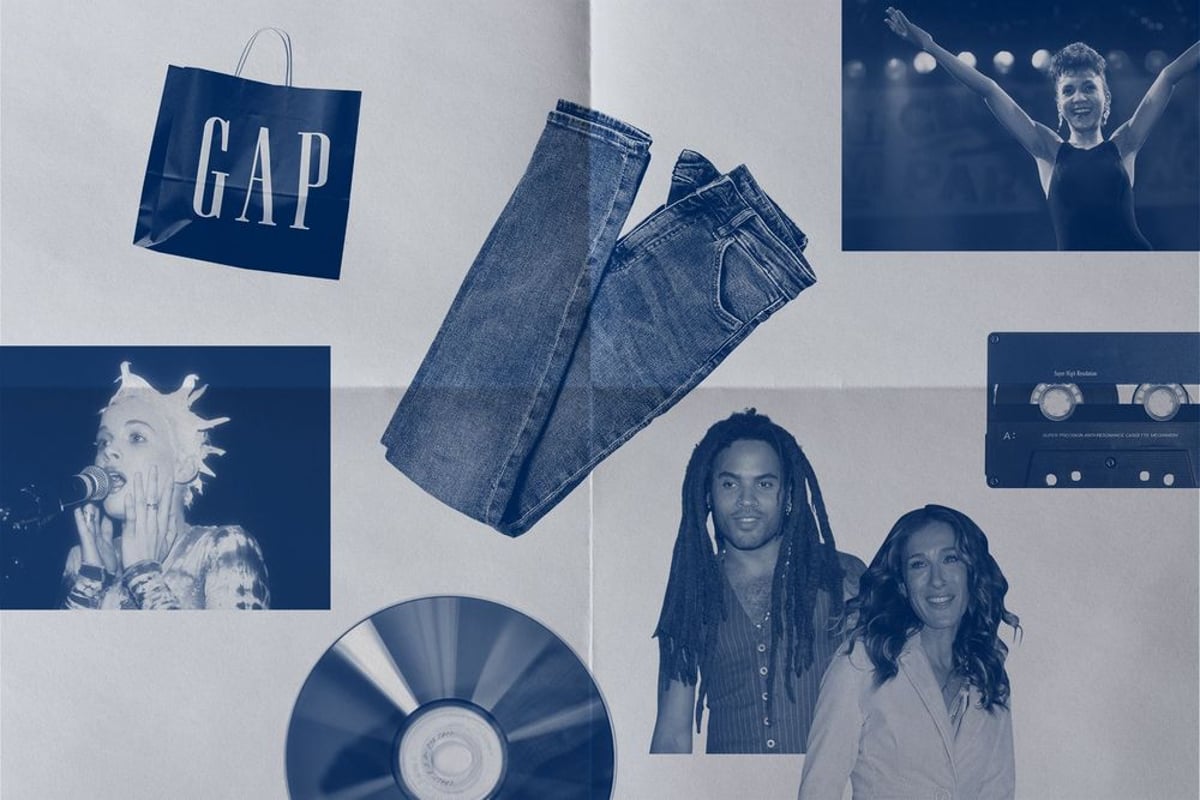
A former Gap employee has spent decades reconstructing the retailer's lost in-store playlists from the 1990s and 2000s, creating what may be the most comprehensive archive of retail music curation from the pre-streaming era. Michael Bise's obsessive quest to recover thousands of songs reveals how companies routinely lose their own cultural artifacts in the rush toward digital transformation.
What started as one employee's fascination with his workplace soundtrack has evolved into a remarkable preservation project that Gap itself couldn't accomplish. Michael Bise began working at a Gap store in Dallas in 1992, immediately struck by the retailer's sophisticated music curation that mixed house, dance, and David Bowie deep cuts instead of typical mall muzak.
"Just right away, it was so different from what I was expecting," Bise told The Verge. The monthly four-hour playlists arrived on cassette tapes with paper tracklists that employees could reference when customers asked about songs. While the tapes got mailed back to corporate, Bise started collecting those paper playlists with his manager's blessing.
By 2005, he'd amassed around 200 playlists containing roughly 10,000 songs total. Then disaster struck during a 2006 move - all the physical playlists vanished. The loss devastated Bise, but it also sparked an obsession that would define the next two decades of his life.
Starting in 2010, Bise began reconstructing playlists from memory, browsing iTunes until songs triggered recollections of specific months and store layouts. "I'm in there, I'm in the entire store," he says about hearing tracks like Opus III's "It's a Fine Day." "I can tell you where everything is in that month."
The project gained momentum in 2015 when Bise launched his Gap Playlists blog, hoping to connect with other former employees who might have saved playlists. An Instagram account followed, and slowly the community grew.
The breakthrough came with a 2017 New Yorker profile that brought mainstream attention to Bise's quest. The publicity attracted both fellow collectors and Gap's corporate attention. Ironically, the company that created these playlists had no archive of its own music history.
"This is what happens in every company," Bise explains. "You're thinking about now and tomorrow. So once you pay for that playlist, do you really need to worry about it again?" Gap has since embraced the project, treating Bise "like part of the family" and commissioning him to curate new playlists for the company's official Spotify account.
The archive reveals fascinating insights about pre-algorithm music curation. Unlike today's data-driven recommendations, Gap's playlists mixed familiar hits with obscure remixes and underground tracks that employees like Bise had never heard. "I wanted to get every obscure remix, every R&B, disco, whatever the mix was," he says.
Bise's project reflects broader questions about digital preservation and corporate memory. In an era where streaming platforms track every skip and replay, it's striking that a major retailer lost its own sonic identity. The playlists represent a lost art of human curation, where music supervisors crafted experiences meant to be heard from beginning to end.
Recent viral success has accelerated discoveries. A July 2024 Instagram post featuring a 2004 Gap commercial with Sarah Jessica Parker and Lenny Kravitz garnered 340,000 views and led to new playlist submissions. But significant gaps remain in Bise's collection, including crucial periods from 1994 and 2002-2004.
The hunt continues through social media archaeology and word-of-mouth detective work. Bise maintains detailed records of missing months, hoping that former employees or even current Gap managers might discover forgotten playlists in storage rooms. His email address (michaelbise@msn.com) serves as a digital tip line for anyone with surviving artifacts from retail music's golden age.
Bise's Gap playlist archive represents more than nostalgia - it's a case study in accidental digital preservation and the cultural artifacts companies routinely lose. As streaming algorithms increasingly shape our musical discovery, his project preserves a time when human curators crafted unexpected sonic experiences for millions of shoppers. The ongoing hunt for missing playlists continues to prove that sometimes the most dedicated archivists work outside the companies that created the content they're preserving.