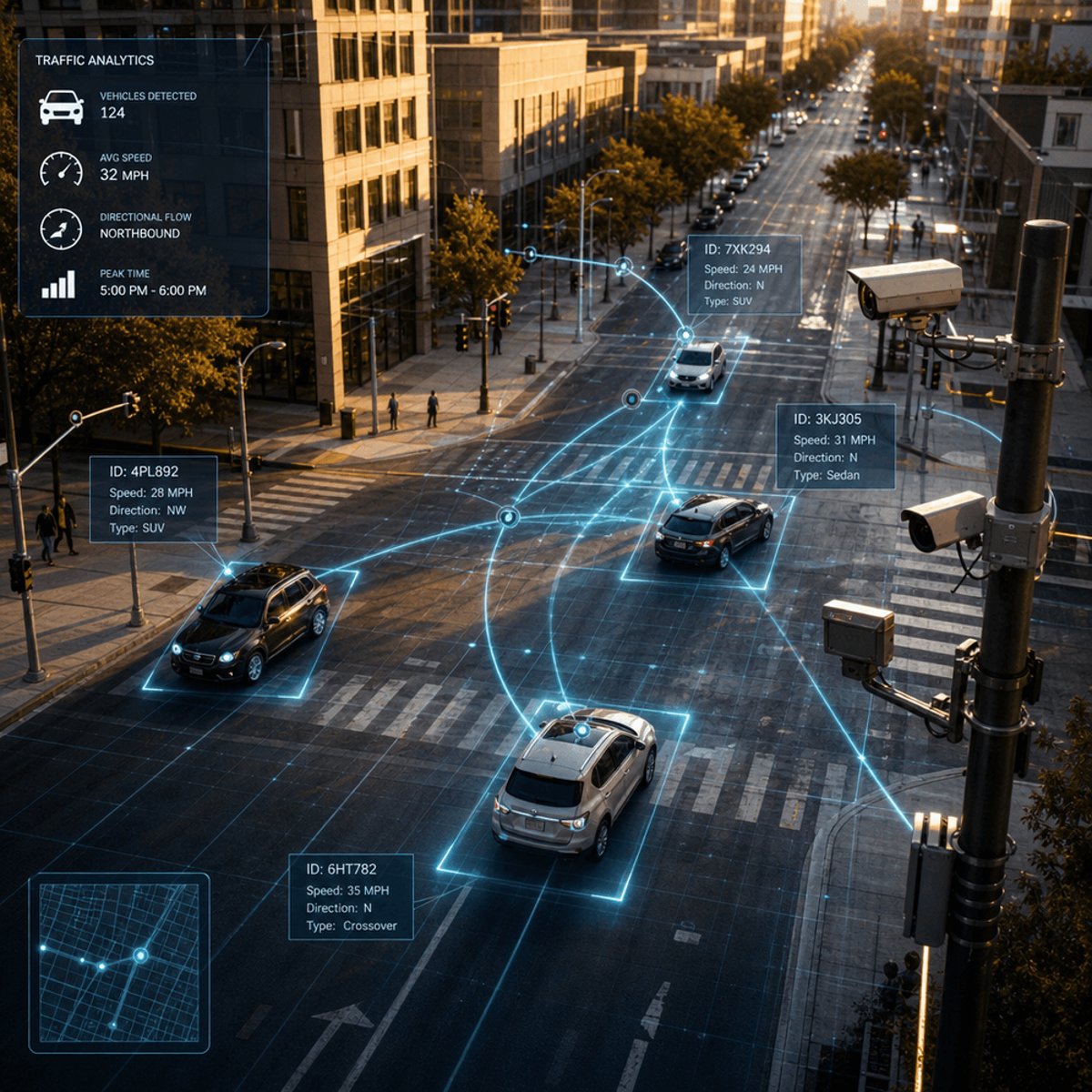
Police surveillance just got a lot more invasive. Flock Safety, the company that blankets neighborhoods with license plate cameras, has quietly rolled out an AI system that tracks far more than just vehicles - and WIRED got its hands on the code. Through technical reconstruction, reporters Dhruv Mehrotra and Dell Cameron confirmed the next-generation platform is already in use by law enforcement agencies, marking a significant expansion beyond the company's controversial automated license plate readers.
Flock Safety built its business on a simple pitch: automated license plate readers that help cops catch car thieves and find missing persons. But the company's ambitions run much deeper, and now there's code to prove it.
Investigative reporters at WIRED didn't just report on Flock's new AI system - they reverse-engineered it. The technical reconstruction reveals a surveillance platform that goes far beyond reading plates, employing advanced computer vision to analyze vehicles, patterns, and movements in ways the company hasn't publicly detailed. Multiple police departments are already using it.
The timing couldn't be more sensitive. Flock's existing camera networks have triggered backlash in communities across the country, with residents questioning whether crime prevention justifies blanket surveillance of every car passing through their neighborhoods. The company claims more than 3,500 law enforcement agencies now use its technology, creating what amounts to a nationwide tracking infrastructure.
But this new system represents a quantum leap. While Flock's original cameras focused on capturing license plates, timestamps, and basic vehicle characteristics, the reconstructed code shows capabilities that privacy researchers have been warning about for years. The AI can apparently identify and track patterns across multiple data points, building profiles of vehicle movements over time and geography.
Flock hasn't been shy about its growth trajectory. The Atlanta-based startup has raised over $380 million in venture funding and reached a $3.5 billion valuation, according to industry reports. That kind of capital buys serious AI firepower, and the company's been hiring machine learning engineers at a rapid clip.
What makes WIRED's investigation particularly significant is the technical depth. This isn't speculation about what Flock might be building - it's documentation of what's already running in production. The reporters reconstructed enough of the system's architecture to confirm it operates well beyond the company's public-facing descriptions.
Law enforcement agencies adopting the technology face minimal disclosure requirements. Many departments sign contracts and deploy Flock systems without public hearings or community input, a pattern that's raised concerns among civil liberties groups. The Electronic Frontier Foundation and ACLU have been tracking Flock's expansion, but the pace of deployment often outstrips oversight efforts.
The technical capabilities WIRED uncovered align with broader trends in police technology. Vendors increasingly bundle multiple surveillance functions into integrated platforms, creating ecosystems that can cross-reference data from cameras, databases, and other sources. What starts as a license plate reader evolves into a comprehensive tracking system.
Flock's defenders argue the technology solves real crimes. The company regularly promotes cases where its cameras helped locate stolen vehicles or identify suspects. Law enforcement agencies praise the system's speed and accuracy compared to manual investigation methods. But critics counter that effectiveness doesn't justify unchecked surveillance of entire populations.
The investigation lands as Congress and state legislatures grapple with AI regulation. Several states have introduced bills requiring transparency around law enforcement use of surveillance technology, but most have stalled. Meanwhile, companies like Flock continue iterating and deploying new capabilities faster than policy can keep pace.
What's particularly noteworthy is how WIRED obtained the information. Rather than relying solely on leaked documents or company statements, the reporters took a forensic approach - reconstructing the system through technical analysis. That methodology makes the findings harder to dismiss or downplay.
Flock hasn't issued a detailed response to the technical findings, and the company declined to comment on specific capabilities when contacted by WIRED. That silence speaks volumes in an industry where vendors typically rush to explain and contextualize critical coverage.
The privacy implications extend beyond individual departments. If thousands of agencies deploy interconnected Flock systems with advanced AI capabilities, the result is a de facto national surveillance network with minimal federal oversight. Vehicle tracking could be cross-referenced with other data sources, creating profiles of individuals' movements and associations.
This isn't theoretical. The code is real, the deployments are happening, and the capabilities are operational. What remains to be seen is whether public awareness and regulatory pressure can catch up to the technology already watching from street corners across America.
WIRED's technical reconstruction of Flock Safety's AI surveillance system exposes a critical gap between what police technology companies promise and what they actually deploy. While communities debate whether license plate readers belong in their neighborhoods, the systems themselves are evolving into far more powerful tracking tools. The investigation proves that oversight mechanisms - if they exist at all - are struggling to keep pace with surveillance capabilities already operational in thousands of jurisdictions. For anyone concerned about privacy and mass surveillance, the code doesn't lie: what's watching from the street corner is far more sophisticated than advertised.