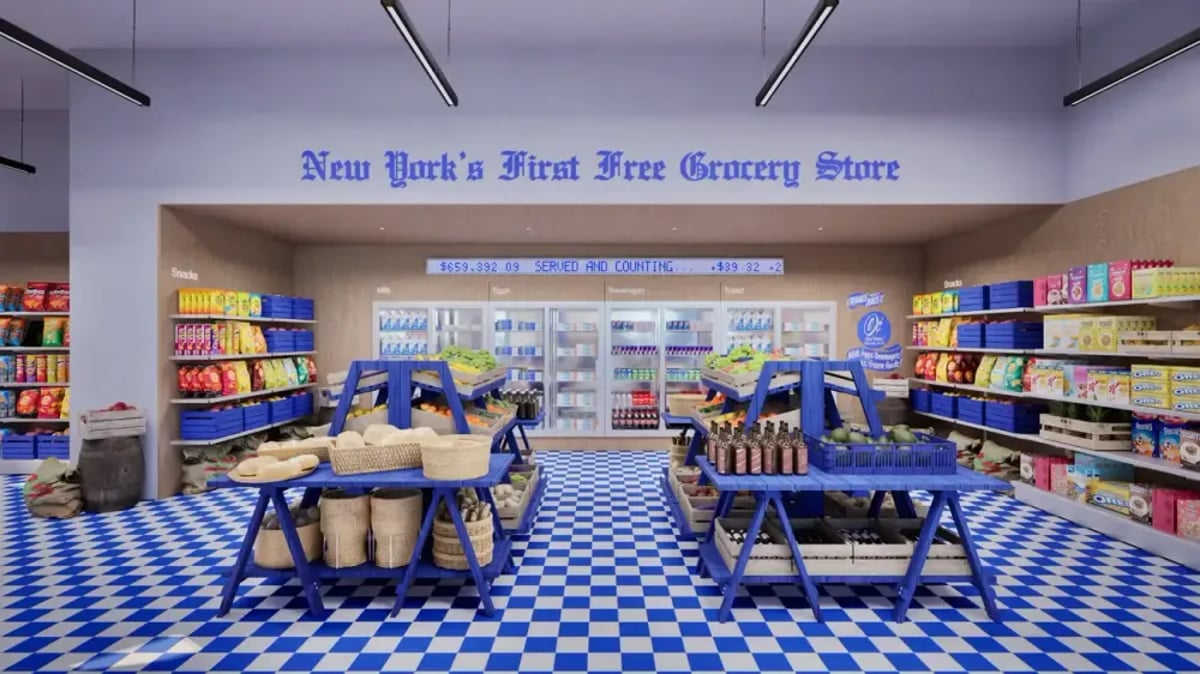
Polymarket just donated $1M to Food Bank for New York City and opened a five-day pop-up grocery store. Kalshi countered with $50 gift cards at an East Village bodega. Both prediction markets are battling for brand supremacy in Mayor Zohran Mamdani's New York, where food insecurity affects 3 million residents and the conversation about city-run grocery stores has moved from fringe idea to front-page policy debate.
The stunts are clever. The optics are perfect. The problem is they're just marketing budgets with expiration dates.
Meanwhile, the actual crisis persists. 47 million Americans face food insecurity. New York's working families spend 40% of their income on food they can barely afford. Mamdani identified the need. He proposed city-run grocery stores as infrastructure, not charity. But here's the uncomfortable question nobody's asking: where's the funding model that lasts beyond election cycles and quarterly earnings calls?
When Publicity Replaces Policy
Polymarket's pop-up opens February 12 for four days. Then what? The $1M donation is meaningful, feeding roughly 10 million meals through Food Bank networks at standard conversion rates. But compare that to the 9.7 billion meals Feeding America distributes annually. It's 0.1% of one year's need. It's a rounding error with a ribbon on it.
Kalshi's $50 grocery giveaway is even more transparent. Three hours. One location. A line around the block for Instagram content. Then everyone goes home and food prices are still unaffordable tomorrow.
Far from long-term solutions, these are brand activations disguised as social responsibility. Prediction markets made hundreds of millions on election betting. They're spending pocket change to look like they care about the consequences of the policies people bet on.
The tragedy is that New Yorkers will remember the free groceries and the smiling faces handing out loyalty cards. They won't remember that none of it was built to last. That's the difference between a stunt and infrastructure.
Mamdani Gets It, But the Math Doesn't Add Up Yet
To his credit, Mamdani understands that food insecurity isn't a food problem. It's an access problem. Distance to grocery stores matters far less than money in pockets, which is why his rent freeze and free transit proposals might do more for food security than any municipal market.
But city-run grocery stores are still worth trying. Istanbul did it and they succeeded. Bogotá subsidizes transit. Vienna built public housing that works. The model exists. What doesn't exist is sustainable funding that doesn't collapse when budgets tighten or political winds shift.
NYC's budget is $118B annually. Mamdani proposed $60M for pilot grocery stores, which is reasonable as experiments go. But operating margins for grocery stores run 1-3% on good days. Rent and tax abatements help, but they don't cover labor, logistics, inventory, or the inevitable inefficiencies of government procurement. Without subsidies far larger than $60M, municipal groceries either fail or become another program fighting for scraps in budget negotiations every year.
The question isn't whether public groceries could work. It's whether they can survive long enough to prove it.
The Missing Infrastructure: Perpetual Funding
Here's what nobody wants to say out loud: charity doesn't scale. Donations spike during crises and dry up during news cycles. Corporate giving is tax optimization dressed up as altruism. Government programs are hostage to elections and economic downturns.
Food insecurity needs funding mechanisms that operate automatically, transparently, and perpetually. It needs infrastructure that generates resources by default, not by asking.
That's what WYDE built.
Our $EAT token launched December 2025 on Coinbase's Base network. The mechanism is simple: 25% of every transaction fee goes directly to verified 501(c)(3) hunger relief partners. Not when we feel generous. Not during fundraising campaigns. Every trade. Automatically. Forever.
By mid-January, normal trading activity funded 4,184 meals - now that figure is over 7000. Not from a pop-up. Not from a publicity stunt. Just from people trading a digital asset, with the protocol routing fees to food banks in real time. The other 75% of fees fund liquidity, platform development, and token holder rewards, which is how you solve the Philanthropic Token Trilemma that i wrote about a while back and build something that lasts decades instead of weeks.
80% of the 100 billion token supply remains locked behind impact milestones: 100M meals, 250M, 500M, 750M, 1 billion. Rewards unlock when outcomes are delivered, not when time passes. The structure ties stakeholder incentives to mission completion.
This isn't theoretical. It's operating. Right now. On-chain. Transparent. Auditable.
There are major Transparency benefits too.
I also wrote recently about the improved transparency built into WYDE's model. I built on the trilemma to discuss how WYDE offers a proven alternative to high-risk cryptocurrency and memecoin philanthropic or impact cause launches like former New York Mayor Eric Adams' disastrous $NYC "rug-pull" Token launch.
How WYDE Could Power NYC's Grocery Model
Imagine if Mamdani's municipal grocery stores were funded by a Causecoin designed specifically for food access in New York. Call it $NYFOOD. Structure it the same way $EAT works, but target it to verified partners operating in the five boroughs.
Every trade generates fees. 25% flows directly to the free grocery store operation.
Trading volume compounds impact.
10M daily volume at 1% fees generates $25,000 per day for food access programs.
$9.1M annually from a single token with modest traction.
Scale it to $50M daily volume and you're funding $45.6M per year in perpetuity without a single donation ask or budget hearing.
The beauty of this model is that it doesn't replace government funding or private charity. It supplements them with a mechanism that operates independently of political cycles, economic conditions, or donor fatigue. Mamdani's $60M pilot becomes the foundation. WYDE's infrastructure becomes the engine that keeps it running when the initial funding runs out.
Participatory Governance Meets Blockchain
A recent One Project report on participatory funding makes the case clearly: when communities control where capital goes, outcomes improve. Boston's Ujima Project lets residents vote on which businesses receive investment. Seed Commons uses non-extractive finance and community decision-making nationwide. Results include 90%+ repayment rates, stronger local economies, and resources reaching people who need them most.
WYDE adopts that model through Wyoming's DUNA framework, which provides legal structure for decentralized governance of nonprofit missions. Token holders vote on which verified charities receive funding. Proposals, votes, and results are public and on-chain. Transparency by design.
For the first 12 months, $EAT is stewarded by a single verified 501(c)(3) partner to ensure stability and credibility. Then full community governance activates. Holders propose partners. Holders vote on deployment. Holders see exactly where funds go and what impact they generate.
This is the future of charitable infrastructure: transparent, automated, community-governed, and built for decades of operation.
The Choice NYC Faces
New York can choose publicity stunts that generate headlines and disappear by Valentine's Day. Or it can build infrastructure that operates automatically, transparently, and perpetually.
Polymarket and Kalshi proved there is a healthy appetite for food security initiatives. Mamdani proved there's political will for public solutions. What's missing is the funding mechanism that survives beyond marketing budgets and election cycles.
WYDE built that mechanism. We proved it works with $EAT. We secured federal 501(c)(4) status as the first tax-exempt impact exchange. We funded thousands of meals in weeks through normal trading activity.
The model exists. The technology works. The legal framework is tested. All that's missing is the decision to deploy it.
Mayor Mamdani has the vision. WYDE has the infrastructure. Food-insecure New Yorkers deserve more than four-day pop-ups and $50 gift cards.
They deserve systems that work. Forever.
About the Author:
Aaron Rafferty is Co-Founder and CEO of WYDE, the world's first Impact Exchange, and a behavioral scientist focused on incentive design for social good. Follow @aaronjrafferty and @wydeorg on X.
Disclosure: This article is for informational and educational purposes only. It does not constitute financial, investment, tax, or legal advice. Cryptocurrency investments carry significant risks including total loss of capital. Always conduct your own research and consult qualified professionals before making investment decisions.