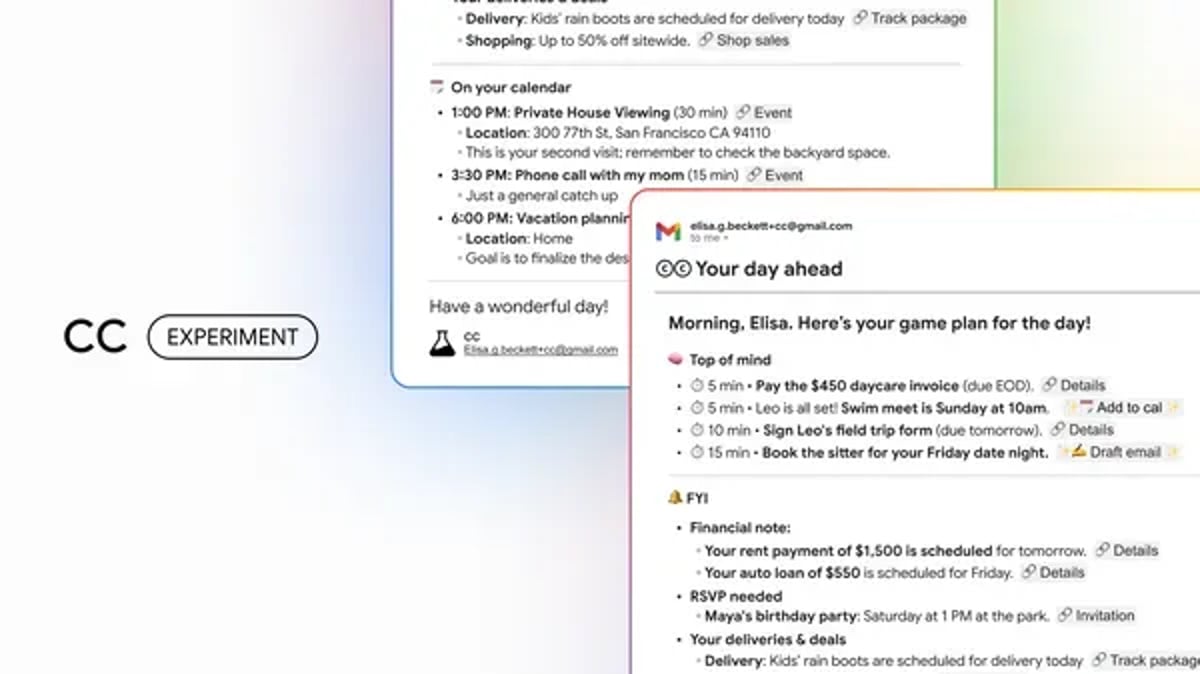
Google just rolled out CC, a new Gemini-powered email assistant designed to save you time managing your inbox and calendar. Available starting today through Google Labs to AI Pro and Ultra subscribers in the US and Canada, CC connects directly to your Gmail, Google Drive, and Google Calendar to send you a daily "Your Day Ahead" email that surfaces tasks, calendar summaries, and key updates. It's the latest bet by the search giant that AI assistants embedded into everyday tools will actually stick with users.
Productivity tools have become the testing ground for AI assistants, and Google just placed its latest bet. The company launched CC today through its Google Labs incubator, an experimental email-based assistant powered by Gemini that aims to be your personal productivity coordinator.
CC does one thing at its core: it sends you a daily email called "Your Day Ahead" that aggregates what's actually important. The assistant pulls from your Gmail, Google Calendar, and Google Drive to build a digest of your tasks, upcoming meetings, and key updates. Instead of jumping between apps to piece together your day, you get a single email that does the work for you. It's a simple premise, but one that addresses a real pain point for anyone drowning in multiple notifications.
What makes CC different from a generic email digest is its interactivity. You can reply directly to the email with requests. Need to add a to-do? Email CC. Want to search your files? Same. The assistant learns your preferences, remembers notes you share, and acts as a conversational interface to your own data. It's essentially turning your email inbox into a command center for productivity.
Right now, CC is rolling out to Google AI Pro and Ultra plan subscribers in the US and Canada who are 18 or older. The company explicitly noted it's for consumer Google accounts only, not Workspace accounts, suggesting enterprise features might come later or require different licensing. It's a deliberate limited release, the kind Google does when testing experimental features through Labs before deciding whether to invest further.
This isn't exactly new territory. Mindy, which raised funding from Sequoia, started as an email-based AI assistant before pivoting to creator and marketing tools. Meeting recorders like Read AI and Fireflies already send users daily briefings of their conversations. But Google's advantage is obvious: CC can access your entire productivity ecosystem without needing multiple integrations. It lives in Gmail, connects seamlessly to your calendar and files, and doesn't require you to sign up for yet another service.
There's also Huxe, an audio app built by former Google NotebookLM developers, which creates a daily podcast-style brief using email, calendar, and news preferences. It shows how the concept of an AI-powered daily briefing has multiple formats competing for attention.
What's really happening here is a systematic push by Google to make its AI models essential to your everyday workflow. By putting CC directly in Gmail and connecting it to services you already use, the company's betting that convenience drives adoption. And if it works, it creates another hook to keep users subscribed to AI Pro and Ultra plans.
The timing is also telling. We're in the middle of a productivity arms race. Microsoft has been pushing Copilot across Office apps. Apple is rolling out Apple Intelligence features. Everyone's racing to show that AI can actually make your life easier, not just add noise. CC feels like Google's answer in the email and calendar space. It's not flashy. It's not a new model. But it's useful in a way that might actually make people care about an AI assistant.
CC represents Google's latest attempt to make AI assistants indispensable rather than just interesting. By embedding it directly into the email clients most people already use and connecting it to Gmail, Drive, and Calendar, the company's removed the friction that killed earlier AI assistant experiments. It's a controlled rollout to high-value subscribers, which means Google's watching closely to see if people actually use it or if it becomes another labs experiment that quietly disappears. The competitive pressure from Microsoft, Apple, and startups like Mindy means this won't be the last productivity assistant we see. But if CC sticks around, it's because it solved a real problem: too many notifications, not enough actual insight.