Google's making a major bet on AI in the classroom. The tech giant is rolling out select Gemini features across its Education tier of Google Workspace at no extra charge, while also introducing Workspace Studio, a new no-code AI agent builder. The move comes as schools worldwide grapple with how to integrate generative AI into teaching and learning workflows, and Google's betting free, integrated tools will become the default.
Google just lowered the gates on its premium AI tools for one of its most strategic markets. At the BETT conference in London, the company announced it's making select Gemini capabilities available free to educators and students across multiple tiers of Google Workspace for Education, a significant move that signals the company's commitment to making generative AI table stakes in schools.
The announcement breaks down into two big pieces: expanded free access to Gemini across Workspace apps, and the introduction of Workspace Studio, a new AI agent builder that lets educators automate workflows without touching a line of code. According to Vivek Chachcha, Product Manager at Google for Education, educators have already been telling the company that integrating AI into their existing tools "has saved them hours of time and helped them be more creative." The rollout is Google's response to that feedback.
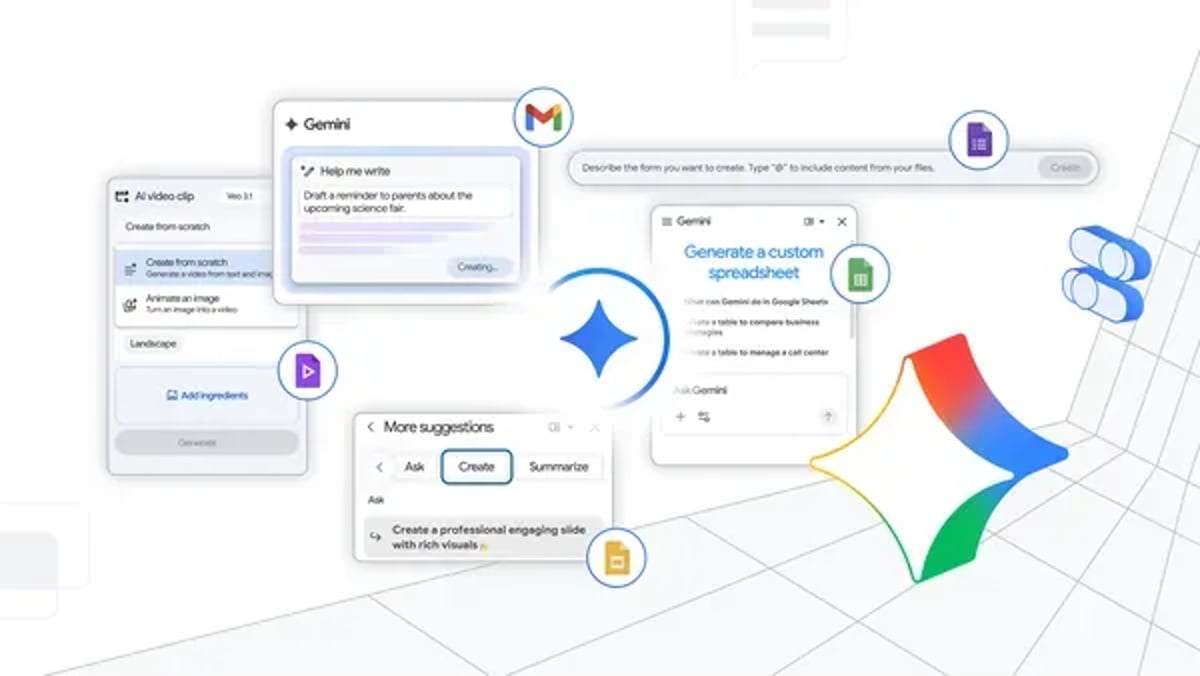
Here's what's actually shipping. Education Fundamentals users get Gemini in Gmail—think Help Me Write for drafting emails, Suggested Replies for quick responses, and AI Overviews for summarizing threads. Education Plus and Teaching and Learning add-on subscribers are getting the full suite: Gemini in Docs for content creation, Gemini in Slides for generating original images and slides, Gemini in Forms for quick assessment creation with AI-powered response summaries, Gemini in Sheets for data analysis with custom functions, and Gemini in Vids for creating polished videos from text prompts or existing slides.
The rollout timing matters here. Most of these features are hitting in the coming weeks for users 18 and older, but Gmail and Sheets are staggered to later months. That's likely a data handling precaution—email and spreadsheets often contain sensitive student information, so Google's probably being cautious with the rollout. Administrators are also getting more granular control, able to toggle individual Gemini apps on or off per app rather than an all-or-nothing switch.
But the real newsmaker is Workspace Studio. This is Google's answer to educators who want to build custom AI workflows without hiring engineers. Workspace Studio, now bundled as a core service in all Education editions, harnesses Gemini 3's advanced reasoning to let anyone create no-code AI agents in minutes. The company showed demos of practical use cases: an agent that preps you for meetings by summarizing notes and pulling attendee details into Chat, another that automatically saves email attachments to Drive and logs them in Sheets (perfect for organizing permission slips), and a third that triages admin emails to surface priorities and extract actionable tasks.
Google's still maintaining a clear premium tier strategy. Google AI Pro for Education stays positioned as the premier offering for faculty and staff, with access to the latest models like Deep Research and Nano Banana Pro, plus deeper Workspace integrations. The company plans to push AI Inbox, Proofread, and the ability to ask your inbox natural-language questions as premium features. By layering free tier capabilities with a paid premium option, Google's betting it can capture broad adoption while preserving a revenue stream.
The education market has been the great untested frontier for generative AI adoption. Unlike enterprises, schools operate on tight budgets and move slowly through procurement cycles. But if you can hook educators and students on free tools early, you build long-term habits and lock in ecosystem preferences. That's what Google's doing here. OpenAI's been pushing ChatGPT for education, but it lacks the integration depth Google has with Workspace. Microsoft's Copilot ties closely to Office 365, which gets enterprise traction but less consumer adoption in schools. Google's advantage is that Workspace for Education is already ubiquitous in K-12 and higher ed.
The moves also signal a shift in how Google thinks about Gemini distribution. Rather than bolting AI onto existing products as a premium add-on, the company's leaning into bundling as a retention tool. Educators adopt free Gemini features, their workflows improve, admin overhead drops, and suddenly switching costs feel real. Some will upgrade to AI Pro; most will just deepen their Google dependency.
One caveat: the rollout timing and tiering around age gates (18+) suggests Google's being careful about how Gemini interfaces with student data, which makes sense given recent privacy scrutiny in the EdTech space. The staggered rollout for Gmail and Sheets hints at even more caution around sensitive information.
Google's leveling up its education strategy by making AI accessible to the teachers and students who need it most. By bundling free Gemini capabilities with an easy-to-use agent builder, the company is raising the stakes for competitors while betting that early adoption in schools translates to long-term dominance. The tiered approach—free features for broad adoption, premium AI Pro for power users—mirrors how Google won the workspace in the first place. What educators and administrators do with these tools over the next semester will determine whether AI in education becomes transformative or just another feature to ignore.