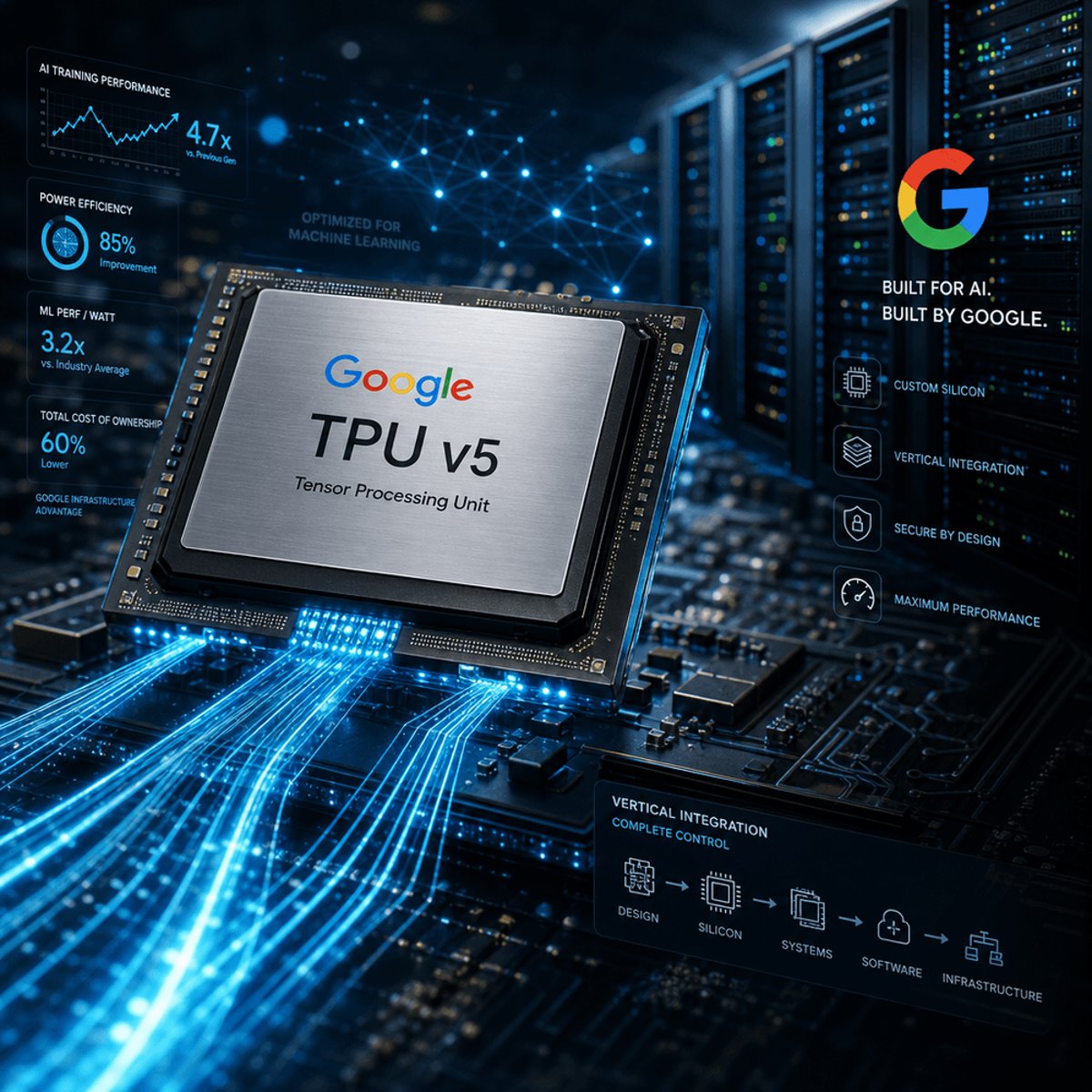
Alphabet is quietly pulling ahead in the AI infrastructure arms race, and it's not just about software anymore. The Google parent's homegrown Tensor Processing Units are proving to be one of its most formidable competitive advantages as companies scramble for scarce computing power to train massive AI models. While rivals like Microsoft and Meta remain dependent on Nvidia for their AI chips, Alphabet's decade-long bet on custom silicon is paying off in ways that could reshape the competitive landscape.
Alphabet just reminded the tech world why it started building its own AI chips back in 2016. While competitors burn through billions renting Nvidia GPUs and wait months for new hardware, Google has been quietly running its AI workloads on custom silicon designed specifically for machine learning tasks.
The advantage is becoming impossible to ignore. Google Cloud customers can now access TPU v5p chips that the company claims deliver better price-performance ratios than comparable GPU offerings. But the real story isn't just about cost - it's about control. At a time when Microsoft, Meta, and Amazon are all scrambling to secure enough Nvidia chips to keep their AI ambitions on track, Alphabet isn't waiting in line.
The strategic implications run deep. Every dollar Alphabet doesn't spend on Nvidia hardware is a dollar it can pour into research, talent, or infrastructure. Every training run that doesn't depend on external chip supply chains is one less vulnerability in an increasingly competitive market. And every optimization Google engineers make to their TPU architecture creates a moat that rivals can't easily cross.
OpenAI learned this lesson the hard way. The company has reportedly explored developing its own chips, recognizing that relying entirely on third-party silicon puts it at a strategic disadvantage. Amazon already figured this out years ago with its Trainium and Inferentia chips. Microsoft is working on its own AI accelerators. The pattern is clear - the companies serious about AI leadership are investing in custom silicon.
But Alphabet had a head start that's measured in years, not months. The first TPU went into production in 2015, designed initially to handle inference workloads for services like Search and Translate. By the time the AI boom exploded in 2023 with ChatGPT, Google already had multiple generations of TPUs deployed across its data centers. That infrastructure didn't just appear overnight - it represented nearly a decade of iteration, optimization, and learning.
The financial impact is starting to show. While exact cost breakdowns remain proprietary, industry analysts estimate custom AI chips can reduce training costs by 30-50% compared to off-the-shelf GPUs for certain workloads. When you're training models that cost tens of millions of dollars to develop, those savings compound fast. Alphabet's capital expenditure on technical infrastructure hit record levels in recent quarters, but the company isn't facing the same supply constraints that have forced competitors to delay projects or scale back ambitions.
There's a technical advantage too. TPUs are built from the ground up for the matrix operations that dominate neural network training. Google's engineers can optimize the entire stack - from chip architecture to software frameworks like TensorFlow - in ways that generic GPU providers simply can't match. That vertical integration means faster iteration cycles, better debugging, and the ability to customize hardware for specific model architectures.
The competitive dynamics are getting interesting. Nvidia still dominates the AI chip market with roughly 80% share, and its latest H100 and upcoming B100 GPUs remain the gold standard for many applications. But Alphabet doesn't need to beat Nvidia in the open market - it just needs its custom silicon to be good enough for its own workloads. And increasingly, that appears to be the case.
Google Cloud is now actively marketing TPU access as a differentiator to enterprise customers. Companies training large models can rent TPU pods at rates that undercut comparable GPU instances. For Alphabet, this creates a virtuous cycle - more external usage means more revenue to fund chip development, which leads to better performance, which attracts more customers.
The strategic calculus extends beyond just training models. Inference - actually running AI models to serve users - represents an ongoing operational cost that scales with usage. Google handles billions of AI-powered queries daily across Search, Gmail, Maps, and other services. Custom chips optimized for inference could save the company hundreds of millions annually in electricity and hardware costs alone.
Not everything is smooth sailing. Custom chip development requires massive upfront investment, specialized talent, and years of iteration. Alphabet's competitors aren't standing still - Microsoft is developing its Maia chips, Amazon continues advancing its Trainium line, and even Meta is exploring custom silicon options. The window of advantage that Google currently enjoys could narrow as rivals catch up.
But for now, Alphabet holds a card that few others can match. In an industry increasingly defined by who can train the biggest models fastest, having your own chip foundry is like owning the oil wells in an energy crisis. It doesn't guarantee victory, but it certainly helps when everyone else is fighting over the same limited supply.
Alphabet's bet on homegrown silicon is transforming from a defensive infrastructure play into an offensive competitive weapon. As the AI compute race intensifies and hardware becomes as critical as algorithms, companies that control their entire stack - from chips to models - are positioning themselves to lead the next decade of technological innovation. Google didn't just build better chips. It built a strategic moat that gets wider every time a competitor has to wait for the next Nvidia shipment. In a market where compute is the new currency, Alphabet just reminded everyone it's been printing its own money all along.