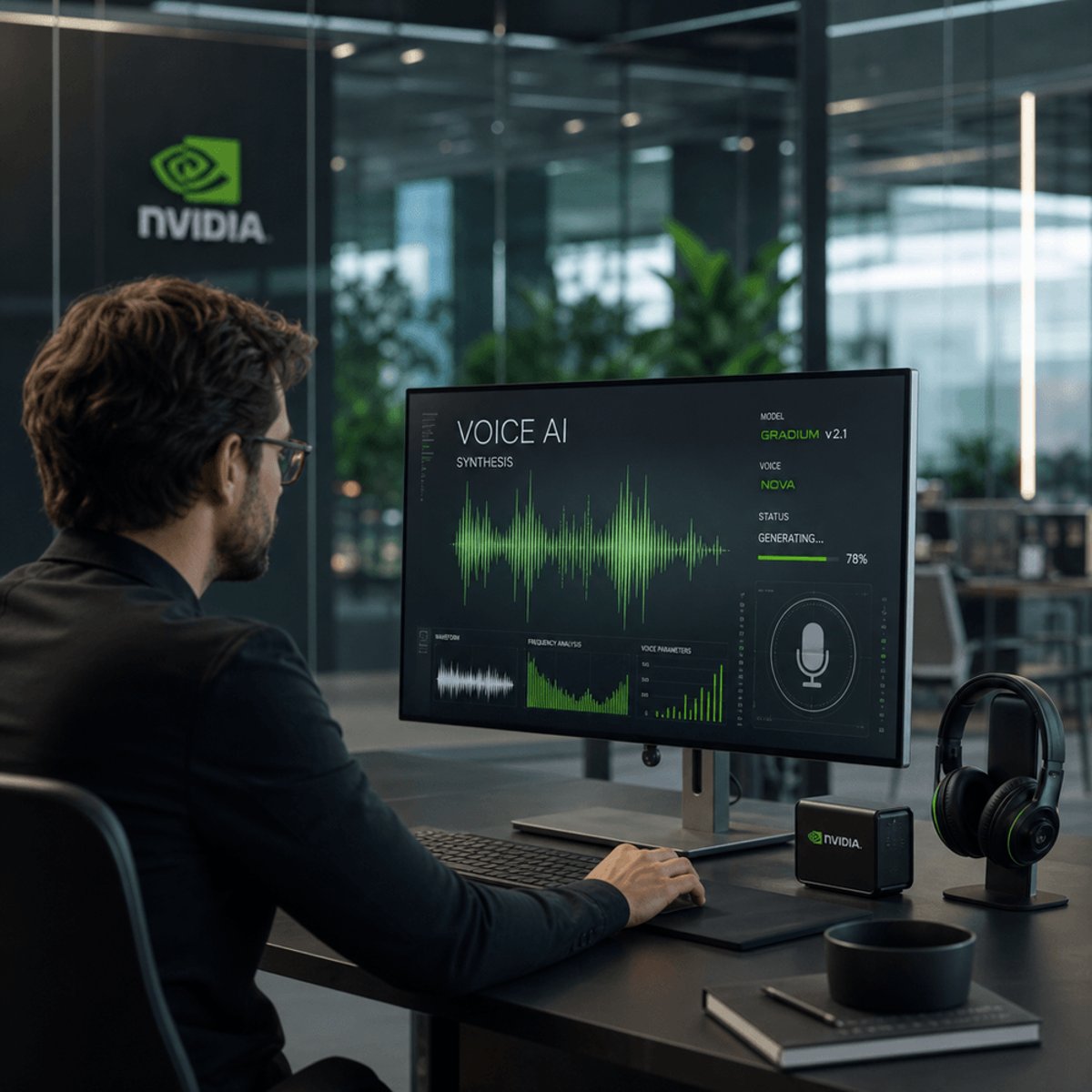
Paris-based AI voice startup Gradium just closed a $100 million seed extension round with backing from Nvidia, marking one of the largest seed rounds in European AI history. The company, which competes directly with unicorn ElevenLabs in the exploding AI voice generation market, is using the capital to scale its enterprise-focused voice technology. The deal signals growing investor appetite for European AI infrastructure plays and Nvidia's continued push to cement relationships across the voice AI ecosystem.
Gradium, a Paris-based AI voice startup, just pulled off what might be the most eye-popping seed extension in European tech this year. The company raised $100 million with strategic backing from Nvidia, according to a TechCrunch report breaking the news Thursday.
The massive round puts Gradium squarely in the ring with ElevenLabs, the New York-based voice AI darling that's been dominating headlines with its hyper-realistic voice cloning technology. But while ElevenLabs has focused heavily on content creators and media applications, Gradium's been quietly building enterprise-grade voice solutions for customer service, accessibility tools, and multilingual communications.
Nvidia's involvement isn't just about cash. The chipmaker's been on a tear inking strategic deals with AI infrastructure companies, betting that whoever controls the picks and shovels of the AI voice boom will need serious compute power. Gradium's technology runs on large language models optimized for real-time voice synthesis, making it a natural fit for Nvidia's GPU ecosystem. The partnership likely includes preferential access to Nvidia's latest chips and enterprise customer introductions.
The $100 million seed extension is remarkable even by 2026's inflated AI funding standards. Most seed rounds clock in between $2-10 million, with extensions rarely topping $20 million. Gradium's ability to command this valuation suggests the company's already generating significant revenue or has locked in major enterprise contracts. The voice AI market's projected to hit $6.9 billion by 2028, and investors are scrambling to back potential category leaders before valuations balloon further.
France has been aggressively courting AI startups with tax incentives and research partnerships, trying to build a counterweight to Silicon Valley and London's tech dominance. Gradium's raise comes just months after French AI startup Mistral AI secured a $640 million Series B, signaling that Paris is becoming a legitimate hub for foundational AI companies. The government's been pushing hard to keep these companies headquartered domestically rather than relocating to the US post-funding.
The competitive landscape is getting crowded fast. Beyond ElevenLabs, Google recently expanded its Text-to-Speech API with more natural-sounding voices, Microsoft is embedding advanced voice tech into Azure AI services, and Amazon continues iterating on Alexa's conversational capabilities. Gradium will need to prove it can differentiate on either quality, pricing, or enterprise features to justify this valuation.
What makes voice AI particularly tricky is the uncanny valley problem - voices that sound almost but not quite human can actually hurt user experience. Gradium's reportedly cracked this with proprietary models that handle emotional inflection and contextual tone shifts better than competitors. Early beta testers in the customer service space have noted the technology's ability to sound genuinely empathetic during support calls, a massive unlock for industries drowning in call center costs.
Nvidia's strategic calculus here extends beyond Gradium. The company's been methodically investing in or partnering with AI application layer companies - from drug discovery to autonomous vehicles - to ensure its chips become the default infrastructure. Every dollar of AI software revenue theoretically drives multiple dollars of GPU spending. With voice AI applications multiplying across gaming, healthcare, education, and entertainment, Nvidia's betting the category will become a major compute consumer.
The funding environment for AI startups remains hot despite broader tech market turbulence. Investors are still writing massive checks for companies with defensible AI moats, particularly in Europe where valuations haven't quite reached Silicon Valley's stratospheric levels. Gradium's seed extension puts it in rare company alongside AI infrastructure plays that have commanded nine-figure early-stage rounds, though specific terms and valuation weren't disclosed in the announcement.
Gradium's $100 million seed extension with Nvidia backing represents a watershed moment for European AI startups and the voice generation market. The deal validates that enterprise customers are ready to spend serious money on AI voice solutions, while Nvidia's involvement signals the technology's evolution from novelty to infrastructure. As voice AI moves from content creation toys to mission-critical business tools, Gradium's war chest positions it to compete with both Silicon Valley unicorns and big tech giants. The real test will be execution - whether the Paris startup can convert this capital into market share before the window closes and consolidation begins. For now, the voice AI arms race just got a lot more interesting.