Icarus Robotics just closed a $6.1 million seed round to solve space's most mundane problem: astronauts spending most of their time as cosmic warehouse workers instead of doing science. The startup's intelligent robots could handle the cargo logistics that currently consume 90 minutes of every two-hour experiment on the International Space Station.
"We're Amazon warehouse workers with PhDs," one astronaut told Icarus Robotics cofounders Ethan Barajas and Jamie Palmer during their startup research. That brutal assessment captures the reality aboard the International Space Station, where highly trained astronauts burn precious time on mundane logistics instead of cutting-edge science.
The numbers tell the story. Every 60 days, roughly 3.5 tons of cargo arrive at the ISS, and astronauts spend two full weeks unpacking and stowing everything. When an experiment should take two hours, the first 90 minutes go to moving cargo and prepping tools. It's a massive waste of talent that costs taxpayers millions per astronaut-hour.
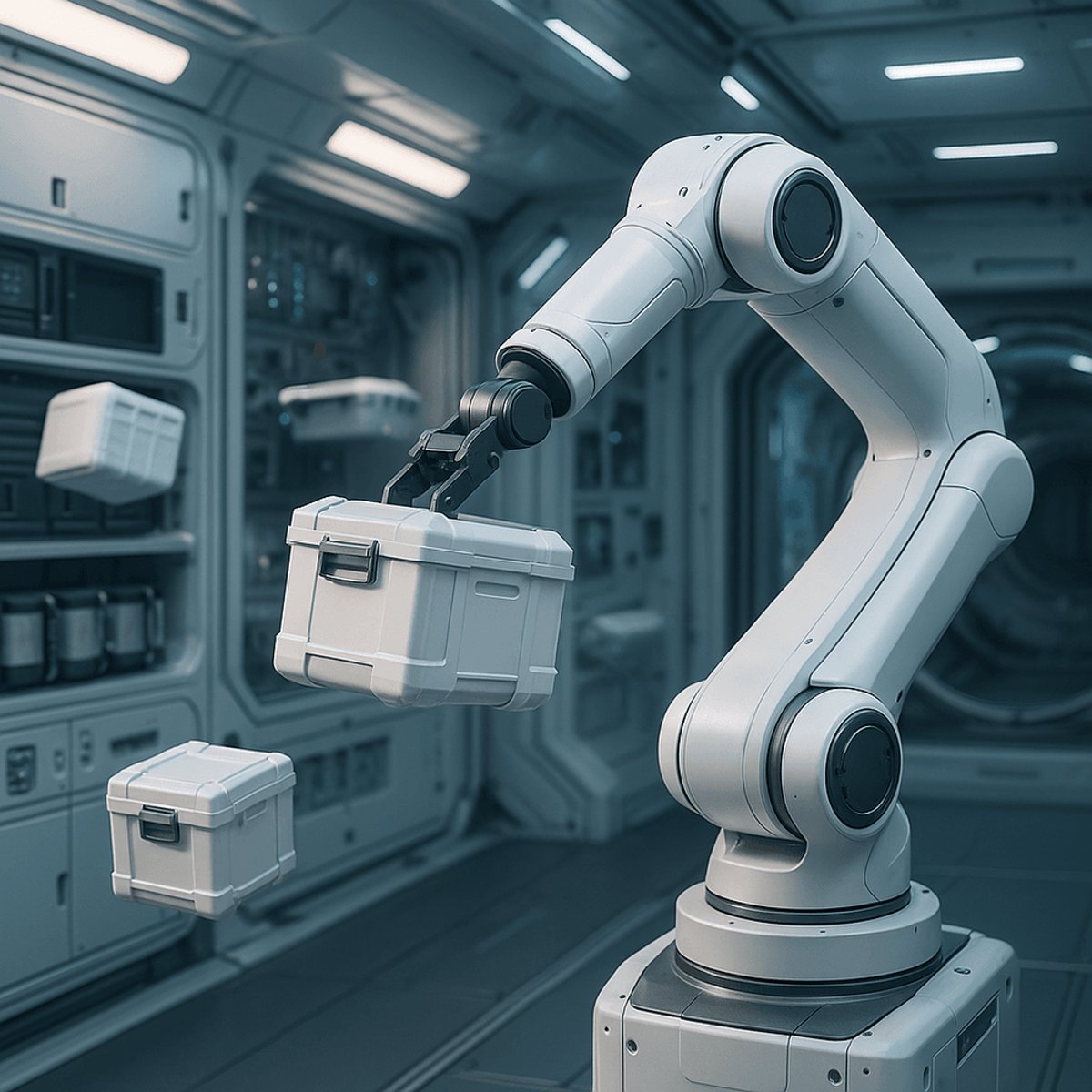
Barajas and Palmer, who connected through the Entrepreneurs First program, saw an obvious solution: let intelligent robots handle the grunt work. But they're not building humanoid robots. Instead, Icarus is starting with something simpler - a fan-propelled robot equipped with two arms and jaw grippers that can tackle 80% of required dexterity tasks.
"We were able to demonstrate that you don't need to go the whole way to hands to get meaningful dexterity at a long distance," Palmer explained after the team successfully demonstrated their bimanual system unzipping, unpacking, and re-zipping actual ISS cargo bags during recent ground tests.
The $6.1 million seed round, led by Soma Capital and Xtal with participation from Nebular and Massive Tech Ventures, will fund their path to orbit. The startup plans parabolic flight testing next year, followed by a full year-long demonstration aboard the ISS through partnership with Voyager Space, which operates the commercial Bishop airlock.
Initially, the robots will be teleoperated from Earth. Palmer argues the ISS is one of the few workplaces where you can justify having a full-time robot operator because "the labor arbitrage margin is so big." A skilled robotic operator costs far less than astronaut time, even when factoring in their high salaries.
The longer-term vision involves "embodied AI" - collecting microgravity manipulation data with humans in the loop, then training foundational models for orbital robotics. This mirrors terrestrial robotics trends but adapted for space physics. Eventually, Icarus wants partial autonomy where humans issue high-level commands like "open the bag" rather than controlling every movement.
Full autonomy becomes critical for deep space missions where Earth-based teleoperation faces communication delays. Mars missions, for instance, experience 4-24 minute signal delays depending on planetary alignment, making real-time control impossible.
Barajas, who landed his first NASA internship at 17, emphasizes they're not replacing astronauts. "We want to augment them. We want to make the short time that they have on station as profitable and as research heavy as possible," he said. The goal is freeing up astronauts for the scientific work they trained years to perform.
The space robotics market is heating up as commercial space stations prepare to replace the aging ISS. Companies like Axiom Space and Blue Origin are building next-generation orbital facilities that will need automated systems from day one. Icarus's early ISS validation could position them perfectly for this transition.
Beyond cargo handling, the robots could tackle routine maintenance tasks like filter changes and seal inspections - work that's currently eating into astronaut science time. As commercial space activities expand and crew time becomes even more valuable, logistics automation stops being nice-to-have and becomes mission-critical infrastructure.
As space commercialization accelerates and orbital real estate becomes premium, every minute of astronaut time gets more valuable. Icarus Robotics isn't just building robots - they're creating the infrastructure that could make space-based research dramatically more efficient. Their ISS demonstration next year will be the first real test of whether embodied AI can finally free humanity's most expensive workers from cosmic warehouse duty.