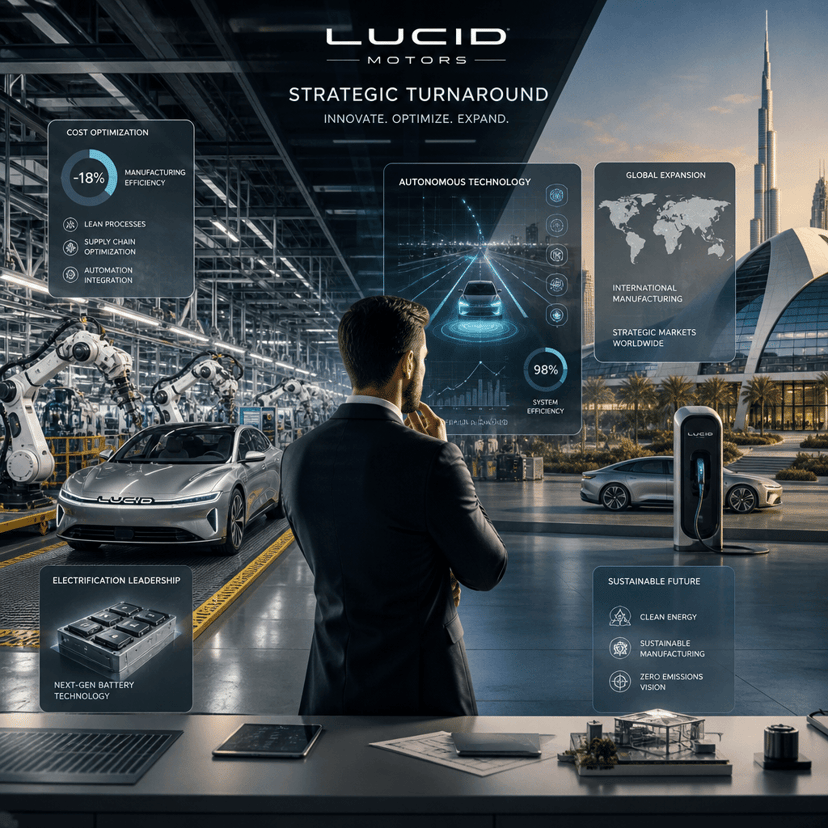
Lucid Motors just lost a top engineering executive in what appears to be the latest tremor from new leadership at the top. Emad Dlala, who was promoted to SVP of engineering and digital just months ago, has left the struggling EV maker, TechCrunch has learned. The departure comes as Lucid's new CEO works to stabilize a company that's burned through billions while delivering fewer than 10,000 vehicles annually, raising fresh questions about the luxury EV maker's ability to retain technical talent during a critical turnaround phase.
Lucid Motors is experiencing leadership turbulence at a moment when it can least afford it. Emad Dlala, who held the critical role of SVP of engineering and digital, has departed the company just months after being elevated to that position, TechCrunch reports. The timing raises eyebrows - Dlala's exit coincides with what sources describe as a broader leadership shakeup under the company's new CEO.
The departure of a senior engineering executive is particularly significant for an automaker still trying to prove it can manufacture vehicles at scale. Lucid has positioned itself as a premium alternative to Tesla, touting superior technology and luxury positioning. But the reality has been far messier - the company delivered fewer than 7,000 vehicles in 2025 while burning through roughly $2 billion in cash, according to recent financial filings.
Dlala's role overseeing both engineering and digital operations put him at the intersection of two critical challenges facing modern EV makers: building reliable vehicles and creating the software experiences that increasingly define them. His promotion earlier this year suggested the company was consolidating these functions under proven leadership. That he's leaving so soon after that promotion suggests something shifted dramatically in the executive suite.
The context matters here. Lucid brought in new executive leadership earlier this year as major shareholder Saudi Arabia's Public Investment Fund pushed for operational changes. The PIF has poured over $6 billion into Lucid and now owns roughly 60% of the company, giving it enormous influence over strategic decisions. When your primary backer controls that much equity and keeps writing checks to keep the lights on, their patience for underperformance has limits.
Industry insiders say executive departures during leadership transitions are common, but the engineering function is particularly sensitive. "You can't afford instability in engineering when you're trying to launch new vehicles and scale production," one former EV executive told us on background. "That's where the institutional knowledge lives - battery systems, thermal management, all the stuff that makes or breaks an EV program."
Lucid's immediate challenge is launching the Gravity SUV, which the company has positioned as a mainstream volume driver compared to the ultra-luxury Air sedan. The Gravity is supposed to start deliveries later this year, targeting the same premium SUV market where Rivian has found traction with its R1S. Any delays or quality issues would be catastrophic for a company already struggling with investor confidence.
The broader competitive landscape isn't doing Lucid any favors either. Tesla continues to dominate the premium EV segment while slashing prices. Traditional luxury brands like Mercedes-Benz and BMW are flooding the market with electric options. Chinese EV makers are eyeing international expansion with vehicles that match Lucid's technology at lower price points. Standing out requires flawless execution - something that's hard to achieve when your engineering leadership is walking out the door.
Lucid hasn't publicly commented on Dlala's departure or the reasons behind it. The company declined to make executives available for comment, instead pointing to recent statements about organizational efficiency and focus on core product programs. That kind of corporate-speak typically signals cost-cutting and headcount reductions, though it's unclear if Dlala's exit was voluntary or part of broader restructuring.
What's clear is that Lucid is at an inflection point. The company has the technology - its Air sedan genuinely offers industry-leading range and efficiency. It has the backing - Saudi investment provides a financial cushion most startups can only dream about. What it doesn't have is proven ability to manufacture vehicles profitably at scale, and leadership instability in engineering makes that challenge even steeper.
The EV market has entered a new phase where technology alone isn't enough. Rivian is struggling despite strong products. Fisker collapsed entirely. Even Tesla is facing margin pressure and slowing growth. For Lucid to survive, it needs stable leadership, flawless Gravity execution, and a path to profitability that doesn't require endless Saudi cash infusions. Losing a top engineering executive months after promoting him doesn't inspire confidence that the company has found that stability yet.
Executive departures are normal in corporate reshuffling, but the timing and role here tell a concerning story. Lucid Motors needs engineering stability more than ever as it tries to launch the Gravity SUV and prove it can be more than a Saudi-funded science project. Losing your SVP of engineering and digital months after promoting him suggests the new leadership's vision isn't aligning with key technical leaders - exactly the kind of friction that derails promising EV companies. With billions invested and credibility on the line, Lucid can't afford many more exits like this one.