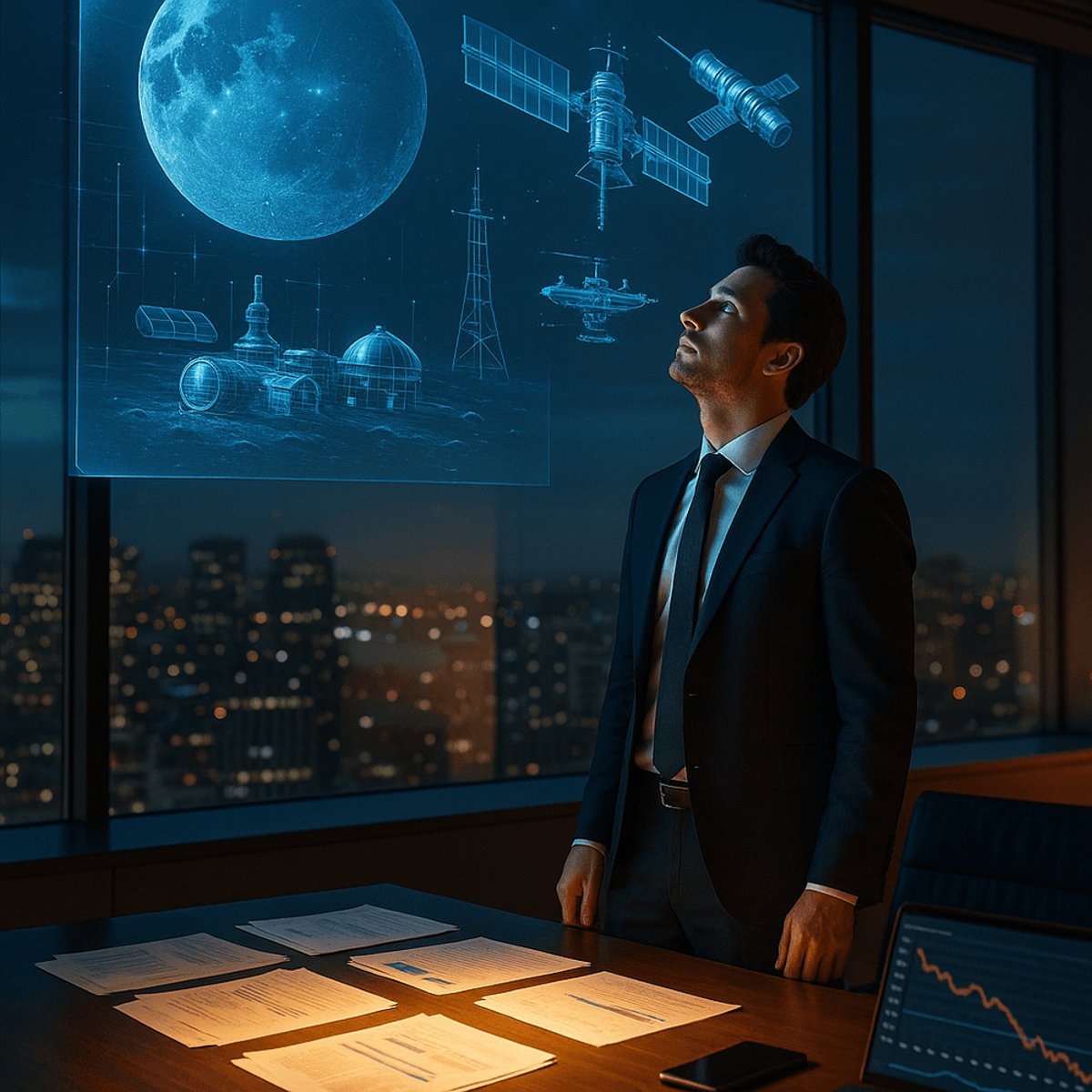
Elon Musk just floated his most audacious distraction yet. As co-founders bolt from xAI and investors circle for an IPO, the serial entrepreneur told employees the AI startup needs a lunar manufacturing facility to build satellites and launch them via giant catapult, according to The New York Times, which obtained audio of the all-hands meeting. The timing couldn't be more revealing - instead of addressing the leadership crisis, Musk's doubling down on sci-fi moonshots that blend his SpaceX obsession with xAI's shaky foundation.
Elon Musk's latest vision for xAI involves something straight out of a science fiction novel - and it's landing at the worst possible time for the embattled AI startup. During an internal meeting, Musk told employees that xAI needs to establish a manufacturing facility on the moon that would produce AI satellites and deploy them into space using a massive catapult system, according to audio obtained by The New York Times.
The lunar factory pitch comes as xAI faces a growing exodus of co-founders and mounting pressure from investors to move forward with an initial public offering. Multiple sources close to the company say the timing of Musk's space ambitions isn't coincidental - it's classic Musk playbook, pivoting to grand visions when operational realities get messy.
xAI launched in 2023 with the explicit goal of building AI systems that could "understand the universe." The company quickly assembled a team of former OpenAI, Google DeepMind, and Microsoft Research veterans. But that star-studded founding team is now fracturing. While xAI hasn't publicly confirmed specific departures, people familiar with the matter say co-founder departures have accelerated in recent months as the company struggles to define its identity separate from Musk's other ventures.
The moon factory concept isn't entirely without precedent in Musk's empire. SpaceX has long discussed manufacturing capabilities in space, and the company's Starship vehicle is designed to eventually support lunar operations. But extending that vision to xAI's satellite constellation - which hasn't even been formally announced - represents a significant leap that critics say reveals confused priorities.
"This is Elon doing what Elon does best - painting a vision so grand that current problems seem small by comparison," one former xAI employee told TechCrunch on condition of anonymity. "But investors who've poured hundreds of millions into xAI want to see competitive AI models, not moon bases."
The IPO pressure adds another layer of complexity. xAI raised its most recent funding round at a reported $24 billion valuation, with terms that included provisions for a potential public offering within 18 to 24 months. That window is closing, and the company's progress on its core AI models has been slower than some backers expected. The startup's Grok chatbot, integrated into X (formerly Twitter), has gained traction but remains far behind OpenAI's ChatGPT and Google's Gemini in market adoption.
Musk's lunar satellite vision appears to merge xAI's AI capabilities with SpaceX's launch infrastructure and Starlink's satellite expertise. The concept involves using AI-optimized satellites manufactured in low lunar gravity and launched using electromagnetic catapults - similar to mass driver concepts that have circulated in aerospace circles for decades but never materialized beyond theoretical papers.
The physics aren't impossible. The moon's lower gravity makes it theoretically easier to launch payloads into space compared to Earth. Manufacturing in lunar conditions could also enable construction techniques impossible under Earth's gravity. But the engineering, logistics, and cost challenges are staggering - likely requiring decades and tens of billions in investment.
That timeline disconnect is what worries current and former employees. xAI needs to ship competitive AI products now to justify its valuation and satisfy IPO-hungry investors. Moon factories are 2040 problems, not 2026 solutions.
Meanwhile, the AI race continues at breakneck speed. OpenAI just raised another massive funding round, Google is integrating Gemini across its entire product suite, and Microsoft continues its aggressive AI rollout through Copilot. xAI can't afford distractions.
Still, Musk's supporters argue his seemingly impossible visions have a way of becoming reality. Tesla was ridiculed before it revolutionized electric vehicles. SpaceX was mocked before it made reusable rockets routine. Perhaps a lunar AI satellite factory will eventually seem obvious in retrospect.
But first, xAI needs to survive its current crisis. The co-founder departures signal internal discord about the company's direction. The IPO pressure creates urgency for near-term results. And Musk's divided attention across Tesla, SpaceX, X, Neuralink, and The Boring Company leaves questions about how much focus xAI actually receives.
Investors are reportedly growing restless. Some want clarity on the IPO timeline. Others are pushing for board-level oversight that would constrain Musk's tendency toward spontaneous strategy shifts. The lunar factory announcement could be the catalyst that forces those conversations into the open.
Musk's lunar factory vision might ultimately prove visionary or catastrophically distracting - but xAI doesn't have the luxury of waiting to find out. The company needs to ship competitive AI products, stabilize its leadership team, and satisfy investors demanding clarity on the IPO path. Moon bases can wait. What can't wait is proving xAI deserves its $24 billion valuation in an AI market that's moving faster than any rocket Musk's ever built. The coming months will reveal whether the lunar pitch was strategic brilliance or the moment xAI lost its way.