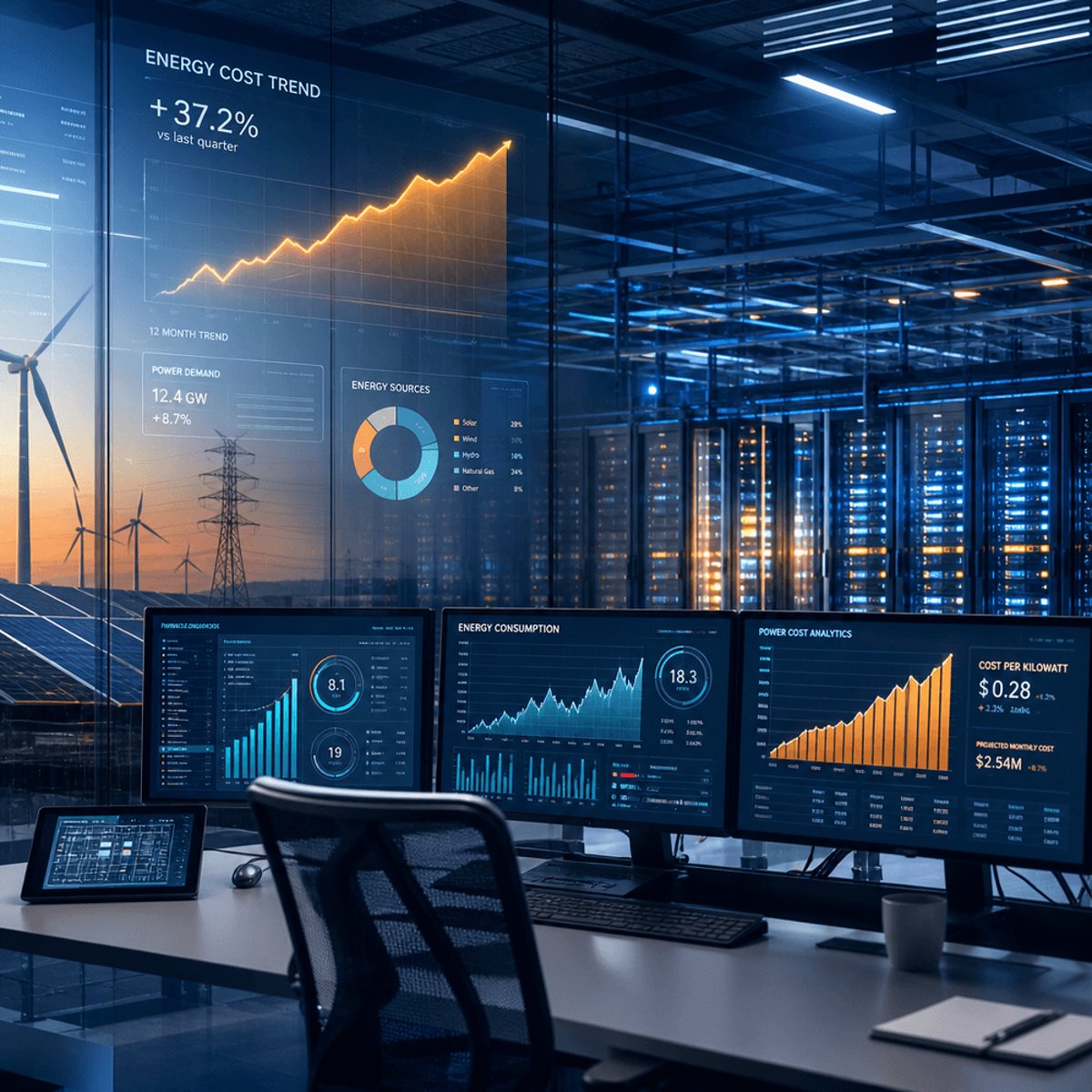
The AI gold rush might hit an expensive snag. New forecasts warn that natural gas prices could triple in parts of the U.S., potentially saddling tech giants like Amazon, Microsoft, Google, and Meta with ballooning energy bills just as they're racing to build out AI data center infrastructure. The timing couldn't be worse—hyperscalers have bet heavily on gas-powered facilities to meet AI's insatiable power demands, and this price shock could reshape the entire economics of the artificial intelligence boom.
Amazon, Microsoft, Google, and Meta might be regretting their natural gas bets right about now. A new energy forecast is sending ripples through the hyperscaler community, warning that natural gas prices could triple in key U.S. markets—precisely where these tech giants have been building massive AI data centers at breakneck speed.
The stakes are enormous. AI training and inference workloads consume vastly more power than traditional cloud computing, and the hyperscalers have turned to natural gas as a bridge fuel to meet surging electricity demand. But what looked like a pragmatic solution just months ago now threatens to become a financial albatross.
The price forecast, detailed in an exclusive TechCrunch report, comes as data center power consumption continues its exponential climb. Microsoft alone has committed billions to AI infrastructure, much of it reliant on gas-fired generation. Amazon Web Services has similarly expanded its gas-dependent footprint across Virginia, Ohio, and Texas—regions now facing the steepest projected price increases.
The irony is sharp. These companies have spent years touting their renewable energy commitments and carbon neutrality goals. Yet the immediate demands of the AI race pushed them toward fossil fuels. Google, which once proudly claimed to match 100% of its electricity consumption with renewable energy purchases, has seen its actual carbon emissions climb as AI workloads multiplied faster than clean energy could scale.
Now the chickens are coming home to roost, and they're carrying triple-digit energy bills. A threefold price increase on natural gas would translate directly to operating costs, squeezing margins on AI services that are already expensive to deliver. Meta, which has been aggressively building out AI infrastructure to power everything from content recommendations to its metaverse ambitions, could see hundreds of millions added to its annual energy expenses.
The ripple effects extend far beyond the hyperscalers' balance sheets. Enterprise customers relying on cloud-based AI services should brace for potential price hikes. If Microsoft Azure, AWS, and Google Cloud face ballooning energy costs, those expenses will inevitably flow downstream to the startups and corporations consuming AI compute.
This price shock also exposes the fragility of the current AI infrastructure boom. The hyperscalers bet that natural gas would provide reliable, dispatchable power while they worked on longer-term renewable solutions. But commodity price volatility—driven by everything from export demand to pipeline constraints—has always been gas's Achilles heel.
Some industry observers see this as an inflection point that could accelerate the shift toward truly sustainable AI infrastructure. Nuclear power, once dismissed as too slow to build, is getting a second look. Microsoft has already explored small modular reactor partnerships, and Google has invested in next-generation geothermal. Wind and solar, paired with massive battery storage, are becoming economically competitive even without considering carbon costs.
But those solutions take years to deploy at scale. In the meantime, the hyperscalers face an uncomfortable reality: the AI arms race they've been fighting might get significantly more expensive. The companies that can weather this price shock—either through superior energy hedging, faster renewable deployment, or more efficient AI architectures—will have a decisive competitive advantage.
The forecast also raises questions about where future AI infrastructure gets built. If natural gas prices triple in Virginia and Texas, suddenly regions with abundant hydroelectric power or established renewable grids look more attractive. Expect to see more data center announcements in the Pacific Northwest, Quebec, and Scandinavia—anywhere electrons come cheap and clean.
For the AI industry broadly, this energy price warning is a reminder that the technology's computational intensity creates real-world constraints. You can't train frontier models on venture capital and enthusiasm alone. The physics of power generation, transmission, and cost still matter—perhaps more than ever as AI scales from research labs to production infrastructure serving billions of users.
The natural gas price forecast represents more than just a cost headache for hyperscalers—it's a stress test for the entire AI infrastructure model. Companies that moved fast to secure gas-powered capacity might now find themselves locked into expensive, carbon-intensive energy contracts just as renewables become more economically compelling. The winners in the next phase of AI development won't just be those with the best algorithms or the most compute—they'll be the ones who solved the energy equation sustainably and affordably. For Amazon, Microsoft, Google, and Meta, the race is on to diversify their energy mix before that triple-price forecast becomes reality.