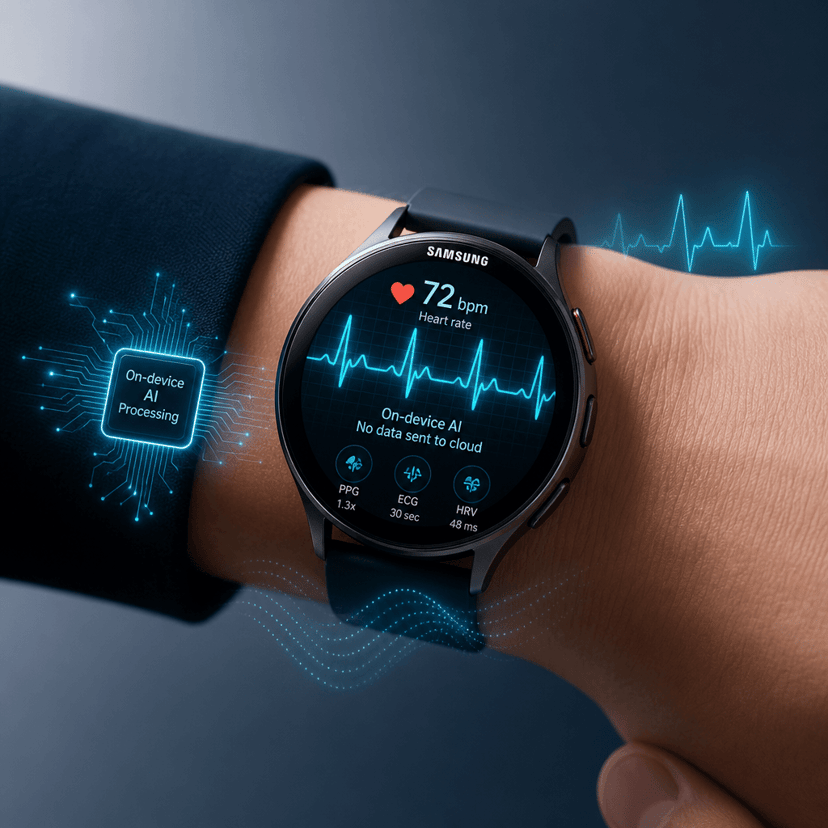
Samsung just dropped two AI models that could transform how smartwatches understand your health. The company's xMAE and HiMAE foundation models can analyze heart rhythms, sleep patterns, and activity data continuously - and crucially, they run locally on your wrist without pinging cloud servers. Announced as part of Samsung's Connected Care vision, the models represent a shift from reactive health tracking to predictive, personalized monitoring powered by AI that lives on the device itself.
Samsung is making a quiet but significant play in health AI, and it's happening right on your wrist. The company's Digital Health Team at Samsung Research America just detailed two foundation models - xMAE and HiMAE - that fundamentally rethink how wearables interpret the body's signals. Unlike most health AI that relies on cloud processing, these models run locally, analyzing everything from heartbeats to sleep cycles without your data leaving the device.
The timing matters. At Galaxy Unpacked in July 2026, Samsung outlined its Connected Care vision - a future where health monitoring shifts from reactive treatment to preventive, personalized experiences. Foundation models like xMAE and HiMAE are the engine making that vision possible.
Here's the technical breakthrough: xMAE solves a longstanding tradeoff in wearable health tracking. Electrocardiogram (ECG) sensors deliver precise cardiac data but require users to stop and actively take a measurement. Photoplethysmography (PPG) sensors work passively and continuously but traditionally offer less precision. xMAE bridges that gap by learning the temporal relationship between the two signals - like understanding the delay between lightning and thunder.
The model reconstructs masked portions of ECG data using continuously measured PPG signals, according to research published at ICML. Samsung pretrained xMAE on roughly 9,400 hours of combined ECG and PPG data. The result: cardiovascular features can now be analyzed precisely using PPG alone, no manual ECG measurement required.
In testing, xMAE outperformed both single-signal models and existing multimodal approaches in 15 of 19 evaluation tasks. Those tasks spanned cardiovascular disease prediction, abnormal test-result detection, and sleep-stage classification. The model also proved adaptable across different sensor types, body locations, and data-gathering environments - critical for real-world deployment where conditions vary wildly.
But xMAE only tells half the story. The second model, HiMAE, tackles a different challenge: time scale. Health data reveals different insights depending on whether you're looking at seconds, minutes, or hours. A heartbeat happens in milliseconds. Sleep patterns emerge over hours. Physical activity accumulates across days.
HiMAE uses multiple encoders to analyze biosignals at both short and long time segments simultaneously, as detailed in research accepted at ICLR. During self-supervised training, the model reconstructs masked portions of data across these different scales, learning to identify which time resolution matters for each health task - heart rate analysis versus sleep prediction, for instance.
What makes HiMAE remarkable is efficiency. A single pretrained model handles classification, numerical prediction, and data generation while remaining smaller than existing alternatives. Samsung achieved sub-millisecond processing times on smartwatch-class CPUs - under one millisecond, to be exact. That's fast enough to analyze raw biosignals in real time, on-device, without cloud dependency.
"HiMAE demonstrates the potential of on-device health foundation models for the first time," the researchers noted. That's not marketing speak. It's a technical milestone. Most health AI models today shuttle data to remote servers for processing, introducing latency, privacy concerns, and connectivity requirements. HiMAE flips that model entirely.
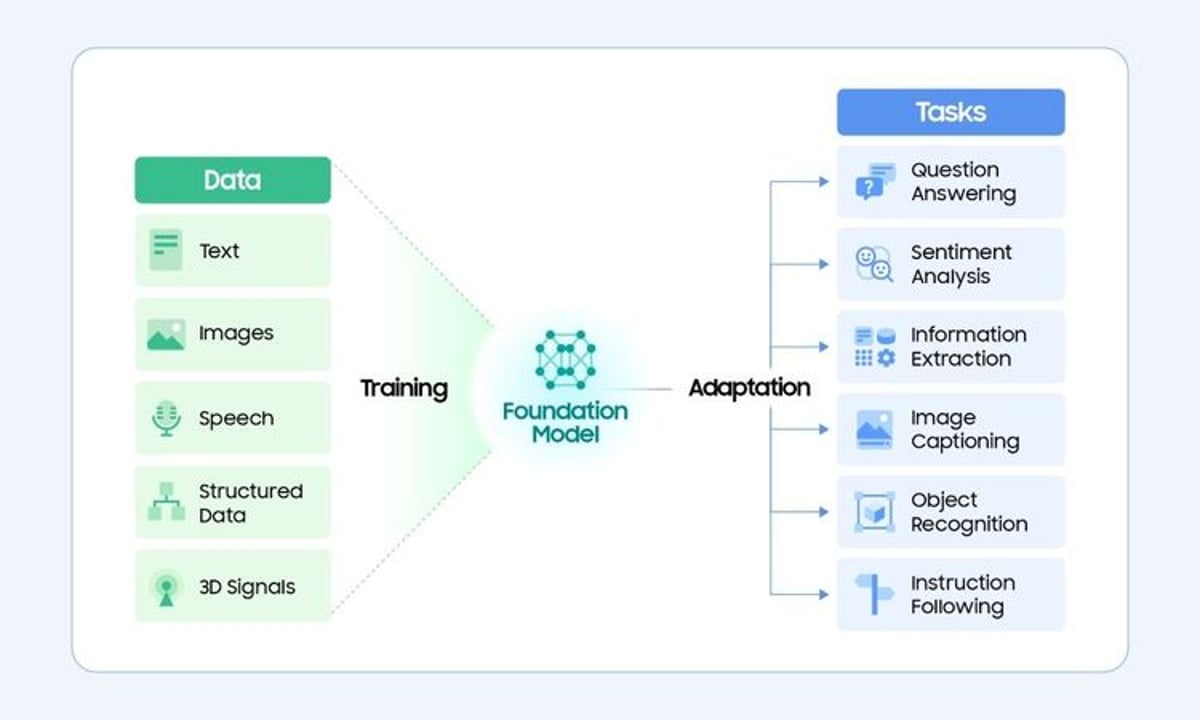
Both xMAE and HiMAE employ self-supervised learning, meaning they extract meaningful features from unlabeled biosignal data. After pretraining on large-scale health datasets, the models can be fine-tuned for specific downstream tasks - biosignal analysis, biomarker development, health issue prediction. It's the same approach that powered the language model revolution, now applied to the body's electrical and optical signals.
The broader context: Samsung is racing Apple and Google to define the next era of wearable health. Apple dominates with tight hardware-software integration and FDA-cleared features like ECG and AFib detection. Google acquired Fitbit and is integrating health AI across Pixel Watch and Android. Samsung's bet is foundation models that generalize across many health tasks from a single pretrained architecture.
The Connected Care vision outlined at Galaxy Unpacked positions Samsung as moving beyond isolated health metrics toward holistic, predictive monitoring. Foundation models are essential infrastructure for that shift. They need to understand physiological relationships - how heart rate, sleep, activity, and stress interconnect - and temporal structures that unfold across minutes, hours, and days.
Researchers Sharanya Desai and Subbu Venkatraman lead the work at Samsung Research America's Digital Health Team. Their focus: developing AI that continuously understands a person's health state from biosignals, generates actionable insights, and offers appropriate guidance. The xMAE and HiMAE papers represent academic validation - acceptance at ICML and ICLR signals the research community views this work as significant.
But academic papers don't ship products. The real test comes when these models land in Galaxy Watch devices and Samsung Health experiences. Can they deliver insights users actually understand and act on? Will on-device processing truly eliminate latency and privacy friction? Can Samsung translate technical superiority into consumer trust?
The competitive dynamics are shifting fast. Meta is exploring health AI through its Ray-Ban smart glasses. OpenAI and Microsoft are pushing multimodal models that could eventually interpret health data. Nvidia is selling chips purpose-built for edge AI. The wearable health market is fragmenting into those who own the silicon, the sensors, the models, and the user relationships.
Samsung's advantage: it controls the full stack. It manufactures the chips, designs the sensors, trains the models, and ships the watches. That vertical integration matters when you're trying to optimize AI models to run in under a millisecond on wrist-worn hardware. It also matters for data privacy - keeping biosignals on-device sidesteps regulatory scrutiny and user concerns about health data in the cloud.
The research also hints at cross-device potential. xMAE's ability to generalize across different sensor devices and body locations suggests Samsung could deploy similar models in earbuds, smart rings, or even embedded clothing sensors. HiMAE's efficiency means the same foundation model architecture could scale from watches to phones to tablets, each analyzing health data at the edge.
What's missing from the announcement: real-world accuracy rates, battery impact, and commercialization timelines. Foundation models are computationally expensive. Running them continuously on battery-powered wearables introduces engineering challenges Samsung hasn't fully disclosed. And while benchmark performance looks strong, clinical validation is a different bar - one Apple has cleared with FDA clearances Samsung hasn't yet matched.
Samsung's xMAE and HiMAE models mark a technical leap in wearable health AI, but the real battle is commercialization. Foundation models that run on-device, analyze biosignals in real time, and generalize across health tasks sound transformative - until they have to prove accuracy, preserve battery life, and earn FDA clearance. Apple and Google aren't standing still. The company that cracks personalized, predictive health monitoring while maintaining user trust will define the next decade of wearables. Samsung just put serious chips on the table.