NVIDIA just unveiled BlueField-4 STX, a modular reference architecture designed to solve one of agentic AI's biggest bottlenecks: storage infrastructure that can handle long-context reasoning at scale. The announcement comes as enterprises and cloud providers scramble to deploy AI systems that need to process massive amounts of contextual data in real-time. This isn't just another chip announcement - it's NVIDIA positioning itself as the backbone for the next wave of AI deployment, where autonomous agents need instant access to vast knowledge stores.
NVIDIA is making its move on the AI infrastructure stack, and storage is the new battleground. The company's BlueField-4 STX architecture announcement represents a calculated bet that agentic AI - autonomous systems that reason, plan, and act - will create unprecedented storage demands that traditional infrastructure can't handle.
The timing couldn't be more strategic. As companies like OpenAI, Anthropic, and enterprises worldwide race to deploy AI agents that can process documents, code, and data spanning millions of tokens, they're hitting a wall. Current storage systems weren't built for the kind of rapid, context-heavy retrieval that agentic AI demands. An AI agent analyzing legal contracts or debugging complex codebases needs to pull relevant information from massive knowledge bases in milliseconds, not seconds.
BlueField-4 STX tackles this through what NVIDIA calls a "modular reference architecture" - essentially a blueprint that cloud providers and enterprises can use to build accelerated storage systems. The STX designation stands for Storage Transformation eXpress, and it's built around NVIDIA's BlueField-4 data processing units that offload storage operations from CPUs while accelerating data movement.
What makes this announcement significant is the "broad industry adoption" language. While NVIDIA hasn't released specific partner names yet, the phrasing suggests major cloud providers and enterprise vendors are already committing to the architecture. That's crucial because storage infrastructure decisions are sticky - once a hyperscaler builds out BlueField-4 STX systems, they're locked into NVIDIA's ecosystem for years.
The architecture leverages NVIDIA's DPU technology to create what the company describes as "composable" storage infrastructure. Instead of fixed storage arrays, enterprises can dynamically allocate storage resources based on workload demands. For agentic AI applications, this means scaling storage capacity and performance independently as models grow and context windows expand.
Long-context reasoning is the killer feature here. Modern AI agents increasingly work with context windows extending to millions of tokens - the equivalent of entire codebases, document repositories, or customer interaction histories. Retrieving and processing this contextual data fast enough to maintain conversational response times requires storage systems that can deliver sustained throughput measured in terabytes per second, not gigabytes.
NVIDIA's pitch is that BlueField-4 STX provides the plumbing for this new reality. The architecture includes hardware acceleration for common storage operations, compression algorithms optimized for AI workloads, and integration with NVIDIA's broader AI software stack including CUDA and NeMo frameworks. It's the kind of vertical integration that's become NVIDIA's calling card - sell the whole stack, not just components.
The broader competitive context matters too. Intel has its Infrastructure Processing Unit line, AMD acquired Pensando for similar technology, and Marvell offers competing DPU solutions. But NVIDIA's advantage is ecosystem lock-in - if you're already running NVIDIA GPUs for AI training and inference, BlueField-4 STX promises tighter integration and better performance.
For cloud providers, the economics are compelling. Offloading storage operations to specialized DPUs frees up expensive CPU cores for revenue-generating compute workloads. According to industry analysts, DPU-based storage architectures can reduce total cost of ownership by 30-40% compared to traditional approaches, while delivering 3-5x better performance for AI workloads.
The agentic AI angle is where this gets really interesting. Companies deploying AI agents for customer service, software development, or enterprise operations need storage systems that can handle unpredictable access patterns - an agent might need to retrieve specific emails from five years ago, correlate them with recent Slack conversations, and cross-reference product documentation, all within a single query. Traditional storage optimized for sequential access or predictable caching patterns struggles with this chaos.
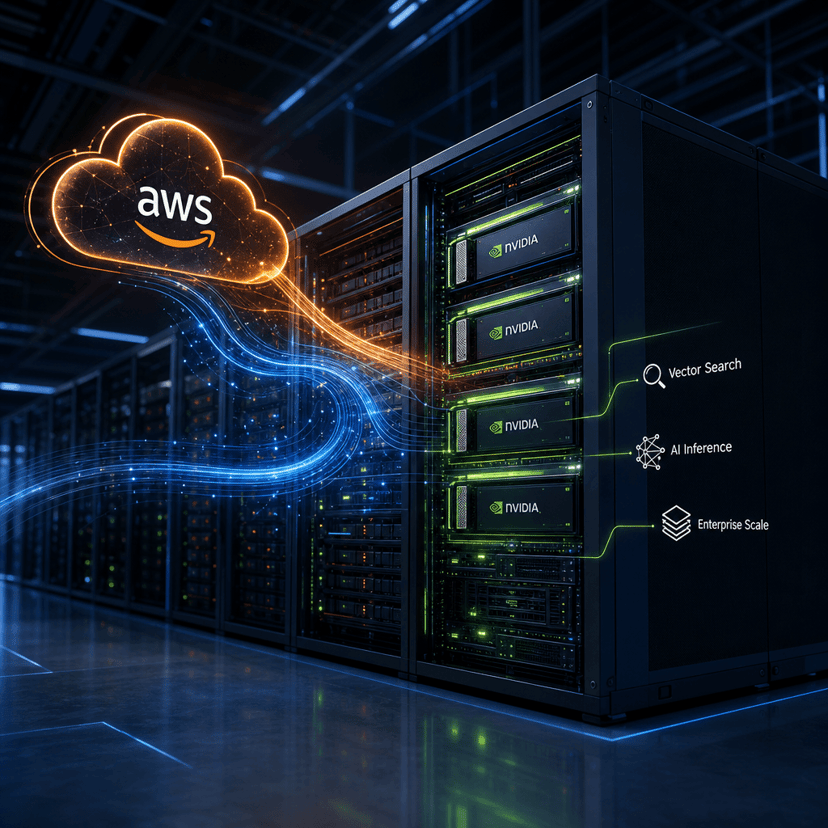
NVIDIA's also betting on retrieval-augmented generation becoming standard practice. RAG architectures, where AI models query external knowledge bases rather than relying solely on training data, are exploding in enterprise adoption. BlueField-4 STX is purpose-built for RAG workloads, with optimizations for vector database operations and similarity search - the core primitives of retrieval systems.
The modular architecture approach is smart positioning. Rather than forcing customers into proprietary hardware, NVIDIA provides reference designs that can be implemented across different vendors' systems. It's the playbook that made CUDA successful - create a standard that others implement, ensuring NVIDIA technology becomes infrastructure.
What we're watching here is NVIDIA expanding from AI compute into AI infrastructure holistically. The company already dominates training and inference with its GPUs, controls the software layer with CUDA, and now it's moving into networking and storage. It's vertical integration designed to capture more of the AI infrastructure spend as the market shifts from research projects to production deployments at massive scale.
NVIDIA's BlueField-4 STX launch signals that the AI infrastructure war is expanding beyond GPUs into every layer of the stack. As agentic AI moves from demos to production, the companies that control the underlying storage, networking, and processing infrastructure will capture outsized value. For enterprises evaluating AI infrastructure investments, the message is clear - storage is no longer just storage when AI agents need to reason across millions of tokens in real-time. The question now is whether NVIDIA's competitors can mount credible alternatives before the ecosystem solidifies around BlueField architecture, or if we're watching another CUDA-style lock-in play unfold in storage infrastructure.