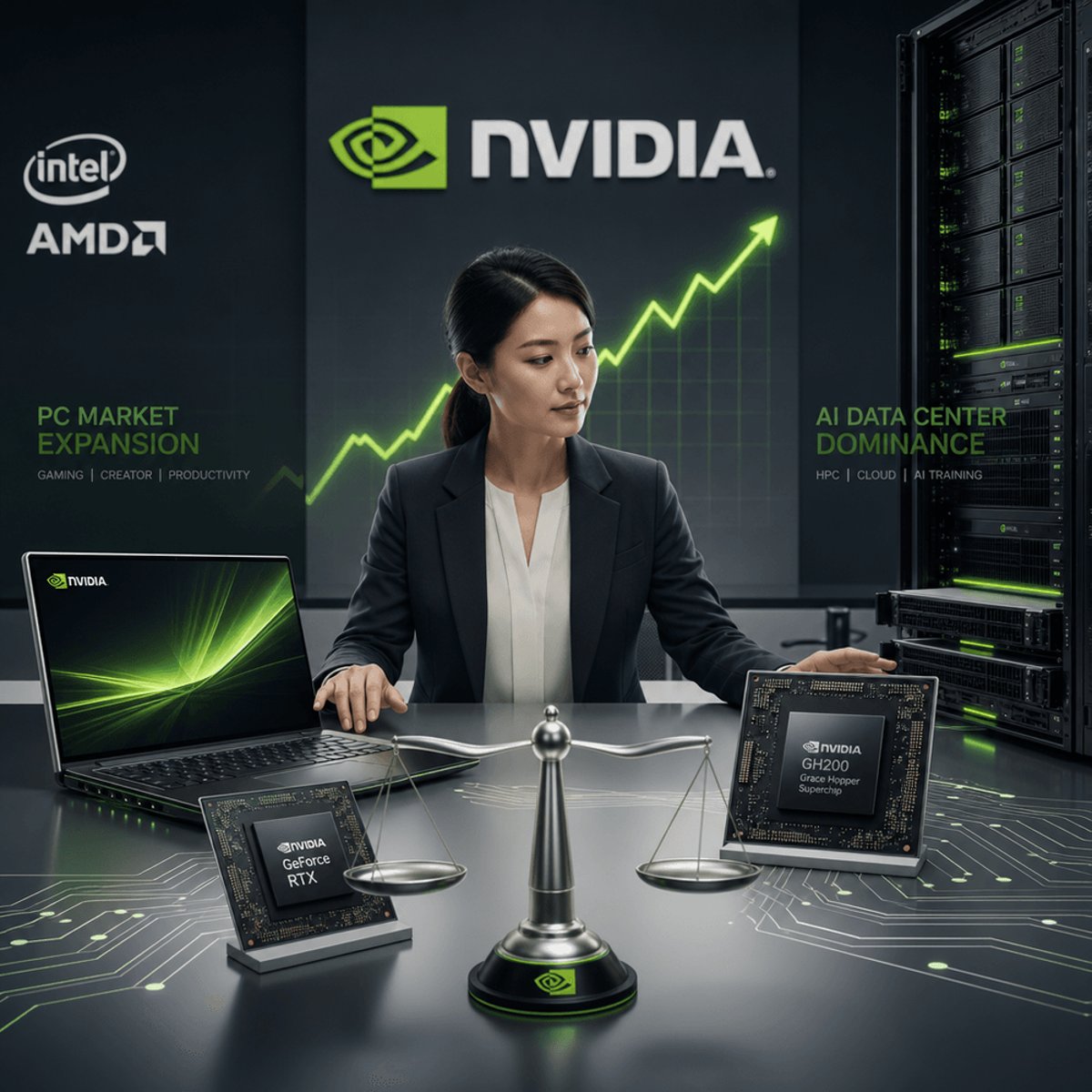
Nvidia is making a calculated play into the PC market, giving investors a fresh reason to bet on the chip giant beyond its AI data center dominance. The move marks a strategic expansion into consumer hardware that could diversify revenue streams just as competition heats up in its core business. With the company's stock already riding high on AI demand, this PC push signals Nvidia isn't content to rely on server farms alone.
Nvidia just broadened its investment thesis in a way that could reshape how Wall Street values the chip maker. The company's entrance into the consumer PC market represents more than just another product line - it's a hedge against over-reliance on data center spending that currently drives 80% of revenue.
The timing couldn't be more strategic. While Nvidia has dominated AI infrastructure with its H100 and upcoming Blackwell chips, the PC market offers something data centers can't: predictable consumer refresh cycles and direct retail relationships. Analysts at major investment firms have been quietly flagging concentration risk in Nvidia's customer base, where a handful of hyperscalers like Microsoft, Google, and Meta account for the bulk of orders.
"The investment case just got materially stronger," according to market observers tracking the semiconductor space. By entering PCs, Nvidia taps into a $200 billion annual market where chip upgrades happen every 3-4 years like clockwork. That's a stark contrast to enterprise AI spending, which can swing wildly based on economic conditions and CapEx budget battles.
The PC play builds on Nvidia's existing RTX gaming GPU business, but with a twist - the company appears positioned to challenge Intel and AMD in CPU territory rather than just handling graphics. This puts Nvidia in direct competition with chips that power everything from budget laptops to high-end workstations. The implications for margin structure are significant, since PC processors traditionally carry lower gross margins than data center accelerators but deliver volume scale that smooths revenue volatility.
Investors have already priced Nvidia as an AI infrastructure play, with the stock trading at premium multiples based on data center growth projections. Adding a consumer PC division changes the valuation calculus by introducing a second major revenue pillar. It's the kind of diversification that typically compresses volatility and attracts a broader investor base, from growth funds to dividend-focused portfolios looking for stability.
The competitive landscape is messy but opportunity-rich. Intel has stumbled through manufacturing delays and market share losses, while AMD has focused heavily on server chips. Apple dominates its own ecosystem with custom silicon but doesn't play in the Windows PC market where Nvidia would compete. That leaves an opening for a third architecture to grab design wins, especially as AI-capable PCs create demand for more powerful local processing.
The financial math is compelling. Even capturing 10% of the PC processor market could generate $20 billion in annual revenue - roughly matching what Nvidia pulled from data centers just two years ago. Add in the halo effect on GPU sales and software licensing, and the PC strategy starts looking like a material earnings driver rather than a side project. Gross margins might dip slightly as the mix shifts toward consumer products, but operating leverage from shared R&D and existing channel relationships should cushion the impact.
What makes this particularly interesting for investors is timing relative to AI infrastructure buildout cycles. Data center spending on AI accelerators will eventually plateau as major cloud providers complete initial deployments. Having a mature PC business ramping as data center growth moderates would provide the earnings offset analysts worry about when modeling out 2027 and beyond. It's the kind of strategic foresight that separates great chip companies from one-hit wonders.
The execution risk is real, though. Building competitive PC processors means going head-to-head with companies that have decades of x86 software compatibility and deep OEM relationships. Nvidia will need to convince laptop makers to take a chance on a new architecture while ensuring Windows and productivity apps run smoothly. That's not insurmountable - Apple proved ARM-based PCs can work - but it requires flawless execution on both silicon and ecosystem development.
Nvidia's PC market entrance transforms the investment narrative from a pure AI infrastructure play into a diversified semiconductor powerhouse. Investors now get exposure to both the high-growth data center business and the stable, predictable PC refresh cycle - a combination that could support premium valuations even as AI hype moderates. The execution challenges are significant, but the strategic logic is sound: broaden the revenue base before you need to. For shareholders, that's the kind of forward-thinking move that justifies holding through volatility and possibly adding on dips.