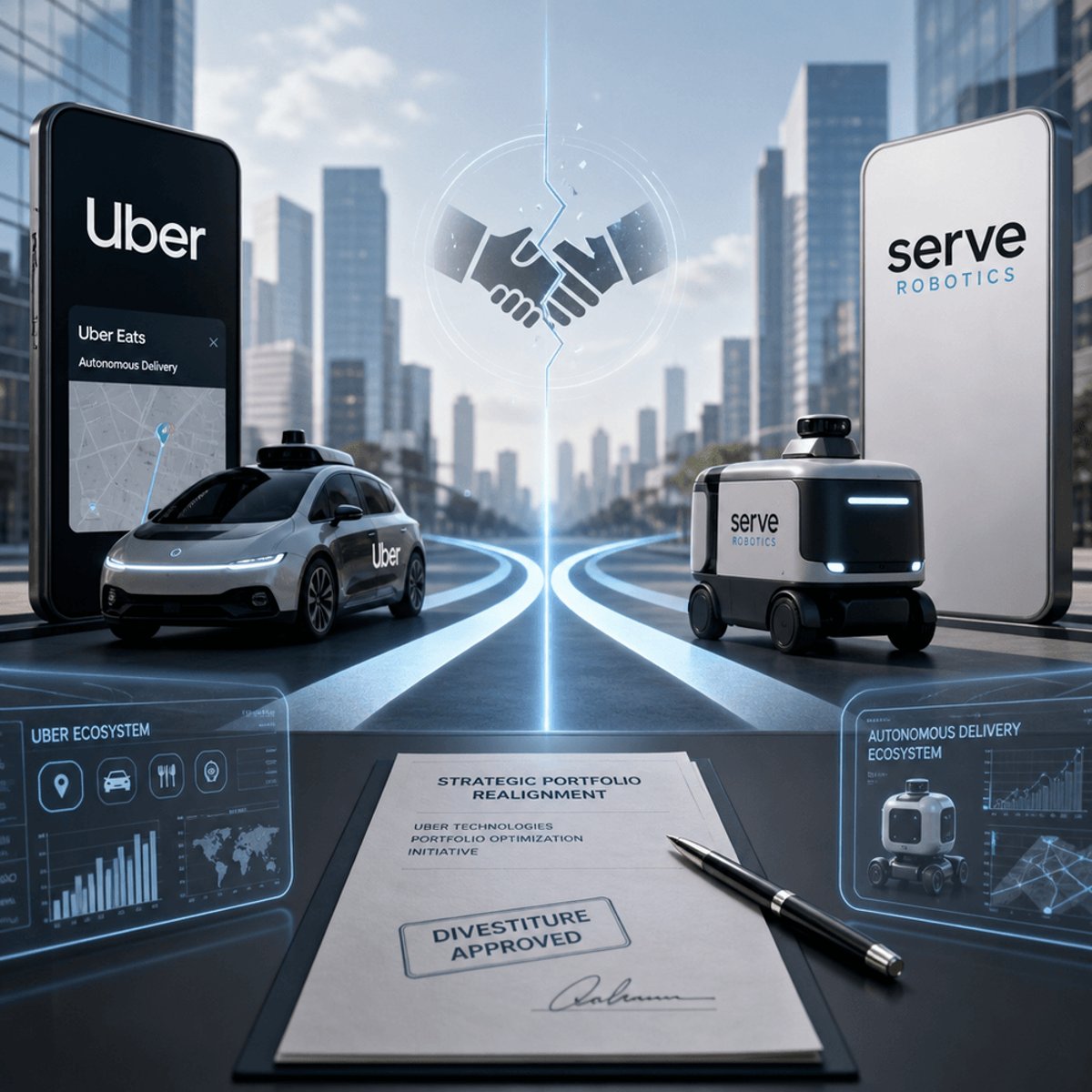
Uber just pulled off one of the more surprising exits in the robotics delivery space, selling its entire stake in Serve Robotics without giving the company advance notice. The move marks a dramatic shift in what was once a tight partnership between the ride-hailing giant and the sidewalk delivery robot maker, signaling deeper strategic divergence as both companies chart different paths in the autonomous delivery wars.
Uber just dropped a bombshell on its former partner Serve Robotics, offloading its entire equity position without any heads-up to the delivery robot company. The surprise move, reported by TechCrunch, represents a clean break between two companies whose fortunes were once tightly intertwined.
The timing couldn't be more telling. As the two companies have started to diverge on the business side, Uber appears to be sending a clear message about where it sees the future of autonomous delivery. And apparently, that future doesn't include small sidewalk robots navigating urban streets at walking speed.
Serve Robotics emerged from Postmates' innovation lab, and when Uber acquired Postmates for $2.65 billion back in 2020, it inherited a stake in what would become an independent robotics company. At the time, the partnership seemed like a natural fit. Uber got exposure to cutting-edge last-mile delivery technology, while Serve gained access to Uber's massive delivery network and customer base.
But that was then. Now, Uber is making bigger bets on autonomous vehicles through partnerships with companies like Waymo and Cruise, focusing on robotaxis and larger autonomous delivery vehicles that can handle more substantial payloads. The strategic shift makes Serve's sidewalk robots - designed to deliver single restaurant orders within a couple of miles - look increasingly tangential to Uber's core vision.
The fact that Serve Robotics was apparently blindsided by the sale adds another layer to the story. When a major investor exits without warning, it typically signals either urgent portfolio rebalancing or a fundamental loss of confidence in the strategic fit. In this case, it looks like the latter.
Serve has been building out its fleet of autonomous delivery robots across select U.S. cities, partnering with restaurant chains and delivery platforms to offer an alternative to human couriers for short-range deliveries. The company went public through a SPAC merger, giving it the capital to scale operations. But scaling in robotics is expensive, and losing a strategic partner like Uber - even if just as a shareholder - removes a potential distribution advantage.
For Uber, the divestiture cleans up its portfolio at a time when the company is laser-focused on profitability and streamlining its bets. After years of experimental investments in everything from flying taxis to autonomous trucks, Uber has been disciplined about cutting loose projects that don't align with its core delivery and mobility businesses. Apparently, small delivery robots didn't make the cut.
The broader autonomous delivery market is at an inflection point. While companies like Starship Technologies have deployed thousands of delivery robots on college campuses and in suburban neighborhoods, the business model remains challenging. Unit economics are tough when robots move slowly, require human supervision, and can only handle small payloads.
Meanwhile, Uber Eats continues to dominate food delivery through its existing network of human couriers and is experimenting with drone delivery in select markets. The company's recent partnership expansions suggest it's betting on a hybrid future - humans for most deliveries, drones for specific use cases, and autonomous cars for larger orders. Sidewalk robots just don't fit neatly into that picture.
The sale also reflects broader investor sentiment around robotics startups. After years of hype and heavy funding, the market is demanding clearer paths to profitability. Companies that can't demonstrate strong unit economics or strategic value to major platforms are finding it harder to maintain investor support.
What remains unclear is who bought Uber's stake and at what valuation. If the shares went to strategic investors who see value in Serve's technology and market position, it could actually benefit the robotics company by bringing in partners more aligned with its vision. But if it was a fire sale to financial investors, that's a different story.
For Serve Robotics, the immediate challenge is proving it can succeed without Uber's backing or potential integration benefits. The company will need to demonstrate that its technology and business model can stand on their own, attracting customers and partners based purely on the merits of autonomous sidewalk delivery.
Uber's surprise exit from Serve Robotics is more than just a portfolio adjustment - it's a clear signal about how the delivery giant sees the future of autonomous logistics. As both companies pursue divergent strategies, the split was probably inevitable. For Serve, the real test starts now: proving that small delivery robots can build a sustainable business without the backing of a delivery platform giant. For Uber, it's another step in its ongoing evolution from experimental tech investor to focused, profitable operator. The autonomous delivery future is still being written, but this chapter just ended abruptly.