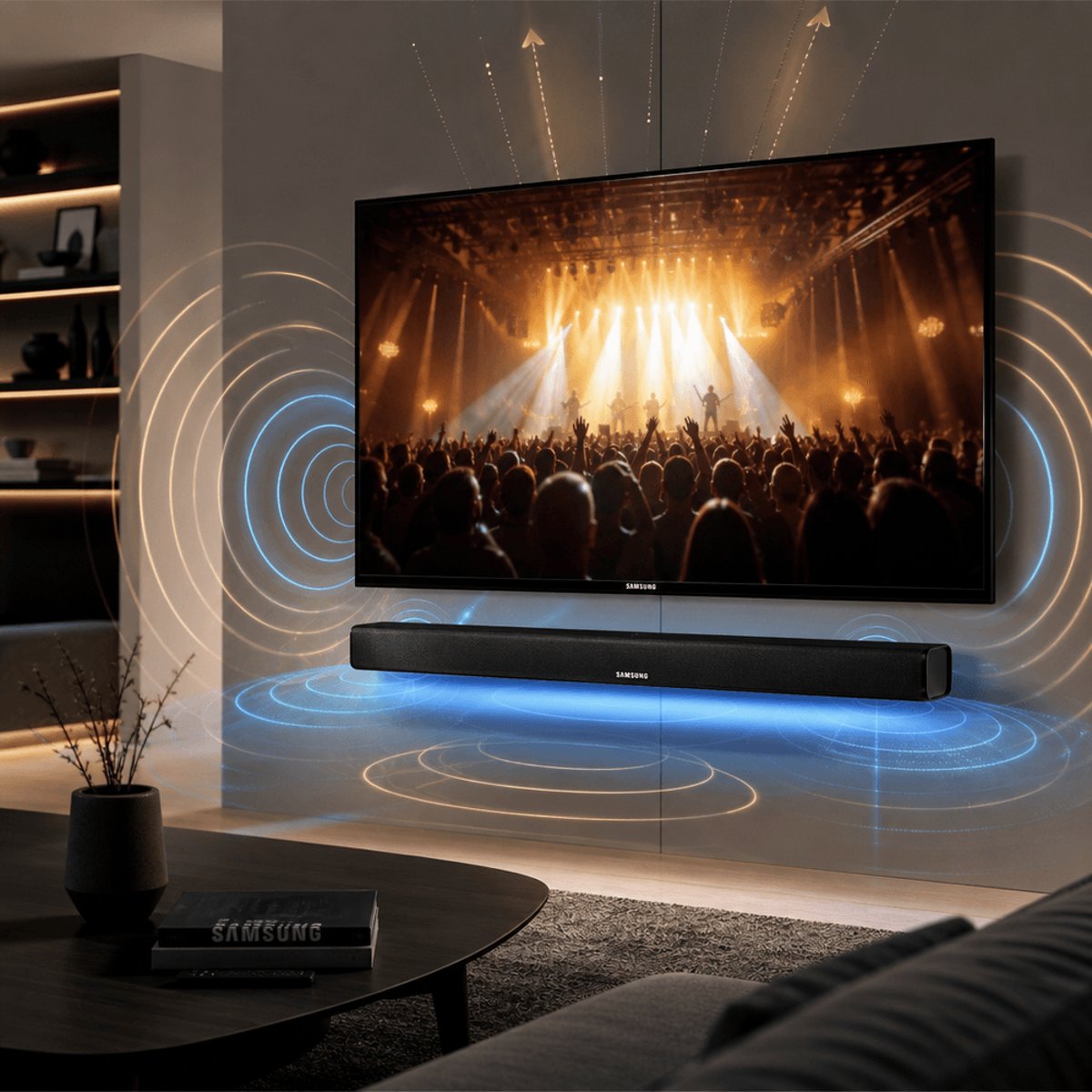
Samsung is bringing concert-hall acoustics to living rooms with Eclipsa Audio, a 3D spatial audio technology now live on Samsung TV Plus. Developed jointly with Google and built on the open IAMF standard, the tech recreates the immersive sound of live venues - from performers' voices to audience reactions - through Samsung TVs and soundbars. It's rolling out first for musicals and live performances, with plans to expand into K-pop concerts, sports, and movies.
Samsung is betting that better audio can turn free streaming into a front-row experience. The company just rolled out Eclipsa Audio across Samsung TV Plus, its ad-supported streaming service, bringing 3D spatial sound to musicals and live performances. It's the first major deployment of audio tech built on IAMF - Immersive Audio Model and Formats - an open standard Samsung and Google developed together.
"People can now enjoy the excitement of musicals and live performances from home," Joonhun Choi, Head of Samsung TV Plus, told Samsung Newsroom. "While Samsung TV Plus makes this content more accessible, Eclipsa Audio recreates the rich, immersive sound of the venue in the living room."
The technology works by embedding spatial information - front, back, left, right, and height - directly into the audio stream. Unlike traditional stereo that limits sound to left and right channels, Eclipsa Audio positions each element in three-dimensional space. Performers' voices stay centered and clear, the orchestra wraps around the virtual stage, and audience reactions feel like they're coming from all directions. The system then adapts that spatial data to match whatever hardware is playing it back, whether that's a TV's built-in speakers or a paired soundbar.
Woohyun Nam, who leads the Display Innovation Lab at Samsung Research, explained the technical challenge: "Eclipsa Audio goes beyond stereo by reproducing sound in three-dimensional space. Performers' voices, musical instruments, venue acoustics and audience reactions are reproduced with their original positioning intact, making viewers feel as though they're sitting in the audience."
Getting spatial audio onto a free streaming service required solving problems most premium platforms don't face. Samsung TV Plus runs on ads, which means Eclipsa Audio content has to transition seamlessly to stereo commercials without disrupting timing or sync. The teams also had to ensure smooth playback across every device configuration - TVs alone, TVs with soundbars, and older models that don't support the format at all. Unsupported devices automatically fall back to standard stereo.
The most critical test happened in a 280-seat concert venue with a professional sound engineering company. Samsung Research captured a live performance's spatial audio, converted it to Eclipsa Audio, streamed it through a Samsung TV Plus channel in real time, and played it back on a Samsung TV. They verified that music, vocals, audience reactions, and venue acoustics translated accurately from the physical space to the home setup.
"One of the most important tests took place in a 280-seat concert venue," Nam said, according to the Samsung Newsroom interview. "We verified that the music, vocals, audience reactions and venue acoustics were recreated accurately, validating both the technology and viewing experience."
The choice to build on IAMF - an open standard independent of proprietary codecs or licensing models - sets Eclipsa Audio apart from closed ecosystems like Dolby Atmos. Because IAMF isn't tied to specific hardware or formats, Samsung can extend the technology across a wider range of content types and devices without licensing overhead. That matters for a free streaming service where margins are tighter and content partnerships move faster.
Early user feedback has been strong. Some viewers told Samsung that certain scenes felt more satisfying than watching from a small theater, while others noticed a clear difference compared to content without spatial audio. Choi recommends pairing a Samsung TV with a Samsung soundbar to get the full multi-channel experience, and using the Multi-Cam feature to switch between full-stage and close-up views during key moments.
Samsung's roadmap extends well beyond musicals. The company plans to bring Eclipsa Audio to K-pop concerts, classical performances, movies, and sports - categories where realistic sound positioning can dramatically change the viewing experience. For sports, that could mean choosing between commentary and venue sound. For music, viewers might eventually emphasize specific instruments or vocals.
"Beyond musicals, we plan to expand Eclipsa Audio to K-pop concerts, classical performances, movies and sports," Choi said. "Ultimately, we want Samsung TV Plus to become a platform for live entertainment, making high-quality performances accessible to everyone, anytime, and anywhere."
Nam's team at Samsung Research is already thinking about personalization. Long term, they want the technology to disappear entirely - viewers just turn on their TV and feel like they're at a live performance or in the middle of a stadium. The vision, as Nam describes it: "Spatial Audio for Everyone, where anyone can enjoy Eclipsa Audio through Samsung TV Plus."
For Samsung, Eclipsa Audio represents a convergence play. The company controls the entire stack - the research lab developing audio tech, the Visual Display business manufacturing TVs and soundbars, and the streaming service delivering content. That vertical integration lets Samsung test and deploy features faster than competitors who rely on third-party platforms or hardware. It also positions Samsung TV Plus as more than a free content library - it's becoming a testbed for next-generation viewing experiences.
The move comes as streaming services look for new ways to differentiate beyond content libraries. Spatial audio has mostly been a premium feature tied to subscription services and high-end hardware. By bringing it to a free, ad-supported platform, Samsung is betting that better audio can drive engagement and content partnerships without raising prices.
Samsung's Eclipsa Audio push reveals how hardware makers are leveraging vertical integration to create differentiated streaming experiences. By controlling the research, manufacturing, and distribution layers, Samsung can deploy spatial audio features without waiting for third-party adoption or licensing deals. The real test will be whether better sound drives meaningful engagement on a free platform - and whether content partners see value in producing IAMF-formatted audio at scale. If it works, expect competitors to fast-track their own spatial audio strategies for streaming.