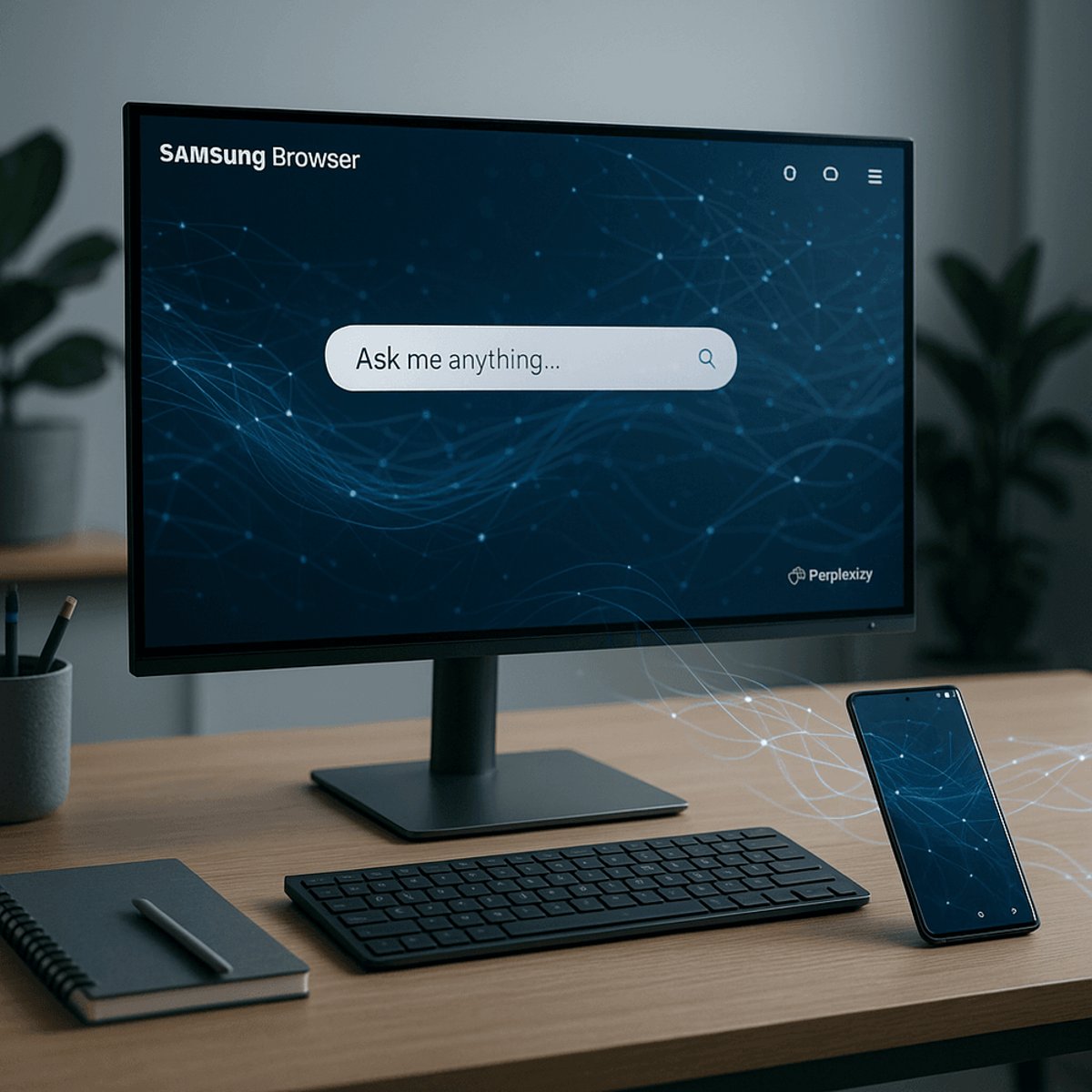
Samsung just made its play for the desktop browser wars, launching Samsung Browser for Windows with agentic AI baked in. Partnering with Perplexity, the company is betting that natural language understanding and cross-device continuity can carve out space in a market dominated by Chrome and Edge. The browser doesn't just sync bookmarks - it picks up your exact scroll position from mobile to PC and lets you search video timestamps or browser history by asking questions in plain English.
Samsung isn't content staying in your pocket anymore. The company just launched Samsung Browser for Windows, extending its mobile browser to desktop with a twist - agentic AI that actually understands what you're doing across tabs, devices, and browsing sessions.
The move puts Samsung in direct competition with Google Chrome and Microsoft Edge on their home turf. But Samsung's betting on something different: seamless continuity between your Galaxy phone and any Windows PC, powered by AI that goes beyond simple chatbot responses.
According to Samsung's announcement, the browser doesn't just sync your bookmarks and history. It remembers exactly where you left off on a webpage when switching from mobile to PC - down to your scroll position. That level of continuity requires the latest Samsung Account and either Samsung Continuity Service or the Galaxy Connect app, currently working on Galaxy Book3, 4, 5, and 6 series devices.
The real differentiator is the Perplexity partnership. Samsung's building agentic AI directly into the browser that understands page context, not just keywords. Planning a trip to Seoul? Ask the browser to create a four-day itinerary based on the travel blog you're reading, and it analyzes the content to generate a structured plan.
But Samsung's going deeper than content summarization. The AI can search inside video content to find specific moments and jump to exact timestamps. Instead of scrubbing through a 20-minute tutorial to find the part about troubleshooting, you ask the browser to find it and it starts playback right there.
Natural language search extends to your browsing history too. Forget trying to remember if you looked at that smartwatch on Tuesday or Wednesday - just ask the browser to find "the smartwatch I was looking at last week" and it retrieves the right page.
The multi-tab awareness is where things get interesting for power users. Samsung Browser can analyze content across multiple open tabs simultaneously, comparing information and surfacing key insights without you clicking through each one. That's genuinely useful for research or comparison shopping, assuming the AI can actually parse complex information accurately.
Samsung Pass integration brings secure autofill for login credentials and personal information across devices, though available functions vary by country due to regulatory differences.
The catch? Agentic AI features are currently only supported in South Korea and the United States, with Samsung promising expansion to additional markets "in the future." Android users need Samsung Browser v29.0.4 or above, and everything requires a Samsung Account and network connection. Search queries may be limited, and Samsung's own disclaimer notes that "accuracy of results is not guaranteed."
That last part matters. Agentic AI sounds transformative until it hallucinates information or misinterprets context. Samsung's essentially putting Perplexity's AI - which has faced its own accuracy questions - at the center of the browsing experience.
The Windows availability is broad: any device running Windows 11 or Windows 10 version 1809 and above. That's a massive potential install base, but Samsung faces an uphill battle convincing users to switch from browsers they've used for years.
Google and Microsoft aren't standing still either. Both companies are racing to integrate AI into Chrome and Edge, with Copilot and Gemini features rolling out steadily. Samsung's advantage is the ecosystem play - if you own a Galaxy phone and Galaxy Book laptop, the continuity features offer genuine utility.
The launch signals Samsung's broader strategy to build software ecosystems that keep users locked into its hardware. It's not enough to sell phones and laptops anymore; the company wants to own the experience across devices. Browser market share is notoriously sticky, but Samsung has distribution leverage through its own hardware and the trust of users who already rely on Samsung Internet on mobile.
Whether agentic AI proves compelling enough to drive browser switching remains the open question. Natural language search and multi-tab analysis sound great in demos, but daily reliability determines whether users actually stick around or retreat to Chrome's familiar interface.
Samsung's Windows browser launch represents a calculated bet that AI-powered continuity matters more than brand loyalty in the browser wars. The Perplexity partnership delivers genuinely novel features - video timestamp search and multi-tab analysis could change how power users research and compare information. But Samsung faces the classic chicken-and-egg problem: users won't switch without compelling features, and developers won't optimize for Samsung Browser without significant market share. Success hinges on whether the Galaxy ecosystem is sticky enough to drive adoption and whether the agentic AI proves reliable enough for daily use. For now, it's available at browser.samsung.com for anyone willing to try something different from Chrome's dominance.