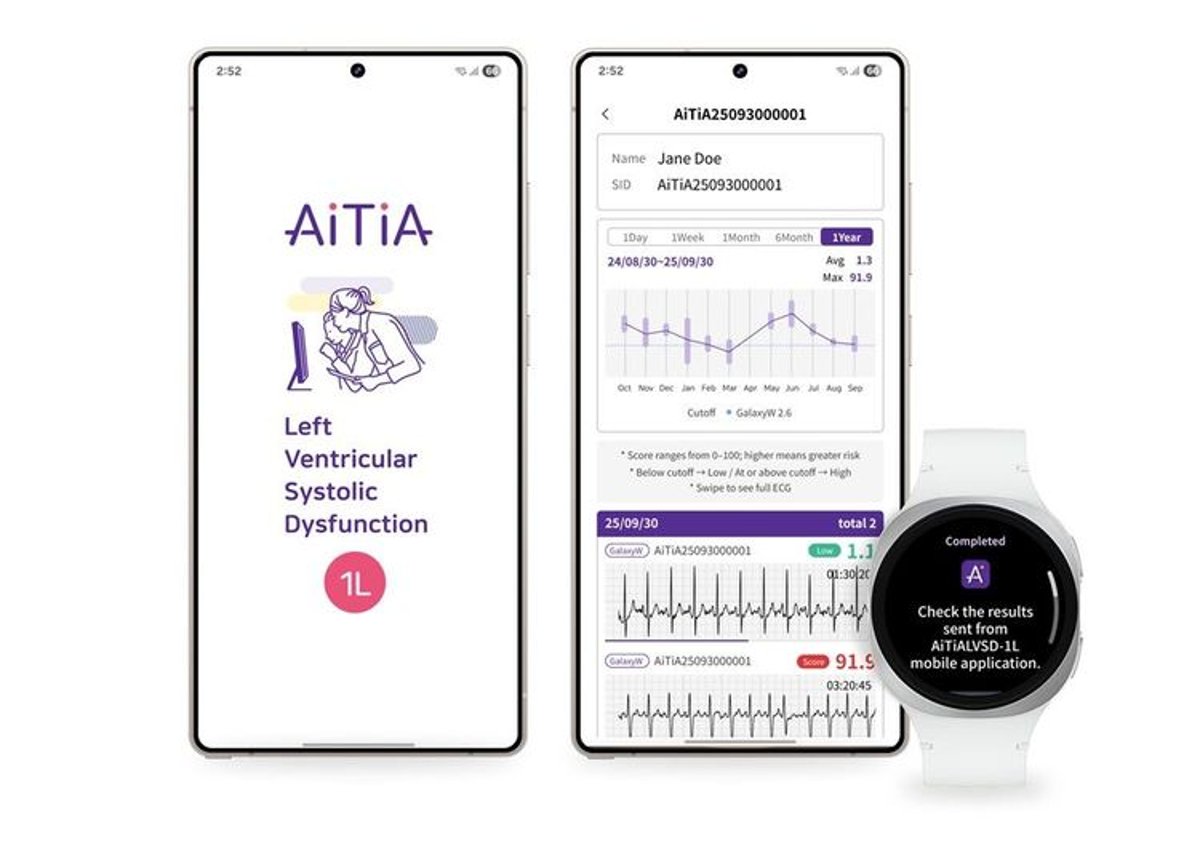
Samsung just dropped a healthcare bombshell that could save millions of lives. The tech giant unveiled the world's first smartwatch capable of detecting Left Ventricular Systolic Dysfunction - a heart condition more fatal than some cancers that affects 50% of heart failure cases. But that's not all: they're also pioneering brain-computer interfaces that can read your drowsiness and video preferences with 92% accuracy.
Samsung just rewrote the playbook for wearable health tech with two breakthrough announcements that sound like science fiction but are hitting the market now. The Korean giant secured regulatory approval for the world's first smartwatch capable of detecting Left Ventricular Systolic Dysfunction (LVSD), a cardiovascular condition responsible for roughly half of all heart failure cases and deadlier than many cancers.
The timing couldn't be more critical. Heart failure kills more people than you'd expect - patients face just a 50% survival rate five years after diagnosis, making early detection absolutely crucial for treatment success. "As a result, early detection of LVSD is critical, as timely diagnosis along with medication and lifestyle adjustments, can significantly reduce hospitalization and lower the risk of death," according to Samsung's official announcement.
What makes this different from typical health tracking features? Samsung didn't go it alone. They partnered with Medical AI, a Korean medical device specialist that's already deployed their ECG algorithms across over 100 major hospitals in Korea, processing data for more than 120,000 patients monthly. This isn't experimental tech - it's clinically proven, real-world medicine now shrunk down to fit on your wrist.
The South Korea Ministry of Food and Drug Safety (MFDS) gave their stamp of approval, making Samsung's device the first smartwatch to gain official LVSD detection capabilities. That regulatory win signals confidence in the technology's accuracy and reliability for consumer use.
But Samsung's health ambitions extend far beyond heart monitoring. In a separate collaboration with Hanyang University's Department of Biomedical Engineering, they've developed an "around-the-ear" electroencephalogram (EEG) prototype that turns brain-computer interfaces from bulky lab equipment into sleek, wearable devices.
This isn't your typical fitness tracker expansion - we're talking about reading actual brainwaves. The Ear-EEG prototype delivered impressive real-world results during testing. It accurately detected drowsiness onset in real-time, potentially revolutionizing everything from student focus to driver safety. Even more intriguingly, the device analyzed participants' brainwaves to identify their video preferences with 92.86% accuracy.
"Using artificial intelligence to analyze brainwaves, the device identified participants' personal video preferences with 92.86% accuracy, pointing to potential applications in neuromarketing and entertainment," Samsung reported in their research findings published in the IEEE Sensors Journal.
Professor Chang-Hwan Im from Hanyang University emphasized the broader implications: "The technology we developed is not limited to education and marketing but has the potential to expand into diverse fields such as entertainment and mental health management." The research was selected as the sole feature article in Volume 25, Issue 18 of the prestigious IEEE publication.
The market timing looks perfect for Samsung's health tech push. Healthcare costs continue spiraling upward, especially for chronic conditions like heart failure that require expensive emergency interventions. Samsung's approach targets the problem at its source - catching issues before they become medical crises requiring hospitalization.
What's especially clever about Samsung's strategy is their focus on partnerships rather than going solo. The Medical AI collaboration brings hospital-grade accuracy to consumer devices, while the university partnership ensures their brain-computer interface research meets academic standards for peer review and publication.
This dual announcement positions Samsung well ahead of competitors in the health wearables race. While others focus on basic fitness metrics, Samsung's diving deep into medical-grade diagnostics that could genuinely save lives. The LVSD detection alone addresses a massive unmet need - heart failure affects millions globally, yet many cases go undiagnosed until it's too late.
The brain-computer interface work opens even more intriguing possibilities. Beyond detecting drowsiness or video preferences, the technology could eventually help with mental health monitoring, cognitive assessment, or even direct device control through thought patterns. Samsung's making these applications sound less like distant future concepts and more like inevitable next steps.
Samsung's dual breakthrough represents more than incremental health tech improvements - it's a fundamental shift toward medical-grade diagnostics in consumer devices. The LVSD detection smartwatch addresses a genuine life-or-death health gap, while the brain-computer interface prototype opens entirely new categories of human-device interaction. With regulatory approval already secured and clinical partnerships providing credibility, Samsung's positioning itself to dominate the next generation of health wearables where the stakes are measured in lives saved, not just steps counted.