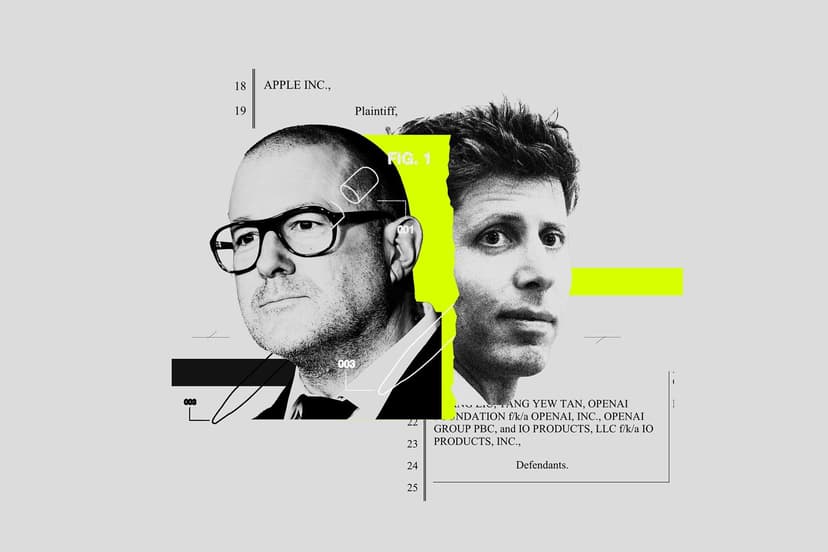
Apple just dropped a legal bombshell that could reshape the entire AI industry. The Cupertino giant's trade secrets lawsuit against OpenAI isn't just about hardware designs allegedly stolen during job interviews - it's about who gets to define the post-smartphone era. With OpenAI burning cash ahead of a delayed IPO and Apple playing its notoriously tenacious litigation card, this case exposes deeper questions about the AI industry's culture of "unauthorized taking" and whether consumer AI hardware can ever succeed.
Apple is doing what it does best - using intellectual property law as a weapon. But this time, the target might not be able to take the punch.
The company's trade secrets lawsuit against OpenAI reads like a corporate espionage thriller. According to Apple's filing, former Apple employees at OpenAI allegedly asked job candidates to reveal confidential project codenames, bring hardware prototypes outside Apple's offices for "show and tell" sessions, and even bragged about accessing Apple's confidential systems with "LOL! So funny that I can access this" messages.
At the center sits Tang Tan, OpenAI's chief hardware officer who spent 24 years at Apple as VP of the Apple Watch. According to Bloomberg's Mark Gurman, Tan had a reputation for "playing fast and loose" even at Apple. The lawsuit portrays him as the mastermind of a systematic effort to extract manufacturing secrets from Apple's supply chain.
But here's what makes this different from Apple's past IP wars. When Apple spent years battling Samsung over patents in the 2010s, Samsung could afford the $1 billion settlement and kept shipping Galaxy phones anyway. When Apple sued Microsoft over Windows in the '90s, Microsoft just kept going. Both companies had the resources and revenue to treat litigation as a cost of doing business.
OpenAI doesn't have that luxury. The company is burning cash, delaying its IPO, and shedding executives at a pace that would alarm any investor. "They cannot afford a distraction right now," The Verge's AI reporter Hayden Field told the Decoder podcast. "This is the IPO year. Things are coming to a head."
The lawsuit lands at a particularly awkward moment for OpenAI's hardware ambitions. The company acquired legendary Apple designer Jony Ive's AI hardware startup io Products for $6.5 billion in 2025, betting big that it could create the device to replace the iPhone. Ive and CEO Sam Altman even shot a video together calling phones and laptops "legacy devices" - a direct shot at Apple's core business.
Yet Ive's name appears nowhere in Apple's lawsuit. That's telling. Either Ive knew how to cover his tracks after decades navigating Apple's secrecy culture, or Apple decided not to cross certain lines with the man who designed the iPhone, iPod, and iMac alongside Steve Jobs. "When you're in a powerful enough role, you don't have to do all this stuff yourself," Field noted. "You have other people doing it for you."
The hardware strategy itself looks increasingly shaky. OpenAI is reportedly working on five different AI devices, starting with a screenless smart speaker. But the fundamental problem hasn't been solved - natural language input, the obvious interface for AI devices, still doesn't work reliably enough to replace a smartphone. "I just do not see a market when everyone is buying an OpenAI hardware device," Field said. "It's going to be one of those things that a few people really love and that the general public probably does not adopt."
This echoes the smartphone wars of 15 years ago, when Nokia, Palm, and Microsoft all tried to compete with iOS and Android with their own operating systems. They all failed. The bar for replacing the iPhone isn't just making something better - you need a Gmail client, Instagram, and access to your entire digital life. Are consumers going to hand all their personal data to OpenAI instead of Google or Apple? The answer seems pretty clearly no.
There's a deeper irony here that goes beyond this specific case. The entire AI industry is built on what could charitably be called "unauthorized taking" - training models on copyrighted books, scraped internet content, and as we just learned from a hack, all the music on YouTube. When Chinese companies distill their models, AI labs lose their minds about intellectual property theft. The cognitive dissonance is stunning.
Apple's lawsuit essentially asks: if you can take all the world's creative output without permission, why can't you take our hardware designs too? It's a question OpenAI has no good answer for. "I haven't seen any of them even acknowledge that or at least even hint toward it one time," Field said about the AI industry's blind spot on this issue.
The timing couldn't be worse for OpenAI's IPO plans. The company already backed off filing its S-1 after Anthropic beat them to it, and now faces the prospect of years of discovery, depositions, and trial preparation. Meanwhile, Anthropic is cleaning up in the enterprise market by positioning itself as the anti-OpenAI - running Super Bowl ads mocking ChatGPT's advertising model.
OpenAI recently pivoted to focus on "key revenue drivers" - enterprise and coding - after shutting down side projects like Sora and Atlas. But the hardware bet is too far along to abandon, even if it no longer makes strategic sense. "They can't afford to cut out this potential side quest because they've already spent a lot on it," Field explained.
The consumer AI gap remains unbridged. While OpenAI claims 900 million free ChatGPT users, that hasn't translated into cultural enthusiasm for AI products. College students are booing AI executives at graduations. Communities are fighting data centers. The Wall Street Journal reports AI CEOs receiving death threats as "AI populism" rises.
"People are extremely worried about so many things when it comes to AI and they're very emotional about it," Field observed. "It's not just logic. When emotions come into play, I don't think they will be able to fully bridge that gap."
Apple, meanwhile, can afford to be petty. The company spent $10 billion on a car project that went nowhere without breaking a sweat. It's shipping Apple Intelligence now with distilled Google Gemini models running in its Private Cloud Compute system. It's late to AI but catching up fast, and it has infinite resources to run this lawsuit for years.
OpenAI has Greg Brockman apparently running the entire company himself as executives keep leaving. Fidji Simo, the former AGI chief, recently departed due to health issues. The company keeps insisting it's all part of one master plan, but from the outside it looks like constant crisis management.
Whether Apple ultimately wins or loses this lawsuit may matter less than what it signals - that the "move fast and take things" era of AI is running into legal reality. Between copyright lawsuits over training data, trade secret cases like this one, and growing public backlash, the industry's assumption that it can just take whatever it needs to build AGI is being tested.
For OpenAI specifically, this lawsuit might be the thing that finally forces a hard pivot away from consumer dreams and toward enterprise reality. You can't fight Apple and build iPhone replacements at the same time, not when you're still trying to figure out how to turn a profit.
This lawsuit is bigger than stolen battery designs or job interview tactics. It's about whether OpenAI can survive the transition from AI darling to sustainable business while fighting legal battles on multiple fronts. Apple's proven it can push copyright, patents, and now trade secrets law to the limit in defense of its products. The difference is that Microsoft and Samsung could absorb those hits. OpenAI is discovering that disrupting the most valuable company in tech history requires more than just hiring its designers and hoping for the best. The post-smartphone era might still be coming, but OpenAI's path to defining it just got a lot more expensive and uncertain.