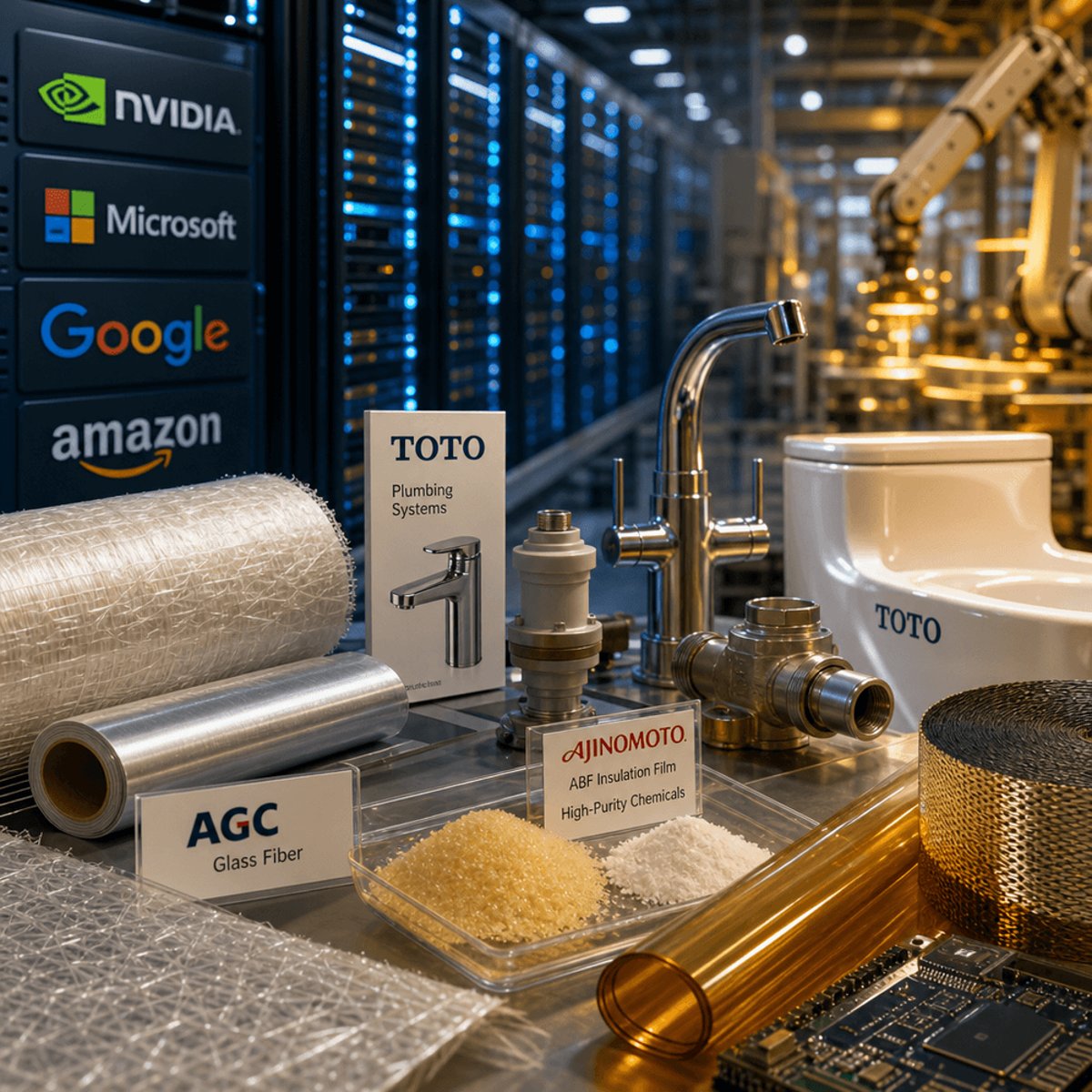
The AI gold rush is minting unexpected winners in Japan, and they're not making chips or software. TOTO, the world's largest toilet manufacturer, Ajinomoto, the company behind MSG seasoning, and Japanese glass fiber producers are riding a wave of profits as data center construction explodes across Asia. According to CNBC, these industrial stalwarts have become major beneficiaries of the AI infrastructure boom - revealing just how deep the supply chain runs beneath the surface of the generative AI revolution.
While Wall Street obsesses over Nvidia and OpenAI, a quieter fortune is being made in the unglamorous corners of Japan's industrial sector. TOTO, best known for its high-tech toilets with heated seats and bidet functions, has found a lucrative new customer base - data center developers scrambling to build the massive facilities that power AI models.
The connection isn't as strange as it sounds. Every hyperscale data center requires sophisticated plumbing and water management systems for cooling infrastructure. TOTO's commercial division specializes in industrial-grade fixtures and water-efficient systems that can handle the extreme demands of facilities pulling megawatts of power. As Microsoft, Google, and Amazon race to build data center capacity across Asia-Pacific, Japanese suppliers with proven reliability are winning contracts.
But TOTO isn't alone in this unexpected windfall. Ajinomoto, the century-old company that introduced the world to monosodium glutamate, has pivoted a significant portion of its business toward advanced materials used in semiconductor manufacturing. The company produces Ajinomoto Build-up Film (ABF), an insulating material critical for packaging the high-performance chips that power AI workloads. As chip demand has skyrocketed, so has Ajinomoto's materials division.
The MSG-to-semiconductors pipeline represents one of the more unusual corporate pivots in recent industrial history. Ajinomoto leveraged its expertise in fine chemicals and amino acid production to develop materials that can withstand the extreme heat and electrical demands of modern processors. With AI chips running hotter and requiring more sophisticated thermal management, these specialized films have become indispensable.
Japanese glass fiber manufacturers are also cashing in. These companies produce the reinforced materials used in everything from server racks to cable management systems to the structural components of data center buildings themselves. Glass fiber's combination of strength, light weight, and electromagnetic neutrality makes it ideal for environments packed with sensitive electronics and heavy equipment.
The data center construction boom has created what industry insiders are calling a "second-tier gold rush" - companies that don't touch AI directly but are essential to building the infrastructure that makes it possible. Traditional construction timelines for hyperscale facilities have compressed from 18-24 months to 12-15 months as companies race to bring capacity online, putting pressure on the entire supply chain to deliver faster.
This phenomenon extends beyond Japan. Cement manufacturers, HVAC specialists, electrical contractors, and even furniture makers are seeing surges in orders tied to data center construction. But Japanese companies are particularly well-positioned because of their reputation for quality control and their geographic proximity to emerging AI markets in Southeast Asia and India.
The financial impact has been significant. While specific revenue figures weren't disclosed, industrial suppliers to the tech sector have reported double-digit growth in their data center-related divisions over the past year. For companies like TOTO and Ajinomoto, which have faced stagnant demand in their traditional consumer markets, the AI infrastructure boom represents a lifeline to growth.
What makes these Japanese winners particularly interesting is that they didn't have to pivot their core businesses - they simply found new applications for existing expertise. TOTO already made industrial plumbing. Ajinomoto already produced advanced materials. Glass fiber manufacturers already supplied construction markets. The AI boom didn't require them to reinvent themselves, just to scale up and adapt to new customers with deeper pockets and tighter deadlines.
The trend also highlights how infrastructure-intensive AI development has become. Every percentage point improvement in model performance seems to require exponentially more compute power, which means more data centers, which means more of everything that goes into building them. For investors looking beyond the obvious plays in chips and cloud services, these industrial suppliers represent a less volatile way to gain exposure to AI growth.
But there are risks. Data center construction is cyclical, and if AI investment slows or if efficiency improvements reduce the need for new capacity, these suppliers could see demand crater as quickly as it surged. They're also facing increased competition as other manufacturers recognize the opportunity and shift resources toward serving the data center market.
The Japanese industrial success story reveals something crucial about the AI economy - it's not just about who builds the best models or the fastest chips. There's a vast ecosystem of unglamorous but essential suppliers making the physical infrastructure possible. As AI development accelerates and data center construction continues its breakneck pace, expect more unexpected winners to emerge from industrial sectors that never imagined they'd be riding the AI wave. For TOTO, Ajinomoto, and Japan's glass fiber makers, the message is clear: sometimes the best way to profit from a gold rush is to sell the picks and shovels - or in this case, the toilets, insulation, and building materials.