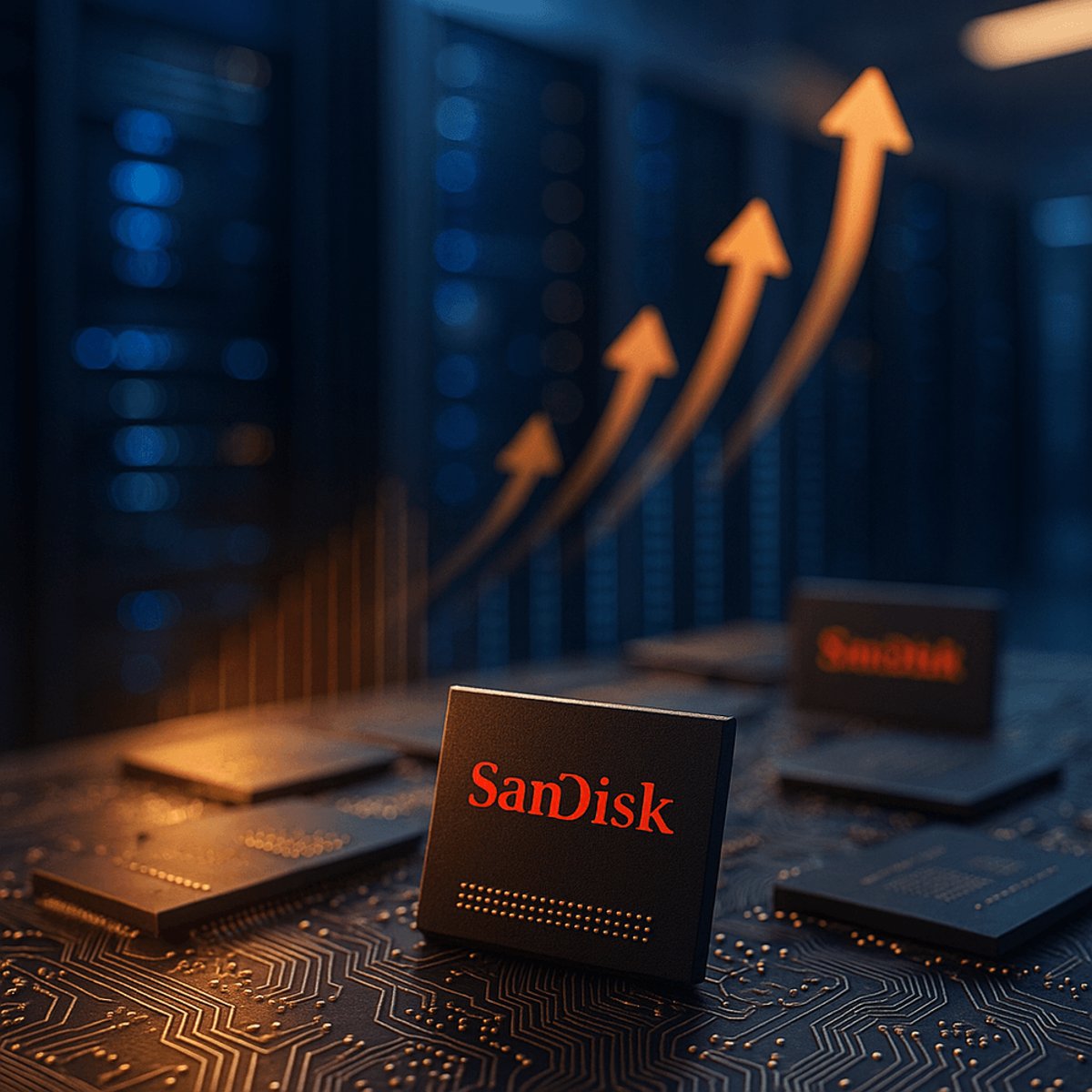
SanDisk is cashing in on the AI infrastructure gold rush. The flash storage company's stock jumped 14% after reporting earnings that doubled Wall Street expectations, driven by an insatiable appetite for memory chips from AI data centers. While tech giants like Apple scramble to secure supply, SanDisk and other memory makers are riding a pricing wave that's sending margins to record highs - a classic supply squeeze that's flipping the usual chip industry dynamics on their head.
SanDisk just delivered the kind of earnings report that makes investors forget semiconductors are supposed to be cyclical. The company's fiscal Q2 numbers didn't just beat expectations - they obliterated them, with earnings per share coming in at $6.20 versus the $3.62 analysts had penciled in. Revenue jumped to $3.03 billion against a $2.69 billion forecast, sending the stock rocketing 14% in Friday trading.
But the real story isn't the backwards-looking numbers. It's what SanDisk told investors about the next three months. The company guided for Q3 revenue between $4.4 billion and $4.8 billion - a forecast that makes the $2.93 billion analyst consensus look almost quaint. Even more striking: gross margins are expected to land between 65% and 67%, miles ahead of the 49.3% Wall Street was modeling.
This is what happens when an entire industry hits a supply wall at full speed. Memory companies are seeing demand from AI data centers that's fundamentally different from traditional computing cycles. These aren't PCs or smartphones with predictable refresh rates. This is infrastructure spending driven by the belief that whoever builds the biggest AI training clusters fastest wins the next decade of tech.
SanDisk's data center business grew 64% from the previous quarter - the kind of sequential growth that's rare outside of nascent markets or severe shortages. And right now, it's both. Meta, Microsoft, and every hyperscaler with cash to burn are racing to secure memory supply for GPU clusters that can't function without massive amounts of fast storage.
The supply-demand imbalance is so severe that memory makers have essentially been given pricing power they haven't enjoyed in years. Flash storage prices have climbed steadily over the past six months, and companies like SanDisk aren't apologizing for it. When you're one of a handful of suppliers and your customers are in an arms race, you don't need to discount.
The flip side of SanDisk's windfall showed up Thursday in Apple's earnings call. CEO Tim Cook acknowledged the company is getting hit by rising memory prices and facing constraints from advanced node manufacturing. "We're looking at a range of options to deal with that," Cook told analysts - corporate speak for "we're getting squeezed and don't have great alternatives."
Apple's pain is particularly instructive. The company that once wielded legendary supply chain leverage now finds itself scrambling for iPhone memory alongside every AI startup trying to secure HBM chips. The memory shortage has become the great equalizer, forcing even the world's most valuable company to compete for allocation.
This dynamic is reshaping the entire semiconductor food chain. Traditional wisdom held that chip buyers - especially giants like Apple and Google - could extract favorable terms from suppliers through volume commitments. But when supply is genuinely constrained and demand keeps accelerating, that leverage evaporates. Memory makers are booking orders quarters in advance at prices that would have seemed impossible two years ago.
Analysts are scrambling to revise their models. The FactSet consensus for SanDisk clearly underestimated how quickly AI infrastructure spending would translate to memory company revenue. But even the bulls might be behind the curve if data center demand continues growing at 64% quarter-over-quarter clips.
The question now is how long this lasts. Memory markets are notoriously cyclical - high prices eventually spur capacity additions that lead to oversupply and price crashes. But the AI infrastructure buildout looks different from previous cycles. This isn't a smartphone boom that peaks when everyone owns a device. This is computational infrastructure with nearly unlimited appetite as model sizes and training runs keep expanding.
SanDisk's guidance suggests the company expects the party to continue at least through next quarter. Margins in the mid-60% range indicate pricing power that's typically unsustainable in commodity chip markets - unless the market has temporarily stopped being a commodity.
For tech companies on the buying side, this creates strategic dilemmas. Do you lock in supply at elevated prices or risk not having enough memory to execute your AI roadmap? Apple's comments suggest even the most sophisticated supply chain operations don't have easy answers.
Wall Street is taking notice. SanDisk's 14% pop reflects not just strong results but a recognition that memory makers have become the picks and shovels of the AI gold rush. While everyone watches Nvidia GPU sales and OpenAI model releases, companies like SanDisk are quietly printing money by providing the unglamorous but essential infrastructure.
The semiconductor industry has a way of humbling companies that get too comfortable with high margins. But for now, SanDisk and its peers are riding a wave that shows no signs of breaking. As long as AI labs keep training larger models and enterprises keep building inference infrastructure, memory demand will likely stay red hot.
SanDisk's blowout quarter crystallizes a fundamental shift in semiconductor economics - when AI infrastructure demand outstrips supply, memory makers transform from price-takers to price-makers. The 65%+ margins the company expects next quarter would be unsustainable in normal cycles, but this isn't a normal cycle. As long as hyperscalers treat memory allocation like strategic assets and companies like Apple scramble for supply, SanDisk and its competitors will keep extracting premium pricing. The real test comes when capacity additions catch up to demand, but that inflection point looks quarters away at minimum. For now, the AI infrastructure boom has crowned unlikely winners in the unglamorous corner of flash storage.