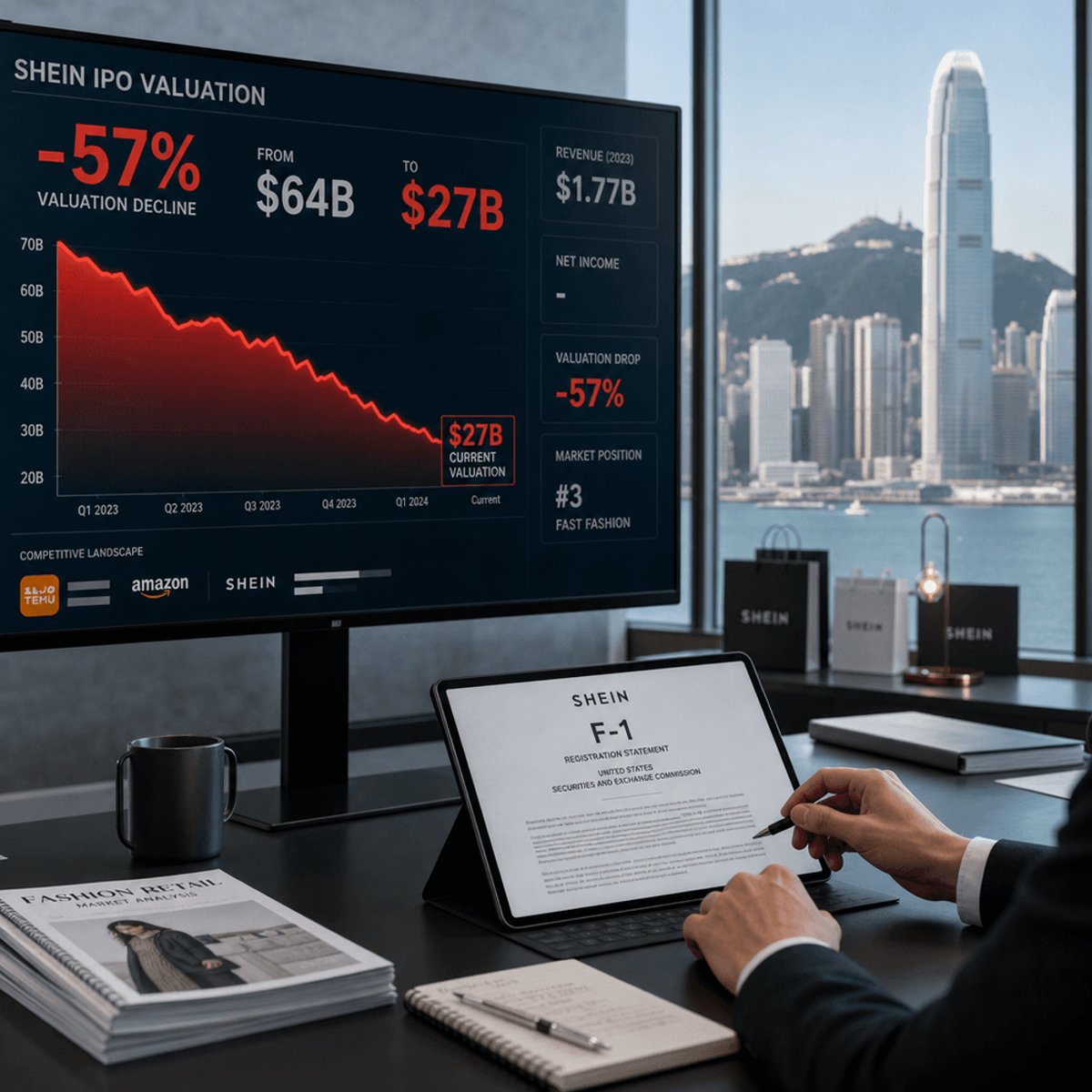
Fast-fashion giant Shein just filed for a Hong Kong IPO that values the company at roughly $27 billion - a stunning 57% drop from its $64 billion peak in 2022. The Monday filing reveals plans to raise $1.77 billion, marking one of the year's most anticipated public debuts and exposing how dramatically investor appetite for cash-burning e-commerce has cooled. For a company that once seemed unstoppable, the markdown signals a reckoning.
The numbers tell a brutal story. Shein, the Singapore-based fashion juggernaut that redefined ultra-fast fashion, is seeking a Hong Kong IPO valuation of approximately $27 billion - less than half what investors were willing to pay just four years ago. According to the filing submitted Monday, the company plans to raise up to 13.86 billion Hong Kong dollars, or about $1.77 billion.
That's a massive comedown from Shein's $64 billion valuation during its Series E round in 2022, when the company was riding high on pandemic-era e-commerce boom and seemed poised for an eventual blockbuster US listing. The 57% haircut ranks among the steepest pre-IPO markdowns for a major tech unicorn since the 2022 market correction began.
The Hong Kong choice itself tells you everything about Shein's narrowing options. Sources familiar with the matter say the company quietly shelved US listing plans earlier this year after facing mounting Congressional scrutiny over its supply chain practices, labor standards, and ties to Chinese manufacturing. What was once pitched as a potential rival to Amazon's scale is now taking the well-worn path of Chinese companies shut out of New York.
But Shein's challenges run deeper than geopolitics. The company's business model - churning out thousands of new designs daily at rock-bottom prices - faces growing backlash from environmental groups and regulators. The EU's proposed Digital Product Passport rules could force Shein to dramatically overhaul its supply chain transparency, while US lawmakers have introduced bills targeting the de minimis loophole that lets Shein ship packages duty-free.
The filing doesn't disclose Shein's current financials, but previous reports suggested the company was burning through cash despite generating estimated revenues north of $30 billion annually. Profitability has remained elusive as Shein pours money into warehousing expansion, faster shipping, and attempts to move manufacturing closer to Western customers. Investors who once overlooked red ink in favor of growth are now demanding clearer paths to profit.
Competitive pressure isn't helping. Temu, backed by Chinese e-commerce giant PDD Holdings, has aggressively undercut Shein on price while building similar influencer-driven marketing machines. Meanwhile, Amazon launched its own ultra-low-price storefront targeting the same budget-conscious Gen Z shoppers that made Shein a phenomenon.
The timing is particularly awkward given Hong Kong's struggling IPO market. The city saw just $3.2 billion in new listings during the first half of 2026, down nearly 60% year-over-year as Chinese economic uncertainty and geopolitical tensions spooked investors. Shein's $1.77 billion raise would instantly become the year's largest Hong Kong debut, but that's a far cry from the $5-10 billion mega-IPO the company once envisioned.
Still, $27 billion isn't nothing. The valuation would make Shein one of the world's most valuable fashion retailers by market cap, ahead of established names like H&M. And Shein's core metrics remain impressive - the app consistently ranks among the most downloaded shopping apps globally, and the company claims over 250 million active customers.
Bankers close to the deal suggest Shein priced conservatively to ensure a successful debut and leave room for the stock to pop. After watching high-profile tech IPOs like Instacart and Klaviyo stumble out of the gate in recent years, there's wisdom in underpromising. A strong first-day performance could help Shein raise additional capital through follow-on offerings.
The IPO also provides an exit for early backers including General Atlantic, Sequoia Capital China, and Tiger Global - all of whom have been sitting on their investments through years of regulatory delays. Their returns will be solid but not spectacular, another sign of how the easy money era has ended.
What happens next depends largely on execution. Shein needs to prove it can maintain growth while improving margins and navigating an increasingly hostile regulatory environment. The company's bet is that its data-driven design process and unmatched supply chain speed create a defensible moat. Skeptics argue fast fashion is a commodity business where today's winner gets displaced by tomorrow's cheaper alternative.
Shein's dramatically reduced IPO valuation captures the broader reset happening across consumer tech. The days when investors would pay any price for growth are over, replaced by cold-eyed scrutiny of unit economics and regulatory risk. Whether Shein can justify even its reduced $27 billion price tag depends on proving that ultra-fast fashion is a sustainable business, not just a pandemic-era fad. The Hong Kong listing will test whether public market investors still believe in the Shein model, or if this markdown is just the beginning of further repricing. For now, the message is clear - even the fastest-growing e-commerce companies aren't immune to gravity.