SK Hynix just pulled off the biggest foreign IPO in US history, raising $26.5 billion on Wall Street in a record-breaking debut that underscores the insatiable appetite for AI chip makers. But the celebration comes with strings attached - US lawmakers are already pressing the Korean memory giant and rival Samsung to commit billions more to building American fabrication plants, turning what should be a pure victory lap into a high-stakes geopolitical negotiation over the future of semiconductor manufacturing.
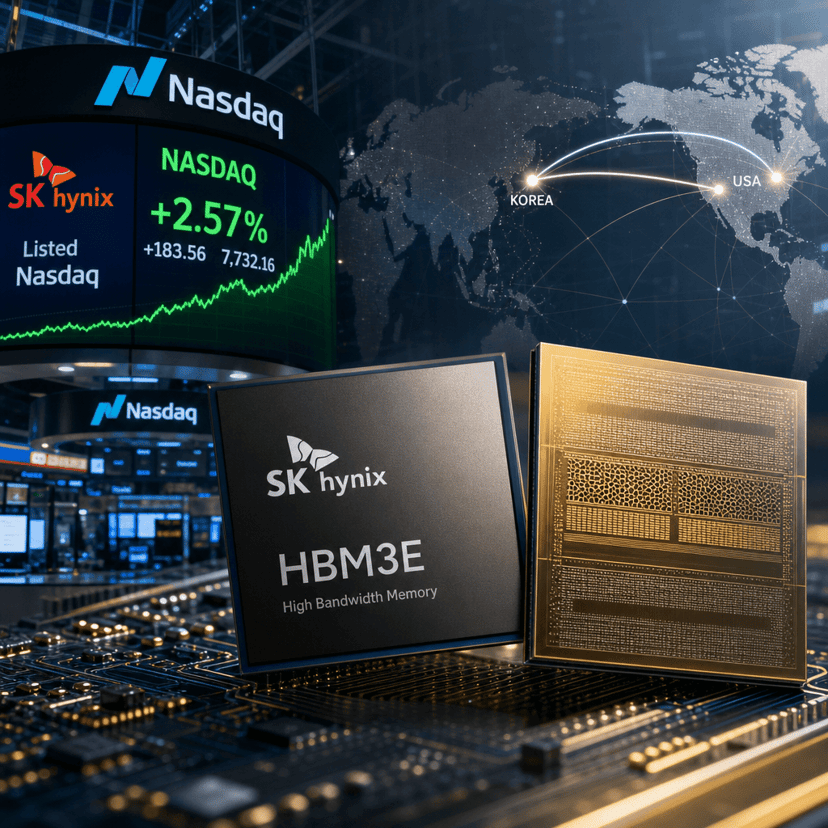
SK Hynix made Wall Street history Friday, closing its first trading day with $26.5 billion raised in what marks the largest foreign company IPO ever on US exchanges. The Korean memory chip giant priced shares at the top of its expected range, and they surged another 18% in opening trades as investors scrambled for exposure to the company supplying critical high-bandwidth memory to virtually every major AI data center.
The offering dwarfs Alibaba's previous record of $25 billion set back in 2014, and it comes at a moment when AI infrastructure spending shows no signs of slowing. SK Hynix's HBM3E memory chips have become the gold standard for training large language models, with Nvidia reportedly consuming over 60% of the company's total HBM production for its H100 and upcoming B100 GPU accelerators.
"We're seeing demand that's essentially infinite right now," one institutional investor told Bloomberg on condition of anonymity. "Every hyperscaler, every AI startup with serious funding, they're all fighting for allocation. SK Hynix can't make this stuff fast enough."
But before the champagne corks finished popping in New York, the political reality set in. According to sources familiar with discussions reported by The Wall Street Journal, senior administration officials have already scheduled meetings with SK Hynix executives to discuss "significant manufacturing investments" on US soil. The message is clear: if you want access to the world's largest chip market, you need to build here.
The pressure extends beyond SK Hynix. Samsung, which trails its Korean rival in HBM production but remains the world's largest memory maker overall, is facing similar demands. Both companies already operate some US facilities, but nothing approaching the scale of their massive fabrication complexes in South Korea. Building cutting-edge memory fabs in the US would require investments exceeding $15 billion per facility and take at least three years to bring online.
This geopolitical chess game reflects a fundamental shift in how semiconductors are viewed in Washington. The CHIPS Act allocated $52 billion to rebuild domestic chip manufacturing, but memory production remains overwhelmingly concentrated in Asia. SK Hynix and Samsung together control roughly 70% of the global DRAM market and nearly half of NAND flash production.
"The IPO validates what we've been saying about AI infrastructure being the defining investment theme of this decade," noted one tech-focused hedge fund manager in a client letter. "But it also highlights the uncomfortable dependency - the chips powering American AI leadership are manufactured entirely overseas."
SK Hynix's stock has been on a tear, climbing over 340% since early 2023 as the AI boom accelerated. The company reported record quarterly profits earlier this year, with operating margins on HBM products exceeding 50% as tight supply keeps prices elevated. Revenue from high-bandwidth memory alone is projected to surpass $20 billion this year, up from just $3 billion in 2022.
The valuation reflects not just current profitability but expectations that AI infrastructure spending will continue growing at 40% annually through at least 2028. OpenAI, Microsoft, Google, and Meta have collectively announced over $200 billion in planned data center investments, nearly all of which require the advanced memory that SK Hynix specializes in producing.
Yet the US fab question looms large. Industry analysts estimate that replicating SK Hynix's most advanced HBM production lines in America would cost between $20-30 billion and require importing hundreds of specialized engineers from Korea. The economics only work if the US government provides substantial subsidies through CHIPS Act funding and if customers commit to long-term purchase agreements at premium pricing.
For Samsung, the calculus is different but equally complex. The company has struggled to catch SK Hynix in HBM performance and yield rates, leading to reported quality issues that cost it Nvidia contracts. Building new US capacity could serve as both a geopolitical olive branch and an opportunity to leapfrog its rival with next-generation designs, but only if it can solve its technical challenges first.
The IPO's success sends ripples beyond memory chips. Other Asian semiconductor companies eyeing US listings are watching closely to see whether SK Hynix faces meaningful pressure to commit to American manufacturing as a condition of maintaining market access. Taiwan's leading DRAM makers and several Chinese chipmakers with US aspirations are reportedly reassessing their strategies.
Wall Street analysts covering the deal note that SK Hynix's management carefully avoided specifics about US expansion plans during the roadshow, instead emphasizing the company's technology leadership and strong customer relationships. That calculated ambiguity likely won't survive the political pressure now building.
SK Hynix's record-breaking Wall Street debut crystallizes both the promise and the tension at the heart of the AI chip boom. The company is printing money supplying the memory that makes modern AI possible, and investors clearly believe that demand has years left to run. But the same geopolitical forces that make semiconductor supply chains a national security priority mean this IPO is just the opening act. The real story will unfold in the coming months as Korean chipmakers decide whether building massively expensive American fabs is the price of admission to the AI gold rush, or whether they can maintain their manufacturing concentration in Asia while still serving US customers. For now, Wall Street has delivered its verdict with a $26.5 billion exclamation point, but Washington is already writing the next chapter.