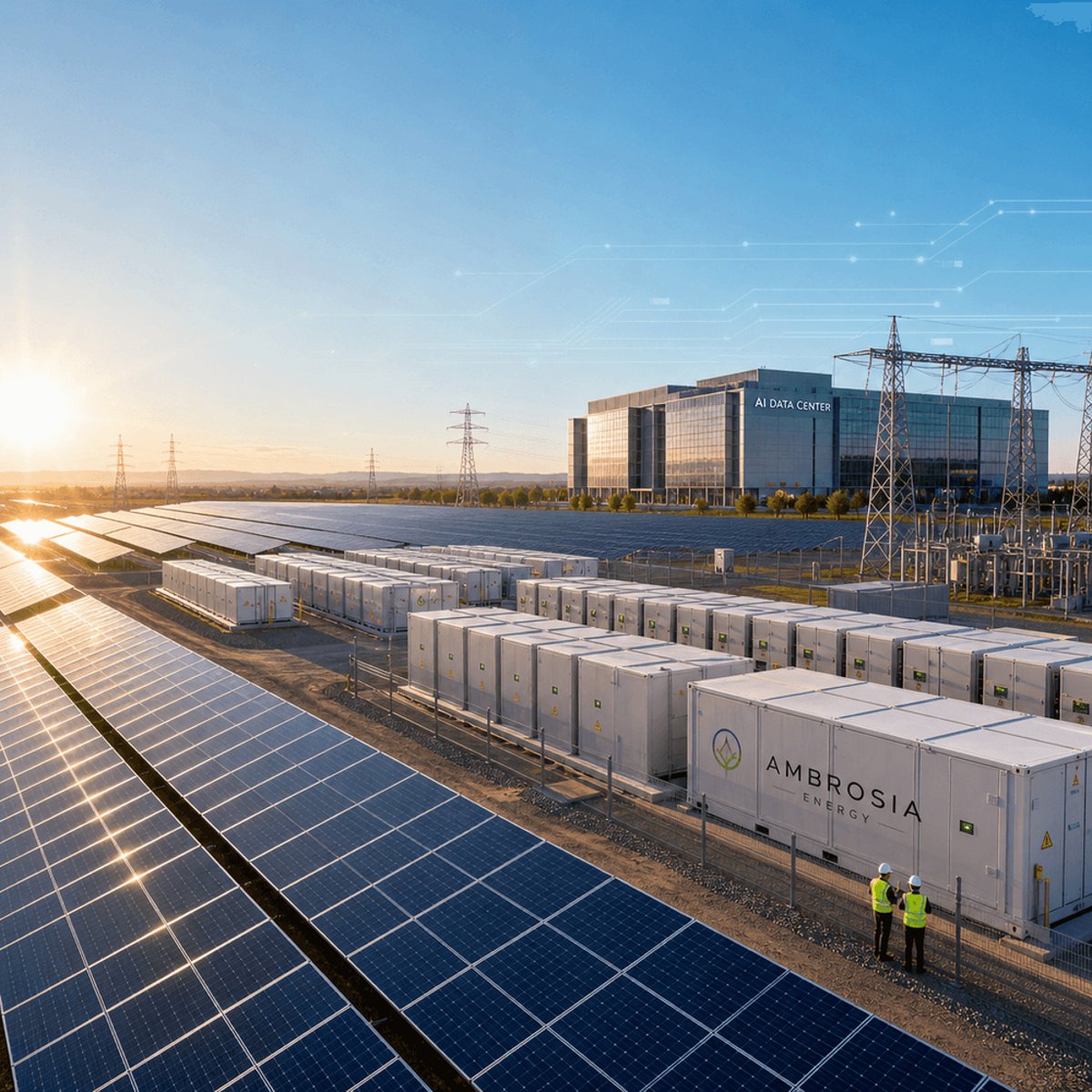
Two SpaceX veterans just launched Ambrosia Energy with an audacious plan: build solar-plus-battery power plants in under 12 months while undercutting natural gas prices. The startup targets the AI industry's growing power crisis, aiming to deploy gigawatts of capacity by 2030 as data centers scramble for reliable, affordable electricity. It's a direct response to the infrastructure bottleneck threatening to slow AI's breakneck expansion.
Ambrosia Energy just emerged from stealth with a promise that sounds almost too good for an industry desperate for solutions. The startup, led by former SpaceX engineers, claims it can deploy utility-scale solar and battery storage facilities faster and cheaper than traditional power providers - precisely what AI companies need as their data centers strain electrical grids nationwide.
The timing couldn't be more strategic. Microsoft, Google, and Meta are locked in an infrastructure arms race, with training runs for frontier AI models consuming hundreds of megawatts. Traditional utility timelines - often stretching 3 to 5 years for new power plants - simply don't match the velocity of AI development. Ambrosia's sub-12-month construction promise directly addresses this mismatch.
What makes the SpaceX connection relevant isn't just founder pedigree. The aerospace company's approach to rapid iteration and vertical integration appears baked into Ambrosia's strategy. Instead of coordinating dozens of contractors across years-long timelines, the startup is building an integrated delivery model that compresses development, permitting, and construction into a single streamlined process.
The economics are equally compelling. Natural gas has long been the go-to for quick-deploy power generation, but volatile fuel costs and carbon concerns are pushing hyperscalers toward alternatives. Solar-plus-storage avoided those fuel price swings entirely while offering increasingly competitive levelized costs. Battery technology improvements over the past three years have made 24/7 renewable power technically feasible, though few developers have cracked the speed-to-market problem.
Ambrosia's gigawatt-scale ambitions by 2030 reflect the sheer magnitude of AI's power appetite. A single large language model training run can consume as much electricity as a small city. OpenAI, Anthropic, and well-funded startups are all racing to build next-generation models, each requiring exponentially more compute - and therefore more power - than their predecessors.
The renewable angle also helps tech giants meet their climate commitments without slowing AI investments. Google and Microsoft have both seen their carbon emissions climb as data center expansion outpaced clean energy procurement. Dedicated solar-plus-battery plants co-located with AI facilities offer a path to reconcile growth targets with sustainability pledges.
But execution risk looms large. Power plant development involves labyrinthine permitting processes, utility interconnection queues stretching years, and complex financing structures. Promising 12-month timelines means solving problems that have stymied the industry for decades. The SpaceX alumni will need to translate rocket-building efficiency into an industry known for regulatory complexity and entrenched interests.
Competition is heating up too. Established renewable developers like NextEra Energy and venture-backed startups such as Crusoe Energy are already courting hyperscalers with co-located power solutions. Amazon recently signed deals for nuclear-powered data centers, signaling the tech industry's willingness to explore any option that delivers reliable baseload power.
The broader question is whether Ambrosia's model scales beyond early adopters. If the startup proves it can actually deliver gigawatt-scale capacity on aggressive timelines, it won't just serve AI companies. Cryptocurrency miners, manufacturing facilities, and traditional data centers all face similar power constraints. The total addressable market extends far beyond the current AI boom.
What happens next depends on Ambrosia securing its first major customer commitments and proving the model in practice. The company's funding status remains unclear, but power plant development requires substantial capital - typically hundreds of millions for gigawatt-scale projects. Expect announcements around anchor customers and financing partners in the coming months as the startup moves from pitch deck to construction.
For now, Ambrosia represents the latest attempt to solve AI's infrastructure crisis through unconventional approaches. The SpaceX DNA suggests an engineering-first mentality willing to challenge industry orthodoxy. Whether that translates to actual gigawatts flowing to data centers by decade's end will determine if this is visionary or just another Silicon Valley moonshot that never reached orbit.
Ambrosia Energy's emergence signals a new phase in the AI infrastructure race where power availability matters as much as chip supply. If SpaceX-style execution can actually crack the renewable energy deployment bottleneck, it could reshape how hyperscalers think about colocation and energy procurement. But the gap between promising 12-month timelines and delivering gigawatts at scale is where countless clean energy startups have stumbled. The next 18 months will reveal whether this SpaceX alumni venture has genuinely solved power plant development or simply repackaged familiar challenges with founder credibility. Either way, the fact that experienced aerospace engineers see bigger opportunities in solar farms than rockets tells you everything about where the real infrastructure constraints lie in the AI era.