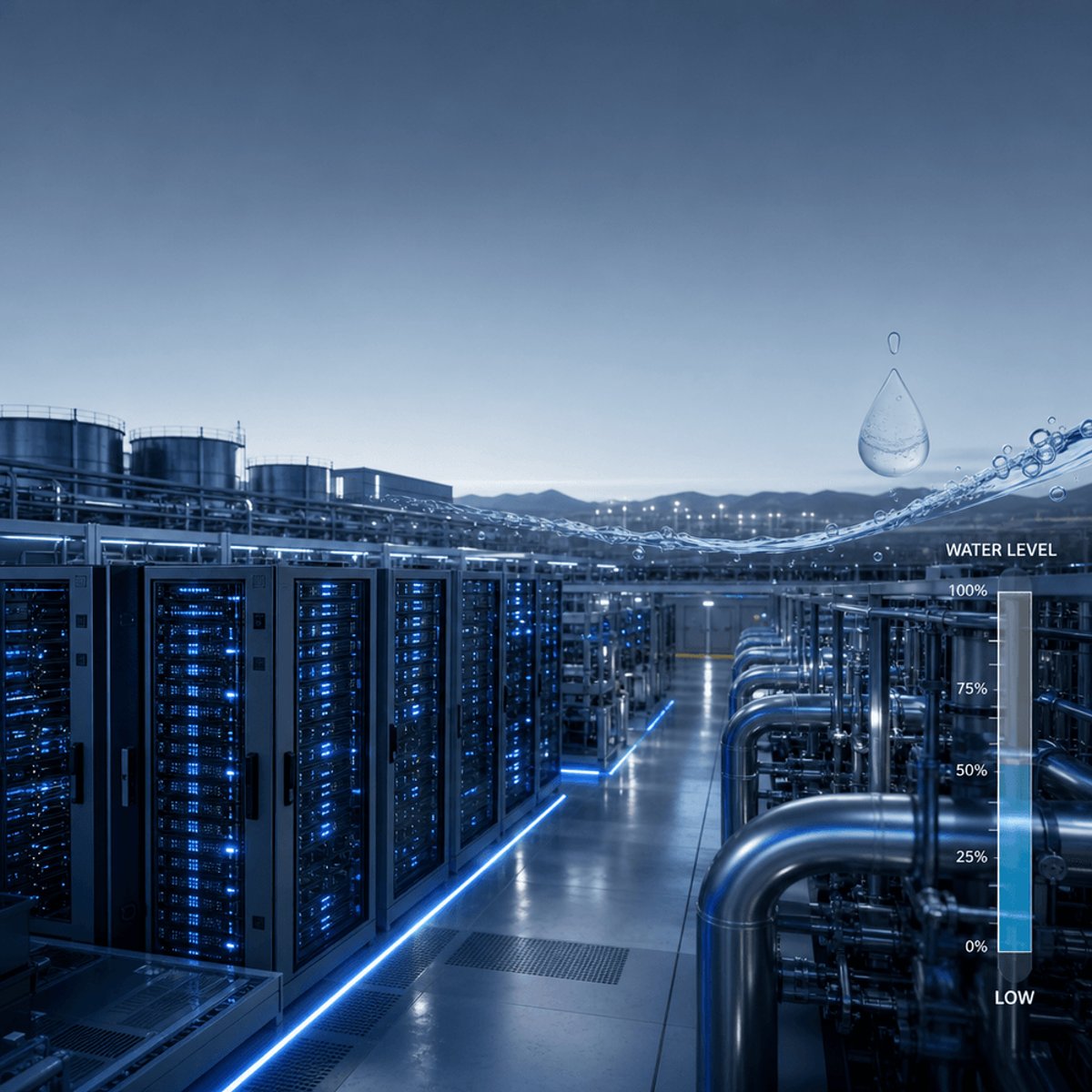
SpaceX just added an unexpected line item to its IPO risk factors: water. The rocket company disclosed in its public offering documents that it needs "significant" water resources to cool its data centers, and that securing abundant, affordable water poses a material challenge to its operations. The admission reveals how deeply SpaceX has waded into AI infrastructure, and signals that environmental constraints could limit the company's computing ambitions as it prepares to go public.
SpaceX isn't just building rockets anymore - it's building data centers, and now it's warning investors that water could become a bottleneck. The company's IPO filing, reported by TechCrunch, reveals that securing "significant" water resources for cooling infrastructure has risen to the level of material risk.
The disclosure marks a striking evolution for a company known primarily for launching satellites and ferrying astronauts. But it also exposes the hidden infrastructure demands driving the AI boom. Data centers running large language models and training neural networks generate enormous heat, and water-cooled systems remain the most efficient way to keep servers from melting down. Microsoft, Google, and Meta have all faced scrutiny over their water consumption, with some facilities using millions of gallons daily.
SpaceX's entry into this conversation suggests the company has been quietly scaling compute capacity, likely to support its Starlink satellite network and potentially its own AI initiatives. The timing is notable - Tesla, also led by Elon Musk, has been aggressively building out its Dojo supercomputer for autonomous driving training. The shared infrastructure playbook between Musk's companies has been well-documented, and this water disclosure hints at similar computing ambitions at SpaceX.
The phrase "abundant, affordable water" in the filing does the heavy lifting. It's not just about availability - it's about cost and location. Data centers need to be near fiber infrastructure for connectivity, near power grids for electricity, and now increasingly near water sources for cooling. That triangle of constraints is getting harder to satisfy as tech companies race to build AI capacity. Amazon Web Services recently pulled back on data center plans in drought-prone regions, while Google faced local opposition in Arizona over water usage.
For SpaceX, the challenge multiplies. The company operates launch facilities in Texas and California, both states grappling with water stress. Its Starbase facility in Boca Chica, Texas, has already drawn environmental scrutiny over its impact on local ecosystems. Adding industrial-scale water consumption for data centers could intensify regulatory friction and community pushback.
The disclosure also raises questions about what SpaceX is computing. Starlink's satellite network generates massive amounts of data - tracking thousands of satellites, routing internet traffic, and managing ground stations. But does that alone justify data centers large enough to warrant IPO-level risk disclosure? Industry observers speculate SpaceX might be processing imagery and sensor data from its satellites, potentially building AI models for earth observation or communications optimization.
Investors now have to price in environmental infrastructure risk alongside SpaceX's more traditional challenges like launch cadence and regulatory approvals. Water access isn't a problem you can engineer around quickly. It requires long-term site selection, utility partnerships, and increasingly, community buy-in. In some jurisdictions, data center water use has become a political flashpoint, with local governments imposing moratoriums or demanding detailed consumption reports.
The filing puts SpaceX in the same conversation as traditional data center operators and cloud providers, a category shift that could complicate its valuation. Rocket companies trade on launch contracts and satellite deployments. Data center companies trade on power usage effectiveness and cooling efficiency. SpaceX is now asking investors to evaluate both, adding complexity to an already ambitious public offering.
This isn't the first time SpaceX's IPO preparations have surfaced operational realities. Earlier filings warned about equity dilution and the challenges of maintaining its launch schedule. But the water disclosure cuts deeper - it reveals infrastructure dependencies that can't be solved with better engineering alone. You can optimize rocket fuel. You can't conjure water where it doesn't exist.
SpaceX's water disclosure transforms the IPO narrative from a pure aerospace play into a hybrid infrastructure bet. Investors aren't just buying into rockets and satellites anymore - they're buying into data centers with all the environmental constraints that come with them. As AI computing demands collide with water scarcity, companies like SpaceX will have to navigate not just the edge of space, but the limits of earthbound resources. The question now is whether the market prices this as a manageable operational challenge or a fundamental constraint on growth. Either way, the filing makes clear that SpaceX's ambitions are increasingly tethered to resources that aren't infinite.