The vibe coding revolution just minted another unicorn. Supabase, the open-source database platform that's become the go-to Firebase alternative for developers, announced a $500 million funding round that values the company at $10.5 billion. The massive raise signals investor confidence that AI-assisted development is reshaping how applications get built, and Supabase is positioned right at the center of that transformation.
Supabase just became one of the most valuable developer infrastructure companies on the planet, and the timing tells you everything about where software development is headed. The company's $500 million raise at a $10.5 billion valuation, announced today via CNBC, comes as AI coding assistants are fundamentally changing how developers build applications.
The phenomenon driving Supabase's meteoric rise has a name in developer circles: vibe coding. It's what happens when AI tools like GitHub Copilot, OpenAI's ChatGPT, and Anthropic's Claude can scaffold entire backends in minutes, and they need simple, well-documented infrastructure to connect to. Supabase fits that bill perfectly.
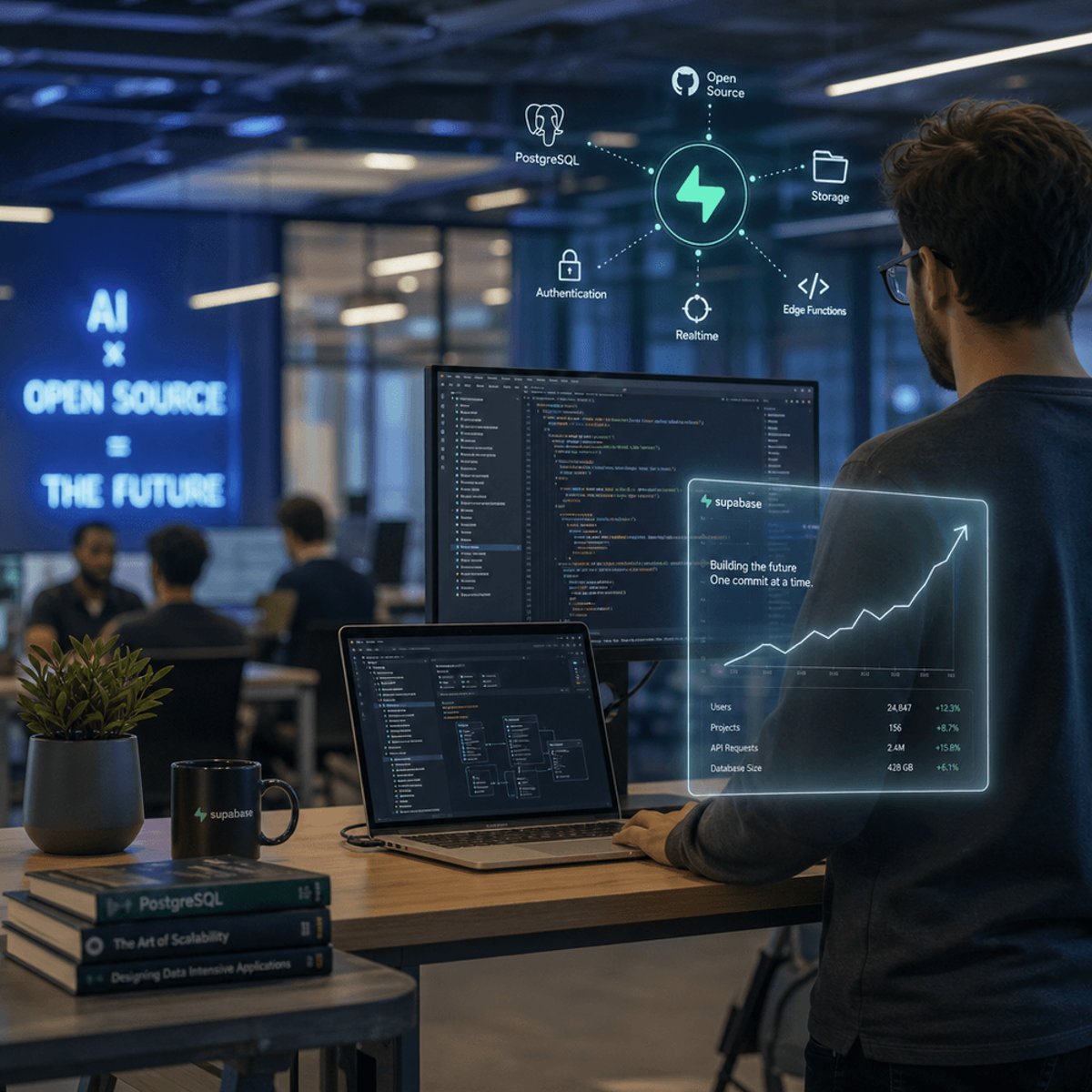
What started as an open-source alternative to Google's Firebase has evolved into something bigger. Supabase combines PostgreSQL databases, authentication, real-time subscriptions, storage, and edge functions into a platform that AI assistants can navigate intuitively. When an AI is helping you build an app and suggests "let's use Supabase for the backend," it's not random - it's because the platform's developer experience is exactly what vibe coding requires.
The valuation jump is staggering when you consider the broader market context. While many late-stage startups have seen their valuations compressed over the past two years, Supabase is moving in the opposite direction. The $10.5 billion figure including the fresh capital represents a bet that developer tools optimized for AI workflows will command premium valuations as software creation accelerates.
Supabase's open-source DNA matters more than ever in this environment. Developers can inspect the code, run it locally, and understand exactly what's happening under the hood - crucial when AI tools are generating infrastructure code at speed. That transparency builds trust in a way proprietary platforms struggle to match. It's also why Supabase has cultivated one of the most passionate developer communities in the infrastructure space.
The competitive landscape is shifting fast. Amazon Web Services, Microsoft Azure, and Google Cloud all offer database services, but they're designed for enterprise procurement cycles, not for developers spinning up projects in AI-assisted coding sessions. Supabase optimizes for the opposite end of the spectrum - frictionless developer experience that gets out of the way.
The $500 million war chest gives Supabase serious firepower to expand its platform and scale infrastructure globally. Backend-as-a-service platforms live or die on performance and reliability, and competing with cloud giants requires massive capital investment in data centers, edge networks, and engineering talent. This funding round puts Supabase on equal footing from a resources perspective.
But the real story is what this raise says about the future of software development. Investors are betting that AI won't replace developers - it'll multiply their output. And when developers can build 10x faster with AI assistance, they need infrastructure that can keep pace. Supabase's architecture, documentation, and developer experience are built for exactly that workflow.
The timing also reflects a broader market realization that developer tools are recession-resistant. Even as consumer tech faces headwinds, companies still need to build software, and developers still need databases. The shift to AI-assisted development might actually accelerate that trend as coding becomes more accessible to a wider range of people.
Supabase's open-source business model is proving that you can build a massive company while keeping the core product free and transparent. The company monetizes through hosted services, enterprise features, and support - letting individual developers and startups use the platform at no cost while capturing value from companies that need scale and reliability guarantees.
What's remarkable is how quickly Supabase has become table stakes in certain developer communities. In startup circles, particularly among solo founders and small teams building AI-powered applications, "just use Supabase" has become default advice. That kind of organic adoption is nearly impossible to buy with marketing dollars - it comes from solving real problems elegantly.
The valuation also reflects confidence in Supabase's ability to expand beyond its PostgreSQL roots. The platform has added storage, authentication, edge functions, and real-time capabilities, transforming from a database service into a comprehensive backend platform. Each addition makes Supabase stickier and increases the lifetime value of customers who consolidate their infrastructure.
As AI coding tools continue improving, the platforms they integrate with best will have enormous advantages. Supabase has clearly positioned itself to be one of those platforms, with clean APIs, extensive documentation, and a developer experience that AI assistants can navigate without human intervention. That's not an accident - it's a strategic bet on where development is heading.
Supabase's $10.5 billion valuation is a clear signal that the infrastructure powering AI-assisted development is entering a new phase. As coding becomes faster and more accessible through AI tools, the platforms that enable that speed without sacrificing power will capture enormous value. The $500 million raise gives Supabase the resources to scale alongside the vibe coding revolution it's helping enable. For developers who've watched Supabase evolve from a Firebase alternative into a comprehensive backend platform, this funding validates what they've known for a while: when AI helps you code, you want infrastructure that just works. That's exactly what Supabase delivers, and investors are betting billions that demand for that simplicity is just getting started.